
Redesign the Work So the Old Process No Longer Fits
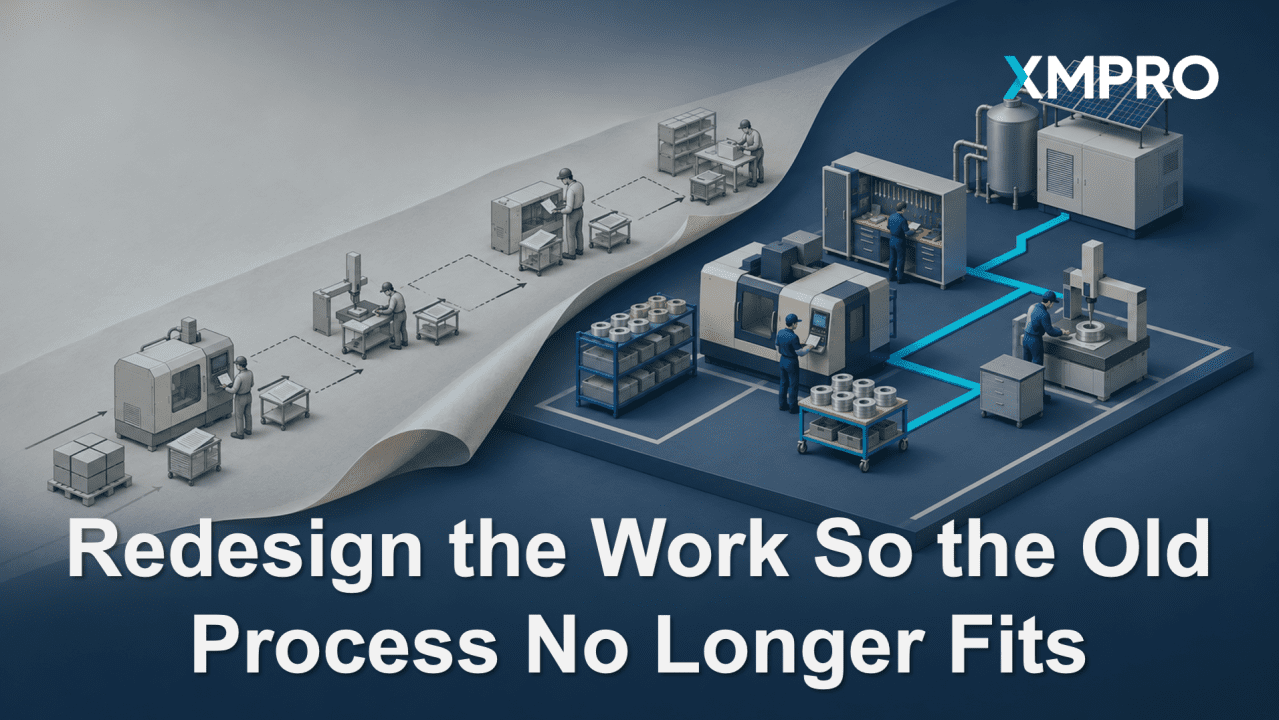
Greg Callahan of Bain writes that some people who have tried artificial intelligence (AI) tools are returning to familiar ways of working. His newsletter, The Old Way Is Still Too Easy, ends with a direct instruction: “Make the old way harder to go back to.”
He argues that companies need to change expectations, training, rewards and how the work is organized. Teams that have changed still have to accommodate those that have not. The company continues supporting both ways of working.
David Shapiro describes related problem: people become more productive with AI, yet the business still struggles to deliver more. Making individual tasks faster leaves the constraints elsewhere in the process untouched. His response is to redesign how work gets done around what AI makes possible.
Together, these arguments suggest a test for an AI initiative: identify what the organization would lose by returning to the old process. The new way of working needs to deliver an outcome the old process can no longer support at the required scale, speed or cost.
Change how the outcome is achieved
Consider a production operation. Maintenance identifies work that needs doing. Production decides when equipment can be released. Energy costs influence when to run, and customer commitments constrain the schedule. The teams bring their information to a daily meeting and agree on a plan.
An AI assistant could prepare the information faster, draft the meeting notes and send the follow-up messages. Those improvements might save useful time. Each department would still perform its part of the same process.
The decisions still wait for the meeting.
If people stop using the assistant, they can prepare the material themselves and carry on. Returning to the old process requires little change to how the teams work together. The same people still decide in the same meeting.
Now consider agent teams that reassess the combined plan as conditions change. Within the authority the organization grants, they coordinate permitted adjustments, carry them out through the existing operating systems, and observe the results. This is closed-loop operation: agents act and use feedback in subsequent decisions. People set objectives and limits, resolve exceptions, and change the rules when necessary.
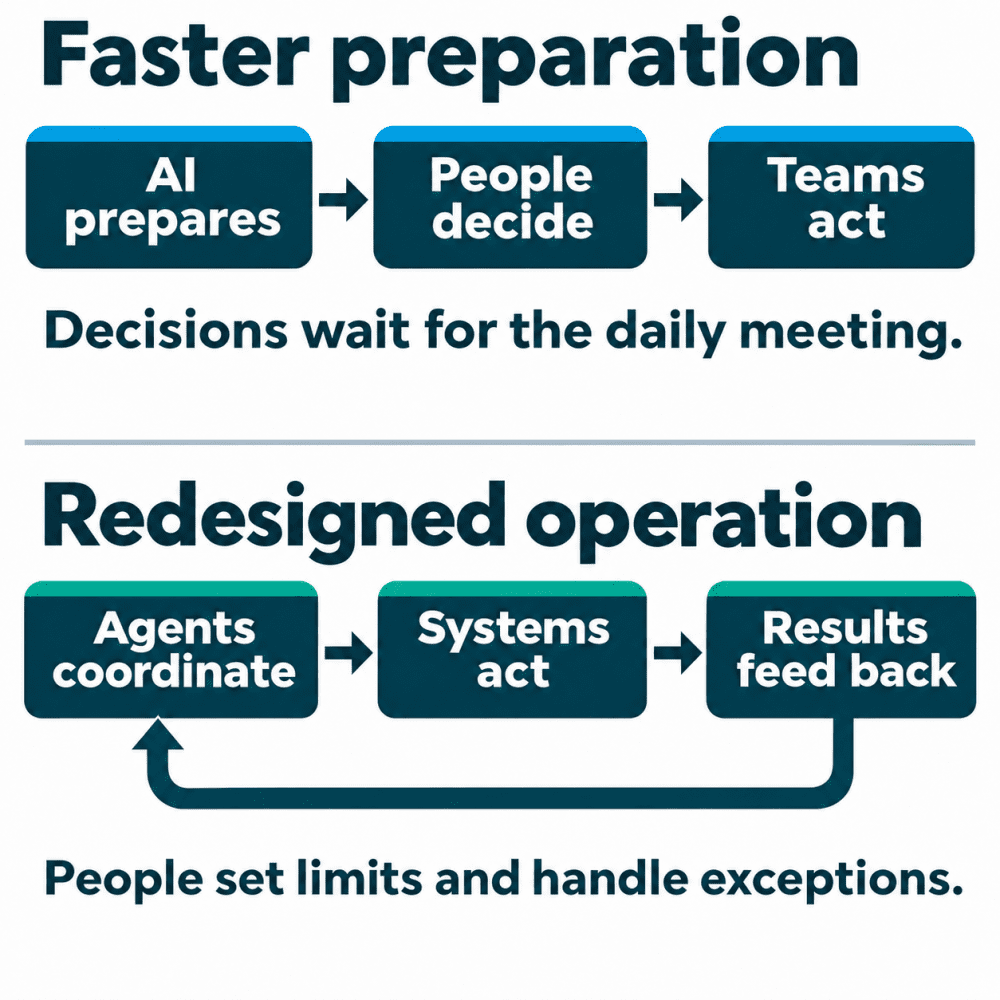 Two ways of organizing the work in the production example.
Returning to a daily meeting would mean deciding less often and asking people to take on coordination the agents now perform. If the business depends on coordination throughout the day, the old process would have to change to provide an equivalent service.
The old process becomes unsuitable for the work the organization now expects to perform. The organization still has to establish whether the new design delivers enough benefit to justify that change.
Retire the steps whose purpose has been replaced
Reports transfer information between teams, while meetings can reconcile conflicting priorities. An approval may establish that an independent person checked a proposed action.
Moving those steps into software does not remove the work they perform. In the production example, the agent teams still need to resolve competing requirements and establish which changes they are authorized to make. Removing the meeting before that coordination works would leave a gap.
Once the replacement has been tested and accepted, update who makes the decisions, how work moves between teams, what requires escalation and which reports or meetings remain necessary. Keeping every previous step can leave people doing the old work alongside the new. They then have little reason to believe the change has made their jobs better.
I have written before about software-defined operations, where decision and coordination logic can be maintained separately from the systems carrying out the work. Engineers can define the redesigned decisions, including their objectives, limits and authority, and revise them as they see what works.
A person taking responsibility for an exception needs the current plan, the relevant evidence and clear authority to act. A fallback for a system failure may require reduced operating scope or capacity. Neither situation requires treating the entire previous process as an equally suitable everyday option.
Change what people are responsible for
Callahan’s argument about incentives applies to the redesigned work. If agents now coordinate routine adjustments, managers need to define good performance for the people supervising those decisions and improving the system.
An engineer might spend less time preparing information for a meeting and more time investigating recurring exceptions or correcting a decision rule. Operations leaders need to assess the resulting performance, including the work required to keep the system running. Training must prepare people for those responsibilities, and recognition should reflect the improvements they make.
To judge whether the production redesign justifies its cost, assess its effect on delivery commitments, operating cost, response time and the amount of manual intervention required. Counting agents or autonomous decisions cannot establish those results.
A useful review of an AI initiative should identify which old steps have become unnecessary, what now performs their purpose, and what the operation would lose by reinstating them. If those answers are unclear, people may still be choosing between two ways to do the same job.
Pieter van Schalkwyk is the CEO of XMPro, specializing in industrial AI agent orchestration and governance. Drawing on 30+ years of experience in industrial automation, he helps organizations implement practical AI solutions that deliver measurable business outcomes while ensuring responsible AI deployment at scale.
He is the lead author of the Industrial AI Agent Manifesto, published by the Digital Twin Consortium in February 2026, a governance framework for trustworthy autonomous operations.
Our GitHub Repo has more technical information. You can also contact myself or Gavin Green for more information.
Read more on MAGS at The Digital Engineer
How this was made: I worked with Claude to check sources, draft from my direction and edit, and with Codex to review the argument and evidence. I do not publish anything I have not rewritten myself.
This article originally appeared on XMPro CEO’s LinkedIn blog, The Digital Engineer, on 16 November 2026.