
Operators, Not Creators
Industrial autonomy needs less creativity, not more. It also needs to stop betting on the model.
The AI industry is racing toward bigger and more creative models, and for industrial operations that is the wrong race. **The agent that runs a plant does not need more creativity.**It needs less, and it needs to stop depending on whichever model is winning this quarter.
That sounds backward until you separate two jobs the word “agent” has quietly merged.
Most AI agents are creators. They produce an artifact for a person to use or review: a draft, a summary, an answer, a shortlist. You judge a creator on the quality of what it made, and a little variation between runs is fine, sometimes welcome, because a fresh phrasing or a second option is the whole point. Generic language-model agents are creators, and for that work they are the right tool. Nothing here is a knock on them.
An operator is a different animal. It makes a governed decision or takes an action that changes consequential state: a quality disposition on a manufactured part, a setpoint on a compressor, a maintenance call, an action taken within set authority. You do not judge an operator on how good its prose was. You judge it on whether the decision was controllable, corroborated, traceable, and reproducible. The yardstick is validation, not fluency.
There is one question settles which is which: does the output get reviewed by a person before it takes effect, or does it act the moment it is issued? Reviewed first, it is a creator. Acting on its own, it is an operator, and consequence and reversibility are what decide which of the two you are looking at.
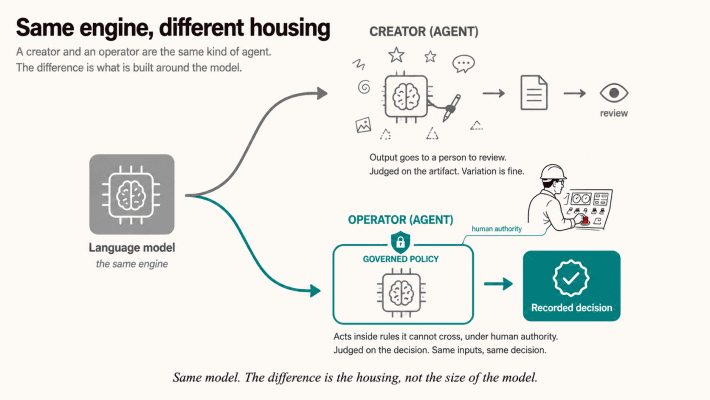 Creator vs Operator: Same kind of agent, in different housing
The category error
The mistake the market is making is dropping a creator architecture into an operator’s seat, then trying to close the gap with a bigger model. It does not close. A creator’s output is a token stream judged on quality. An operator’s decision spans observations, objectives, constraints, corroboration, and an actuation boundary, and it has to survive an audit. Those are different kinds of object, and a system that cannot reproduce its own output cannot be validated, so no amount of scale promotes a creator into an operator.
“But your agents use language models too.” They do. The difference is where the model sits. Inside an operator the language model does creator-like work, interpreting a signal, summarizing a state, drafting a plan, and it does all of it under governance. The model proposes, and a deterministic policy disposes. The creator becomes a bounded service inside the operator, never the control logic, and that nesting is the entire design.
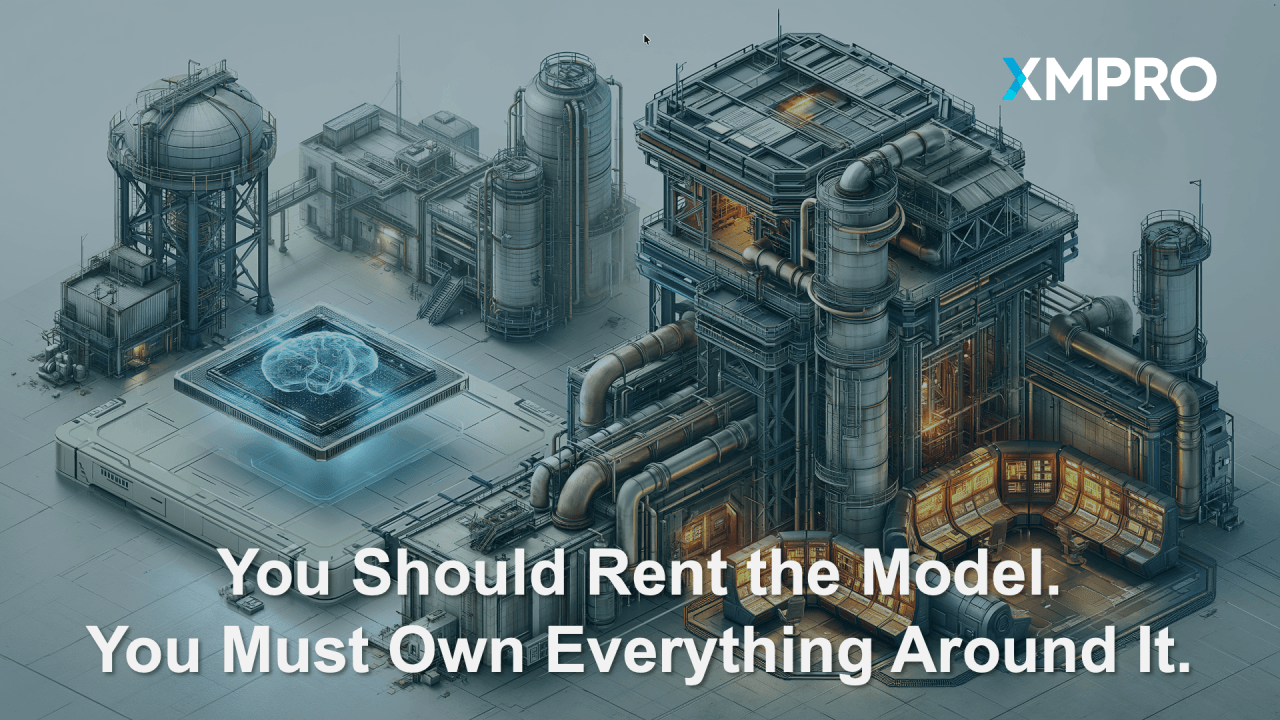
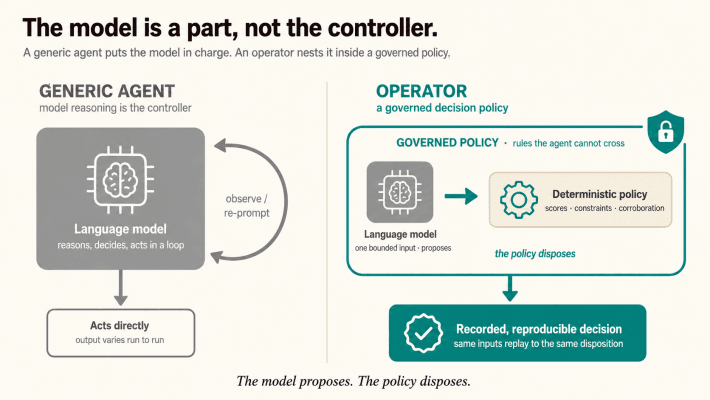 The model is just a part, it is not the solution
Every operations person understand this example. Put two control-room operators in front of the same situation and they will reason about it differently. A well-run operation does not care, because the procedure and the constraints, not their private reasoning, decide the action, and both are expected to reach the same governed decision. Our agent teams hold themselves to exactly that standard. Two reasoning passes over the same evidence may differ in wording. The governed decision is fixed by the objective function and the constraints over the recorded evidence, so it lands on the same disposition, and whatever the model said along the way is recorded so the decision can be replayed exactly. Variation in reasoning is expected. Variation in the decision is engineered out.
None of this is a new trick. A governed decision is a mathematical function of recorded state, so the same inputs and the same rules produce the same decision every time, the way a function always has. That is mature decision science, the same mathematics of deciding under uncertainty that has run logistics, energy markets, and supply chains for decades, and it is what lets a decision be bounded, scored, and reproduced rather than only generated. A general language-model agent carries none of that machinery. No policy, no objective, no state it holds from one moment to the next. It produces an artifact and stops, which is the whole distance between a creator and an operator, and no amount of model size closes it.
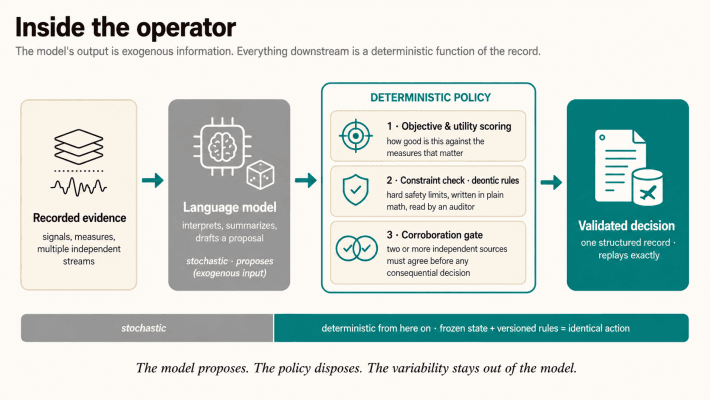 Inside the operator: how the model’s input becomes a recorded, replayable decision
Why the seat does not need a frontier model
If the intelligence of an operator lives in its governance, the policy, the objectives, the constraints, the corroboration, the scoring, then the model underneath is doing constrained work inside rails the architecture enforces. What you need from it is reliability, clean instruction-following, and grounding, and capable mid-tier models already give you that. Nothing more exotic is required. Frontier creativity is mostly wasted in the seat, and it can work against you, because creative latitude means variance, and variance is the one thing an operator exists to remove.
Recommended by LinkedIn
You do not want a chemistry PhD improvising at the panel. You want the procedure executed, reliably, within bounds. The deep exploration is the process engineer’s job, a real creator job the strongest models serve well, and that work matters, just not the work you replicate across a thousand assets.
The part most vendors skip: management of change
Anyone who has run a regulated plant knows you cannot change the control logic on a whim. Management of change is a discipline: any change to a process, an instrument, or the logic that drives an action gets assessed, tested, approved, and recorded before it goes live. That discipline is how plants stay safe and how audits stay clean.
Now put a creator in the operator’s seat and watch what happens. The behavior of that agent is a property of the model. So every time the model is updated, retired, or swapped, and frontier models change constantly, you have changed your control logic. Strictly, that triggers re-validation of the entire behavior envelope, because the thing that decides has changed underneath you. Testing a model’s full range of behavior is not a weekend job. For a consequential process it is close to impossible to automate, because the surface you would have to test is the model’s open-ended creativity itself.
When the variability lives in the governed policy and the model is a bounded, swappable input, the change you have to manage is the policy, not the model’s imagination. You validate the decision logic once, against a fixed set of inputs and constraints. A model swap then gets tested against that same frozen decision envelope: same recorded inputs, same disposition, or it does not ship. Management of change is tractable precisely because the variability is not in the model. That is the difference between an autonomy story you can put in front of an auditor and one you cannot.
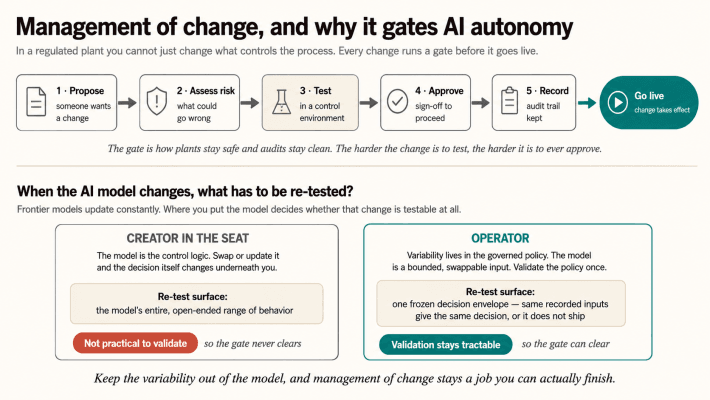 Management of change, and why it gates AI autonomy
The scaling math, and a model that vanished in a weekend
The economics decide it at scale. The operator is what gets copied across many facilities and thousands of assets, so model cost and latency multiply with every one of them, and industrial sites need edge, on-premises, and data-sovereign operation that cannot wait on a reachable frontier API. A right-sized model makes that possible. A frontier dependency would block it, which makes a smaller model an enabler of the operator role rather than a compromise.
There is also a supply risk that most teams have not priced in. This month a state-of-the-art model was pulled from every customer worldwide within days of its launch, not by a competitor and not by a technical failure, but by a government export-control order its vendor had to comply with inside hours. If your operator’s behavior had been resting on that model, your plant would have inherited that disruption, through no decision of your own. A control system you cannot count on being there next week is not a control system. Because the value sits in the decision architecture and not in the model, this approach is largely insulated from both the arms race and its politics, and it gets better as capable models get smaller, cheaper, open, and local.
**There is a catch worth heading off, because people hear “you don’t need a frontier model” and read it as “use a weak one.” It does not mean that.**The model still has to clear a real bar: it has to follow instructions reliably, return well-formed structured output, and stay grounded in the narrow job it has been given, and below that bar it has no business in the seat. Above it, a bigger model buys you very little, because the point is to right-size the model to the task rather than handicap it, and if you want to run a frontier model in that seat, go ahead. The decision still will not come from it.
There is a point worth noting on all of this. The “director” in the control room is a person, and the agent does not replace that person: the human stays the authority, sets the bounds, and holds the stop while the agent works within them. That is the only version of industrial autonomy worth putting near a plant.
Most agents create. Industrial operations need agents that operate, and operating asks for less of the creative, more of the operative, and far less faith in whichever model happens to be on top this week.
Pieter van Schalkwyk is the CEO of XMPro, specializing in industrial AI agent orchestration and governance. Drawing on 30+ years of experience in industrial automation, he helps organizations implement practical AI solutions that deliver measurable business outcomes while ensuring responsible AI deployment at scale.
He authored the Industrial AI Agent Manifesto, published by the Digital Twin Consortium in February 2026, a governance framework for trustworthy autonomous operations.
Our GitHub Repo has more technical information. You can also contact myself or Gavin Green for more information.
Read more on agentic operations at The Digital Engineer
This article originally appeared on XMPro CEO’s LinkedIn blog, The Digital Engineer, on 16 June 2026.