

You Can't Optimize an Egg Into a Bird
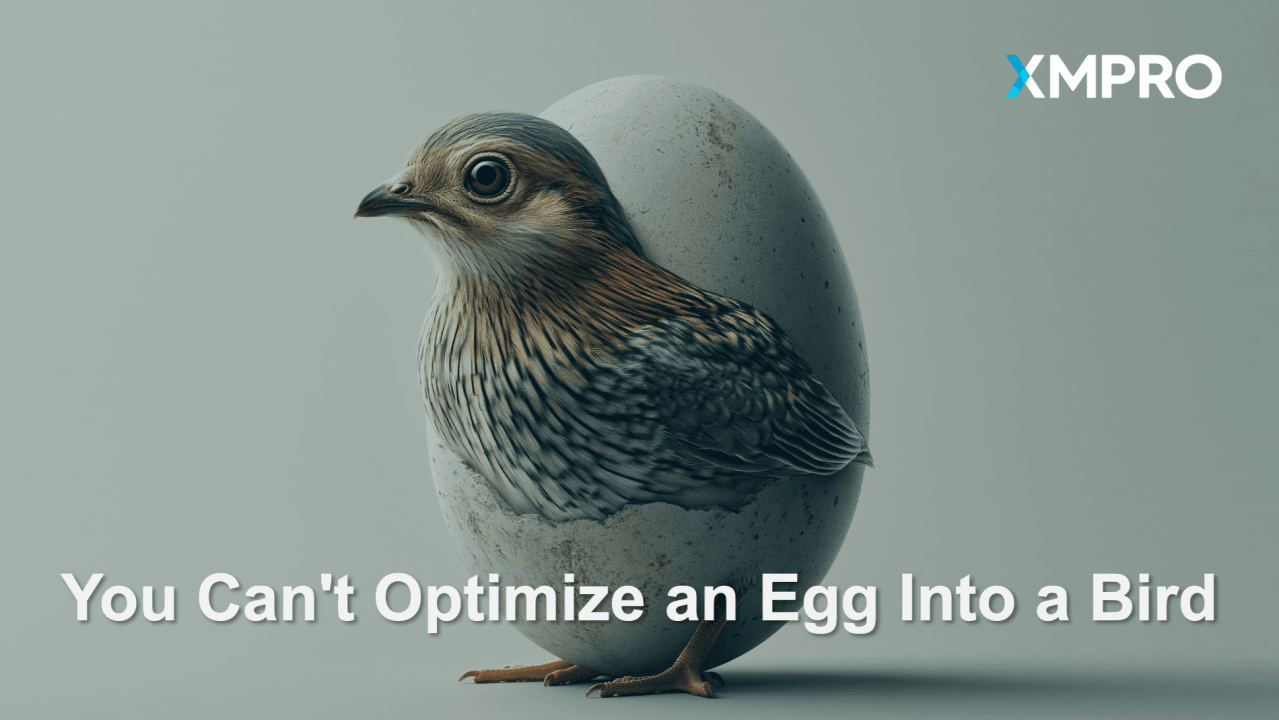
C.S. Lewis wrote in 1952 that it may be hard for an egg to turn into a bird, but “it would be a jolly sight harder for it to learn to fly while remaining an egg.” His conclusion was blunt: “We must be hatched or go bad.” He was writing about people. The analogy came up in a conversation this morning about business transformation, and it explains the last decade of industrial digital transformation better than most frameworks I have read.
The objective of transformation was never a bigger egg. It was always the bird.
A transformation, by definition, ends with something of a different kind than what you started with. The egg does not survive the process. That part of the analogy is the part everyone skips, because breaking things sounds like a failure mode rather than the mechanism. So for twenty years, industrial companies have run transformation programs whose unstated goal was to keep the egg intact while making it bigger, smoother, and better instrumented.
The Bigger Egg Problem
Michael Hammer saw this coming in 1990, before anyone said “digital transformation.” His Harvard Business Review article told companies to stop “paving the cow paths”: using technology to automate existing processes instead of asking whether those processes should exist at all. His advice was “don’t automate, obliterate.” Almost nobody took it.
The numbers tell you how that went. Roughly 70% of digital transformation programs still fail to deliver their intended results. I wrote earlier about the digital transformation paradox: industrial manufacturers invest $1.1 trillion annually, yet 64% remain stuck in early implementation. We spent a trillion dollars a year making eggs bigger and called it transformation.
Look at what most of that money bought. SCADA data moved into dashboards. Paper rounds moved onto tablets. Shift handovers moved into Teams. Work orders got a mobile app. Every one of these made an existing process faster, cheaper, or more visible, and almost none of them changed what the process was. The shell got thicker and shinier, with better telemetry on the inside temperature.
Nothing hatched.
Efficiency Polishes the Shell. Effectiveness Breaks It.
Drucker’s old distinction does real work here. Efficiency is doing things right. Effectiveness is doing the right things. Digitizing a process asks “how do we do this better?” That question can only ever produce a better egg, because it accepts the process as given. The question that produces a bird is different: why does this process exist at all?
I made a version of this argument in Beyond AI Horseless Carriages: process reengineeringasks how we can do this better, decision reengineering asks what we should be doing in the first place. The egg analogy adds the part I underplayed then. Getting from the first question to the second requires breaking something, and the egg does not get a vote.
Take shift handover. You can digitize it: structured forms, voice-to-text logs, a dashboard the incoming shift reviews. That is a more efficient handover, a better egg. Or you can ask why the handover exists. It exists because human shifts cannot share context. Everything the day shift learned about that compressor lives in people’s heads and must be laboriously transferred before they walk out the door. An agent team that holds operational memory continuously does not need a better handover. It dissolves the reason the handover exists. That is a bird: a capability the egg could not grow into, no matter how big it got.
The same test applies to daily production meetings, end-of-day logs, most status reporting, and a large share of work order administration. These processes are not the work. They are compensations for the limits of human coordination, and when the limit goes away, the compensation should go with it, not get a faster user interface.
Why We Kept Polishing
Companies did not keep building bigger eggs because their leaders were foolish. The technology forced a trade-off. Automate a process and it froze: rigid, brittle, breaking on the first exception that its designers had not anticipated, which in an industrial operation arrives roughly every Tuesday. Keep humans in the loop and you stayed adaptive but could never scale past the number of experienced people you could hire and retain. I wrote about this trade-off recently: automate and lose agility, or stay agile and stay manual. Given that choice, polishing the shell was the rational move.
Agentic systems are the first technology that is automated and adaptive at the same time. That combination was simply not purchasable before, and it removes the excuse.
Recommended by LinkedIn
The strategy firms have caught up to this. McKinsey’s work on the agentic organization describes redesigning end-to-end processes with humans above the loop, and is explicit that this is not automation layered on existing workflows. Gartner predicts that 40% of enterprise applications will embed task-specific agents by the end of 2026, up from less than 5% in 2025. Adoption is not the constraint anymore. The constraint is that most of those agents will be deployed into processes designed for human limitations, which is paving the cow paths with a third generation of asphalt. An agent that fills in the same work order a human used to fill in is a bigger egg with a chick painted on the shell.
The Shell Is Not the Safety System
Industrial operators flinch at “break your old processes,” and they should. Plant processes encode safety cases, compliance obligations, and lessons written in incidents. If the egg analogy meant discarding those, it would be a Silicon Valley analogy, the kind that works fine until it meets rotating equipment.
So separate two things the old process bundled together. The process is the shell: the meetings, handoffs, forms, and approval chains that exist because humans cannot share context instantly or pay attention continuously. The constraints are the nest: the operating envelopes, permit conditions, safety interlocks, and regulatory boundaries the process was built to respect. Digital transformation treated both as fixed. Agentic transformation breaks the first and hardens the second, because autonomous processes need stronger boundaries than human ones, not weaker. The bird does not get the run of the sky on day one; it lives in the nest, within boundaries that are explicit, monitored, and enforced. You break the shell. You never break the nest. That is what bounded autonomy means in practice, and it is the difference between agentic operations and letting a language model loose in a control room.
What This Means
If you are planning an agentic initiative for 2026, three questions sort the eggs from the birds.
Which of your processes exist only because humans cannot share context, be everywhere, or pay attention continuously? Handovers, status meetings, and most reporting sit in this bucket. These are candidates for dissolution, not digitization. For each candidate, what is the outcome the process was protecting, and can an agent team be accountable for the outcome directly? Redesign around the outcome. If you find yourself specifying the old workflow steps for the agents to follow, you are decorating a shell. Where are your boundaries written down? If your operating constraints live in procedures and tribal knowledge, agents cannot respect them. Making the nest explicit is the unglamorous work that makes the breaking safe.
Twenty years of digital transformation gave industrial companies the best-instrumented eggs in history. The incubation period is over, and Lewis’s warning applies to operations as much as it ever applied to people. Hatch, or go bad.
How much of your operation is shell, and how much is nest? I am curious how operations leaders are drawing that line.
Pieter van Schalkwyk is the CEO of XMPro, specializing in industrial AI agent orchestration and governance. Drawing on 30+ years of experience in industrial automation, he helps organizations implement practical AI solutions that deliver measurable business outcomes while ensuring responsible AI deployment at scale.
He authored the Industrial AI Agent Manifesto, published by the Digital Twin Consortium in February 2026, a governance framework for trustworthy autonomous operations.
Our GitHub Repo has more technical information. You can also contact myself or Gavin Green for more information.
Read more on agentic operations at The Digital Engineer
This article originally appeared on XMPro CEO’s LinkedIn blog, The Digital Engineer, on 11 June 2026.