
You Don't Want an Operator With Four PhDs
An engineer at a large manufacturer showed me a dashboard last week. Sharp work, built fast, and he was rightly proud of it. The plan was to convert it into AI skills so agents could do the analysis on demand. So I asked the boring questions. How do you maintain those skills across the organization? How do you secure them and version them? How do you know the engineer who runs that skill next month asks the same questions and gets the same answers?
They hadn’t thought about that part yet.
I have this conversation several times a week, with operators, with analysts, with vendors. Different companies, same gap. Most of the industrial AI I see demonstrated is a creator wearing an operator’s badge. And the distinction between those two things decides whether your agents ever make it out of the pilot.
Related: Operators, Not Creators
The operator you actually want
Think about who you put in front of a steam boiler. Not the person with four PhDs in chemical engineering who wants to reason about the plant from first principles every shift. You actively do not want that person at the panel. You want an operator who follows standard operating procedures, inside a safe operating framework, on live contextual data. They can reason their own way through a situation. But given the same data and the same procedures, they need to arrive at the same conclusion, every shift, every time.
Creators are different, and useful. A creator produces an artifact a person reviews before anything happens: a report, a summary, a piece of analysis, some code. Judged on quality and fluency, variation tolerated. An operator changes the state of a plant. Judged on whether the decision was controllable, traceable, and repeatable. We build plenty of creator agents, and there is nothing wrong with them. The trouble starts when a creator gets dropped into an operator’s seat because the demo looked convincing.
The model doesn’t decide
Here is the design rule that follows, and it is the one most agent architectures skip. The decision has to live outside the model.
The model observes, reflects, and synthesizes. It gets everything ready, in a structured form. What it hands over is an intent: here is what I think we are looking at, here is what I propose. That intent then passes through a decision layer the model does not control: validated against operating constraints, scored against explicit objectives, checked for what it is allowed to do. There is forty years of mathematics for exactly this. Warren Powell at Princeton built the field of sequential decision analytics on making decisions under uncertainty with math and statistics, not with eloquence.
The model proposes. The policy disposes.
Engineers push back: you cannot make a generative system deterministic. Correct, and we should stop pretending that is the standard, because the humans running plants today are not deterministic either. Human reasoning is generative, right more often than not, just not repeatable on demand. That is precisely why plants wrap operators in procedures, permits, interlocks, and management of change. Give two competent operators the same data, the same procedures, and the same rules, and they get to the same action most of the time. Put an agent inside the same discipline and it gets there every time. The discipline was never the model. It was always the system around the model.
Decision rights, written for machines
Fewer than half the utility executives in a recent industry survey could say they had defined decision rights for AI. Everyone is deploying agents; almost nobody has written down what those agents are allowed to decide.
Defining decision rights on a slide is the easy half. The rights have to be codified, persisted, and machine-readable, or they evaporate the moment an agent acts. In practice that means three verbs: obligations, permissions, prohibitions. What must this agent always do, what may it do, what may it never do. Medicine solved the shape of this problem long ago. My GP holds my complete history; the specialist treating my broken foot has no business seeing my mental health records. The rules travel with the request. Agents need the same construct: a token that carries what this agent is entitled to see and do in this context, checked the way a security token is checked, before anything moves.
Ask your agent vendor where that lives in their architecture. The pause tells you a lot.
Recommended by LinkedIn
Context is a system, not a lookup
Agents are context hungry, and industrial context is the hardest kind. A plant is not a collection of boxes. It is a system of interdependent systems. If I change the furnace temperature, what does that do to my splitter three units downstream? What is upstream of me, what is beside me, which alarm actually matters right now? A flat graph over your tags does not answer those questions. We tried. You need real ontological understanding, and plants speak several ontologies at once: one standard for maintenance records, another for the asset model, half the site described in a historian’s asset framework, engineering data somewhere else again.
The part that keeps me disciplined is what happens when the system learns something new. You can discover relationships in real-time data, and you should. But discovered context gets a confidence score based on where it came from, and if discovered context can trigger consequential action, a process engineer signs it off before anything relies on it. An inferred connection between two valves is a hypothesis. In a plant, acting on a guessed hypothesis has consequences that no amount of model capability walks back.
Run the math, don’t imitate it
One more rule that sounds obvious and mostly isn’t followed. When a question has a known mathematical answer, compute it. Remaining useful life on a pump comes off a regression model. Scheduling six machines, four technicians, and a maintenance window is linear programming. Anomaly cause-and-effect is a causal model. The agent runs those as tools, takes the result, and explains it in plain language. We do not ask a language model to hallucinate arithmetic we already know how to compute. The generative part of the stack is small, and it should be.
One platform, three speeds
None of this arrives in one leap, and it should not have to. The pattern I see work runs in three phases on the same infrastructure. Monitor and predict: the pipeline feeds dashboards and humans decide. Advise and guide: the same pipeline feeds advisors, over-the-shoulder prognostics, even a council of advisors for a process engineer to interrogate. **Coordinate and Autonomize:**the same pipeline, now with agents executing inside the governance framework you have been hardening since phase one.
**Same connectors, same context, same decision discipline throughout, which means moving between phases is a permission change rather than a migration.**Some processes will stay dashboards forever. Some will sit at advisory for years. Some will run autonomously on the weekend and drop back to advisory on Monday when the plant is full of people, and the slider belongs to your operations leadership, not to a vendor roadmap and not to the model.
The harness is the product
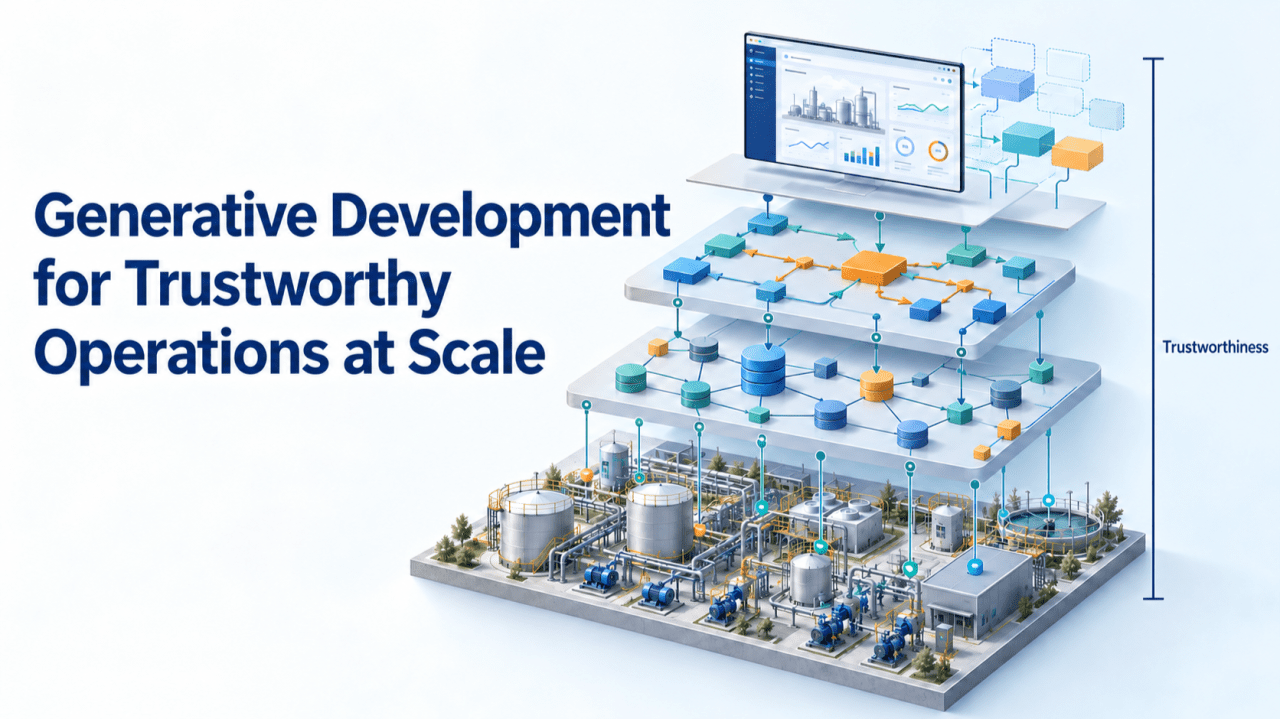
The model is going to keep improving without any help from you. It gets the headlines, and it is the least differentiated part of the system. What decides whether industrial AI produces a return is everything wrapped around it: the decision layer, the decision rights, the context, the identity, the audit trail. The unglamorous machinery that makes a thousand agent decisions land the same way a good operator’s decisions land.
The model is not the hard part. The harness is. Build the harness, and every better model that ships makes your operation stronger instead of stranger.
Pieter van Schalkwyk is the CEO of XMPro, specializing in industrial AI agent orchestration and governance. Drawing on 30+ years of experience in industrial automation, he helps organizations implement practical AI solutions that deliver measurable business outcomes while ensuring responsible AI deployment at scale.
He authored the Industrial AI Agent Manifesto, published by the Digital Twin Consortium in February 2026, a governance framework for trustworthy autonomous operations.
Our GitHub Repo has more technical information. You can also contact myself or Gavin Green for more information.
Read more on agentic operations at The Digital Engineer
This article originally appeared on XMPro CEO’s LinkedIn blog, The Digital Engineer, on 12 July 2026.