
What Operations Leaders Actually Ask About Agentic Operations
I gave a keynote on agentic operations for asset-intensive industries recently. The questions that followed were more revealing than the presentation itself. Not because they were unexpected, but because the same questions keep coming up in every conversation I have with operations leaders globally, whether it is mining executives in Latin America, refinery managers in the Middle East, or energy companies in Australia.
The questions cluster around four themes. Understanding them tells you more about where the industry actually is with agentic operations than any analyst report.
”What is it, and how is it different from what we already have?”
This is always the first question, and it deserves a simple answer. **Agentic Operations is the coordination of multiple AI agents to autonomously execute, optimize, and continuously improve operational processes through progressive decision intelligence.**The key phrase is “coordination of multiple agents.” The innovation is not the individual agent. It is orchestrating multiple agents to work together toward common operational goals while maintaining safety, efficiency, and compliance.
This distinction matters because it separates agentic operations from four things people confuse it with.
It is not chatbots applied to industrial data. It is not traditional automation with better algorithms. It is not a single AI model trying to optimize everything at once. It is not a chain of subagents passing tasks down a sequential workflow, which is just a workflow engine with an LLM in each node.
Coordination in this context means parallel, significance-driven collaboration where each agent runs its own continuous cognitive cycle independently, communicating when something matters, not when it is next in line.
MAGS is an operator, not a controller. It doesn’t send commands to PLCs. It reasons, coordinates, and decides, then proposes actions through the same supervisory paths a human operator uses.
The reason this distinction matters is structural. We published a detailed analysis of the intelligence gap in industrial process control that maps nine specific gaps in the current automation stack. The execution layer is mature: PLCs, DCS, SCADA, and APC are well-proven. What is missing is governed reasoning across the boundaries these systems were never designed to cross. APC optimizes within a single unit but has no visibility into what the upstream feed unit is doing or what the market requires from the product slate today. Industry estimates suggest 30-50% of installed APC controllers are in manual or degraded mode at any given time, not because the technology failed, but because the model maintenance burden exceeded available engineering capacity. Optimization disappears during the non-steady-state transitions when intelligence is needed most. And the experienced operators who fill these gaps through tacit knowledge and ad hoc coordination are retiring faster than they can be replaced.
Related: The Intelligence Gap in Industrial Process Control | IndustrialClaw
Traditional automation solved the execution problem. Agentic operations addresses the reasoning problem that execution cannot reach. It replaces human coordination across organizational and structural boundaries with adaptive intelligence that learns, reasons, and coordinates across multiple variables, multiple units, and multiple organizational functions simultaneously. A single maintenance timing decision might require vibration data from a SCADA system, maintenance history from an ERP, production targets from an MES, and energy costs from a historian, all processed simultaneously. That is not a chatbot problem. It is a cross-boundary coordination problem, and coordination is what agent teams are built for.
The other phrase worth unpacking is “progressive decision intelligence.” This means the system does not start fully autonomous on day one. It progresses from visibility (showing you what is happening) through advisory (recommending what to do) to autonomous coordination (acting within approved boundaries). The progression matches the organization’s readiness, not the technology’s capability.
”Can we actually trust it?”
This question comes up second, and the data around it is surprisingly clear. LNS Research ( Niels Erik Andersen ), “Autonomous Operations: AI with Guardrails”) found that only 4% of organizations want to avoid AI agents entirely, but 67% refuse to give them full control. Separately, Stanford University’s Future of Work research, studying 1,500 workers across 104 occupations, found that 45.2% of workers prefer collaborative autonomy over full automation, and 61.5% prefer high human involvement.
The industry is not skeptical about agent intelligence. It is cautious about agent authority. That is a rational position, and the architecture should reflect it.
The practical answer is bounded autonomy. You define a safe operating envelope at the infrastructure level, not at the agent level. Agents cannot modify or override these boundaries under any circumstances. Within that envelope, you implement what we call Human Agency Controls that determine how much execution authority the agents have. Start conservative: agents observe and recommend, humans approve every action. As agents demonstrate consistent, explainable, and safe decision-making, you expand their authority incrementally. The same agent intelligence serves organizations across the entire autonomy spectrum. What changes is the approval pathway, not the reasoning capability.
This mirrors how we already manage human autonomy in critical systems. A nuclear plant operator has significant autonomy, but within strict boundaries defined by technical specifications, safety protocols, and regulatory requirements. We don’t respond to operator risks by eliminating autonomy. We create structured environments where autonomy can be exercised safely. The same principle applies to AI agents.
Trust follows transparency. Every agent decision must be traceable through three steps:
Sensor data transformed into value through utility functions Multiple values combined through objective functions that reflect business priorities Optimization that selects the best action.
When an agent decides to reduce throughput to protect equipment, you can trace that decision back through the math. That is more accountability than most manual processes provide.
”What does the intelligence actually look like inside?”
Operations leaders with engineering backgrounds want to understand the mechanism, not just the outcome. The architecture has three layers worth explaining.
First, each agent has four independent components.
Its own observation domain: the specific data streams it monitors continuously. Its own clock: reflection cycles driven by the significance of what it sees, not by a shared schedule. Its own objective function: a mathematical expression of what “good” looks like from its perspective. Its own memory: accumulated experience that makes reflection intelligent rather than reactive.
These components run independently per agent. The team’s intelligence emerges from parallel, overlapping cognitive cycles, not from a prescribed workflow.
**Second, the cognitive cycle itself.**Each agent runs an Observe-Reflect-Plan-Act (ORPA) cycle, drawn from Stanford’s research on generative agents (Park et al., 2023) and mapped to John Boyd’s OODA loop. Observe means monitoring data streams for changes. Reflect means building context by comparing the current state to historical patterns. Plan means determining whether to act and what to communicate. Act means executing within authority or escalating. Agents communicate when their significance threshold is crossed, similar to how operators in a control room speak up when they see something that matters, not because it is their turn in a sequence.
Recommended by LinkedIn
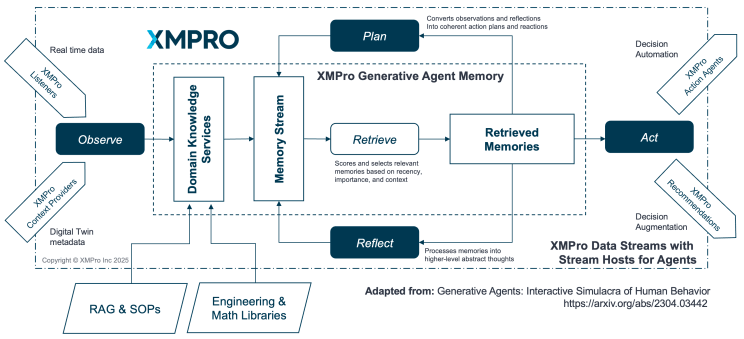 XMPro MAGS ORPA Cycle
Third, memory. The architecture mirrors how the human brain stores and retrieves information through three distinct systems. A graph database functions as semantic memory, storing relationships and structure. A time-series database functions as episodic memory, recording what happened, when, under what conditions. A vector database functions as associative memory, enabling rapid pattern recognition in 50 to 100 milliseconds. This three-tier architecture implements Dual-Process Theory from cognitive psychology: fast intuition (vector similarity search) backed by careful analysis (graph traversal and time-series analysis) when stakes are high. This is how experienced operators actually work.
In the Depropanizer example below, each of the four XMPro MAGS agents have their own ORPA cycle, decision traces, collaboration and consensus. The MAGS team optimizes the operation of a depropanizer column, focusing on maximizing profit per hour by balancing product revenues against steam costs. They achieve this by relaxing overly conservative quality margins, improving propane recovery when prices are favorable, and reducing response time to feed changes from hours to roughly 5–10 minutes, all while keeping product quality and safety within limits
For this team, the intelligence does not reside in the large language model alone. The LLM provides reasoning capability. The agent’s intelligence comes from the operational context stored in its memory, the business objectives encoded in its utility functions, and the constraints defined by its rules of engagement. Without that context, an LLM generates plausible text. With it, the agent makes operational decisions grounded in physical reality.
”What changes for our people?”
This is the question that reveals the most about an organization’s readiness. Leaders who ask it are already thinking past the technology.
The shift is from execution to orchestration. In traditional operations, humans execute work and coordinate with each other. In agentic operations, AI agents execute work while humans orchestrate agent networks. Consider reliability management in a mine. The traditional model requires reliability engineers monitoring equipment health, maintenance planners scheduling interventions, operators adjusting production around maintenance windows, and supervisors coordinating across all of it. Coordination overhead often exceeds actual value creation.
In the agentic model, specialized agent teams handle continuous monitoring, pattern detection, cross-referencing with maintenance records, and coordination with production scheduling. The human reliability team, now perhaps two to three people instead of a dozen, oversees the agent network. They handle exceptions that fall outside agent capabilities. They make strategic trade-offs when objectives conflict. They define what “good” looks like through objective functions. They continuously improve agent behavior based on operational learning.
This is not about eliminating roles. It is about solving a practical reality that every asset-intensive industry faces: you cannot find enough skilled people. The APQC/ATD/Lightcast Knowledge Exodus survey projects that 52.4% of the current industrial products workforce will retire or leave within five years. Training a replacement to equivalent competency requires five to ten years of direct operational experience. The math does not work. The knowledge that fills the gaps in automated systems, what to do during transitions, when to override the controller, how to interpret a pattern of alarms, is walking out the door and is encoded nowhere. Agentic operations multiplies the impact of scarce expertise rather than trying to replace it. The 3 AM shift gets the same depth of expertise as the day shift. Every operator gets the cognitive support of a team of domain experts with infinite memory and continuous attention.
The trajectory is not toward agents replacing human decision-making. It is toward a graduated spectrum of authority, similar to the SAE autonomous driving levels that the mining industry already understands from autonomous haul trucks. At the collaborative level, which 45.2% of workers prefer, humans and agents share decision-making. At higher levels, agents manage routine operations with humans intervening at critical decision points.
The question for operations leaders is how quickly they can implement the governance frameworks that allow them to safely expand agent authority where it makes operational sense, while keeping human expertise focused on the strategic decisions where it matters most.
The hardest part
The hardest part of implementing agentic operations is not the technology.It is unlearning workflow thinking. We have spent decades designing systems as sequences. When teams configure cognitive agent systems, their natural instinct is to draw a flowchart. The moment the flowchart becomes the architecture, you have built something that looks like AI but behaves like a very expensive workflow engine.
The right place to start is with the business objectives, the rules and constraints, and the tools and actions available to the agent team. Define what “good” looks like. Define the boundaries that must never be crossed. Define what each agent can do. Then let the agents work out the flow. The process that emerges from their reasoning, visible through decision traces, will be more accurate than any flowchart drawn in advance, because it reflects what actually happens under real conditions, not what you thought would happen.
**The second challenge is integration depth.**A single operational decision might require data from SCADA, ERP, MES, and historian systems simultaneously. Most organizations have these systems but not the integration fabric to make them available to agents in real time. Enterprise agents don’t need better models. They need better plumbing.
The third is governance architecture. Safety requirements must be implemented as deterministic constraints that agents cannot override, not as suggestions encoded in prompts. The safe operating envelope must be defined and managed independently from the agents themselves. This is an architectural decision, not a policy decision.
These conversations are happening in every asset-intensive industry, in every geography. The questions are remarkably consistent because the operational realities are consistent: skills shortages, increasing complexity, pressure to do more with less. The organizations that engage with these questions seriously, that build the governance frameworks and integration infrastructure before they need them, will be the ones that capture the competitive advantage agentic operations creates.
The ones that wait for perfect certainty will find themselves competing against organizations whose operations never sleep, never forget, and never stop improving.
Sources:
LNS Research: Niels Erik Andersen, “Autonomous Operations: AI with Guardrails.” https://blog.lnsresearch.com/autonomous-operations-ai-with-guardrails Stanford University Future of Work: SALT Lab, Human Agency Score research. https://futureofwork.saltlab.stanford.edu/ Stanford Generative Agents: Park, J.S. et al. (2023), “Generative Agents: Interactive Simulacra of Human Behavior.” https://arxiv.org/pdf/2304.03442 IndustrialClaw: “The Intelligence Gap in Industrial Process Control.” https://industrialclaw.ai/insights/the-intelligence-gap-in-industrial-process-control/ APQC/ATD/Lightcast: Knowledge Exodus survey, 52.4% industrial workforce attrition within five years.
Pieter van Schalkwyk is the CEO of XMPro, specializing in industrial AI agent orchestration and governance. Drawing on 30+ years of experience in industrial automation, he helps organizations implement practical AI solutions that deliver measurable business outcomes while ensuring responsible AI deployment at scale.
Our GitHub Repo has more technical information. You can also contact me or Gavin Green for more information.
Read more on MAGS at The Digital Engineer
This article originally appeared on XMPro CEO’s LinkedIn blog, The Digital Engineer, on 9 April 2026.