
The Operational Decision Owner’s Dilemma
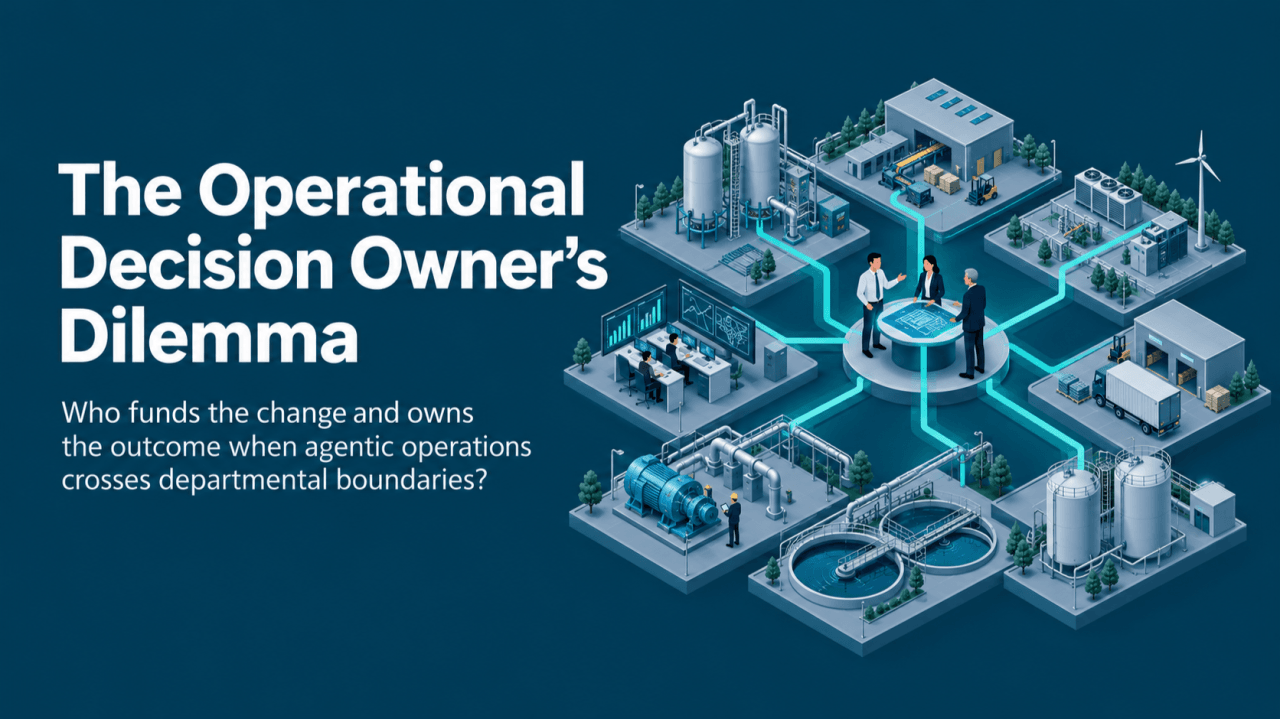
Who funds the change and owns the outcome when agentic operations crosses departmental boundaries?
Agentic operations can help a business evaluate production, maintenance, energy and workforce decisions together as conditions change. Acting on a shared assessment may require departments to accept different priorities, share information and change who can approve or carry out the work.
At company scale, this can require reconsidering an operating model that still appears successful. In Moonshots episode 301, Dave B. Blundin describes a T. rex that has dominated its environment for millions of years and cannot believe a warning about an approaching meteor. He uses the analogy to explain his conversations with established pharmaceutical and insurance companies: their experience of success makes a different competitive threat difficult to accept.
An investment that depends on changing how departments work together needs an owner with authority to make those changes. That authority may extend beyond the team selecting the software or building the first application.
I see this division of responsibility in our industrial projects. A maintenance and engineering function owns the operational need while a digital transformation team provides the funding. In other cases, digital leadership initiates the work and brings the operating function into it. I remember the ownership problem from business process management: we could explain how the concept applied across an organization, yet struggle to identify who would fund it.
Shared capabilities, different operating outcomes
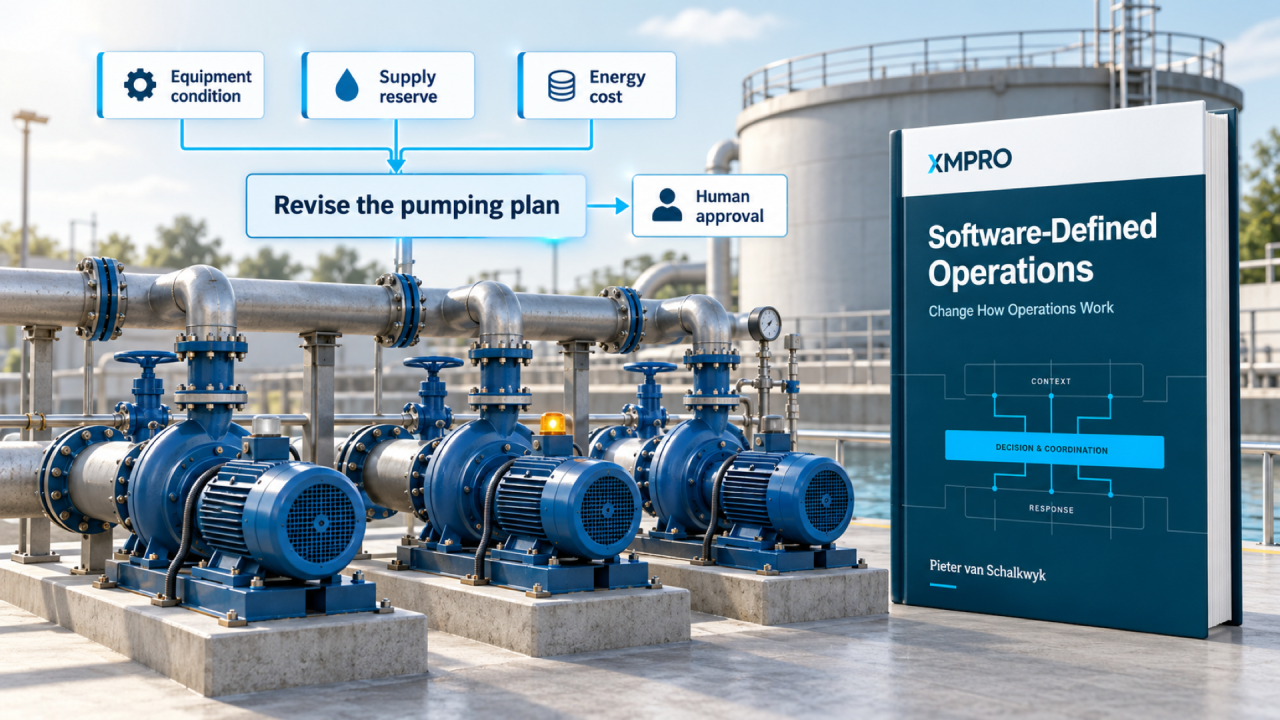
I have written before about Software-Defined Operations: making the logic, requirements and authority behind operating decisions explicit in software, connected to the systems that supply information and carry out actions.
In 2024 we described shared XMPro capabilities supporting process optimization, asset performance and predictive maintenance, quality management, environmental, social and governance measures, operational risk, safety, supply chains and workforce management. The same architectural definitions can support all eight areas. Engineers can reuse connections and decision structures, configuring the models and limits for the operation and its required outcome. A mine deciding when to withdraw a haul truck and a utility positioning crews before a storm need different expertise and investment cases, even when they use common capabilities.
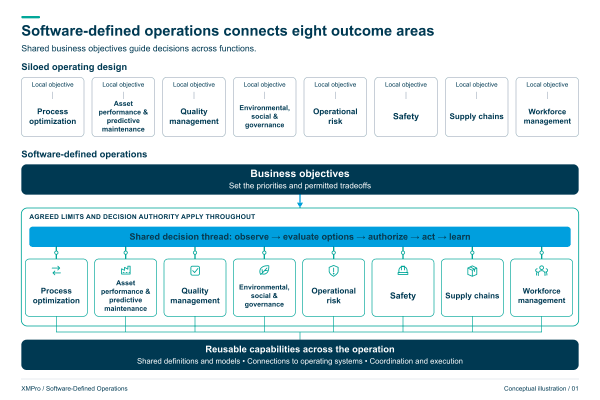 Software-defined operations connects eight outcome areas
Agents can expand what teams evaluate together
Consider the design of a paper approval process. A form carries selected information from one department to the next, with each person checking their part before passing it on. Putting that form on a screen can preserve the same sequence and division of responsibility. The opportunity with agents includes reconsidering which decisions should be evaluated together and which handoffs are still necessary.
People have limited time and attention to compare alternatives and their consequences. Herbert Simon’s work on decision-making examines those limits alongside the computational limits of machines. Engineers have used optimization software for decades. With agents coordinating access to operating data, models and optimization tools, we can investigate a wider set of responses and reassess them as conditions change. The achievable scope depends on the quality of those inputs, available computation and validation against the operation.
A fixed workflow covers the situations its designers anticipated and provides routes for handling exceptions. An agent team can develop candidate plans within the objectives and constraints it has been given. That creates scope to evaluate maintenance, production, energy and workforce effects together, including combinations that people would struggle to compare manually in the time available. Whether that improves the decision must be tested in the intended setting.
Leaders must agree the objectives and limits
In his writing on purpose and agent authority, Salim Ismail argues that leaders need to specify objectives, prohibited actions and permitted tradeoffs. A shared assessment needs priorities that the affected functions have agreed. Someone must decide how the organization values the outcomes and which limits every option must respect.
Gavin Green and I described our approach in From Measurement to Meaning, dated November 24, 2025. A utility function expresses the value the business assigns to a level of performance. An objective function uses those values to compare options. Our paper calls for agreement on which objective controls when business and technical priorities conflict, with other objectives monitored for deterioration.
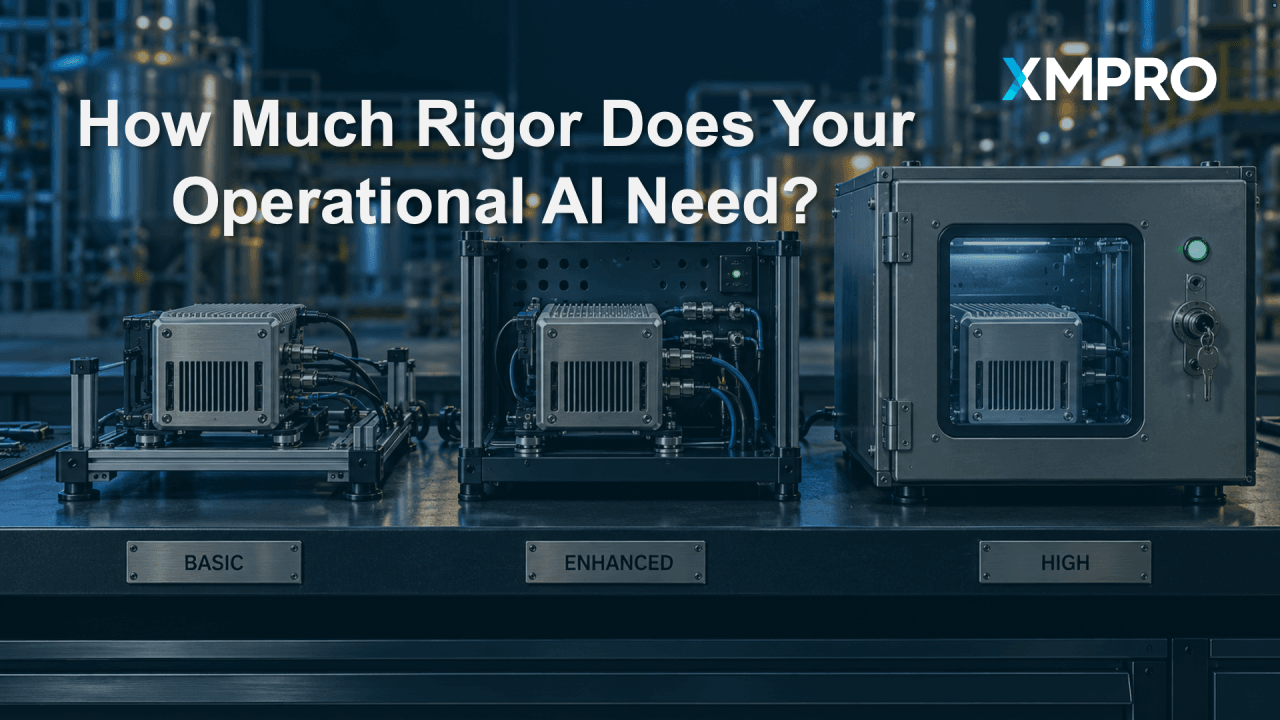
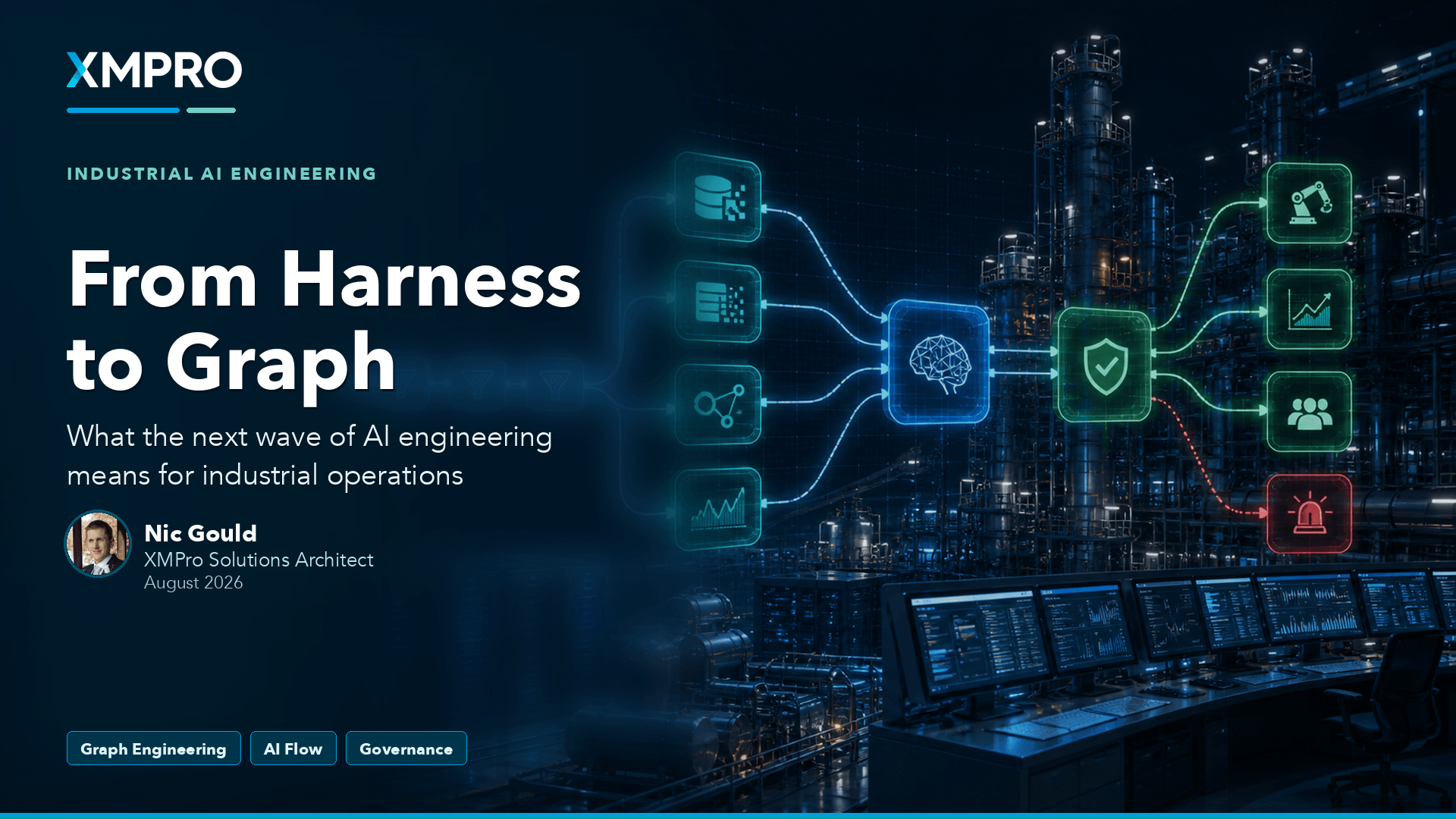
Decision engineering defines the evidence, objectives and authority used to evaluate a choice, which decision optimization then uses to seek better outcomes as conditions change. Safety remains a mandatory constraint. Several outcomes can inform an assessment, but each option must meet the applicable limits. Our decision architecture uses deterministic checks to enforce configured action limits and approval requirements; people agree those limits and review decisions that exceed the agents’ authority.
The promised benefit determines whose commitment is needed
Consider a hypothetical equipment decision. Maintenance proposes an outage. Production wants to finish the campaign, and a planner reconciles the requests in a meeting. An agent team could compare alternative schedules against agreed production, quality, energy and emissions objectives, including the maintenance team’s workload. The comparison could be updated when equipment condition or demand changes, with a supervisor authorized to accept plans within agreed limits and wider conflicts referred for approval.
That changes the investment case. Maintenance may bear the cost while production receives much of the benefit. If the return depends on production changing its schedule, the investment needs a commitment from the leader who can authorize that change. Managers must agree who can accept a combined plan, how departmental targets reflect the combined result and what work people take on as evidence gathering becomes automated.
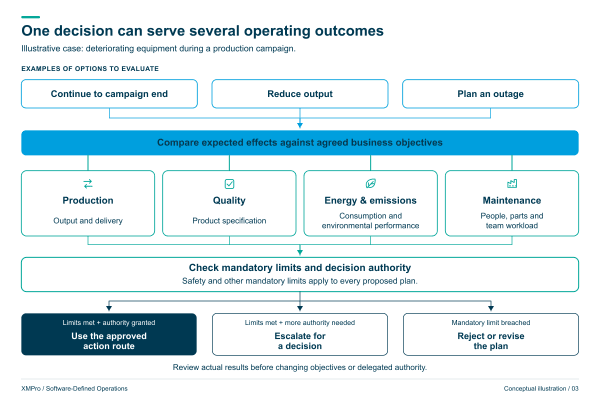 One decision can serve several operating outcomes
The necessary authority depends on the scope. A plant manager may be able to secure those agreements at one site. A business-unit leader may be needed across several sites. A central maintenance or engineering team may sponsor a common capability while local leaders retain responsibility for adoption. One person can hold several roles. Where mandates overlap, the proposal needs an agreed way to resolve conflicting priorities before relying on those changes for its return.
In his work on the Organizational Singularity, Salim proposes defining the future organization first and working backward, with the chief executive approving that direction. I would apply that reasoning within the scope being changed. Leaders need to consider how work could be organized around the decisions now possible, then establish the investment and authority required to get there.
Define a first investment people can support
Digital leadership may hold the investment mandate. Its mandate may fund a capability across several operations while plant leaders remain accountable for local performance. Shared definitions and capabilities can also be an explicit service funded by a digital or engineering platform owner, with consuming teams agreeing what they need and how continued use will be paid for. Establish the actual investment authority. The person signing the contract may perform a separate administrative role.
A first investment can be narrower than the architectural opportunity.
For example, one plant could improve product-release decisions while people retain approval and the team tests recommendations against current practice. Include the engineering work, operating changes and ongoing support alongside the software. That investment needs an operational sponsor and someone authorized to fund it, with engineers responsible for validation and maintenance. Funding a trial establishes a trial budget; production deployment and continued use need their own confirmed approval route.
Our ValueForge approach provides a starting point for this assessment. It frames the operational decision, examines the available evidence, identifies suitable limits on agent authority and estimates a range for the potential benefit. For an investment that crosses functions, those discussions should also establish which leaders can authorize the required operating changes and what they are prepared to commit to. The assessment can support a recommendation to proceed, revise the scope or defer. Implementation and operating costs then need to be assessed alongside the benefits to complete the investment case.
Before commissioning the work, the people involved should be able to name:
The operating result the investment is intended to achieve, its baseline and the person accountable for improving it. The person or approval body that can authorize the investment, the budget and the evidence needed for that decision. The leaders who can agree objectives, permitted tradeoffs and the changes required across affected functions. The people responsible for adoption, validation and continued operation, including shared capabilities and recurring funding.
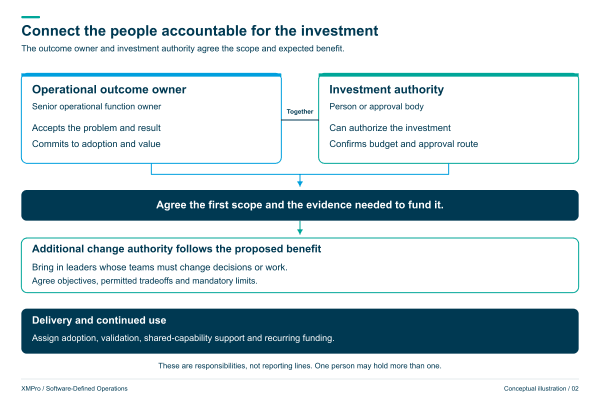 Connect the people accountable for the investment
An investment in Software-Defined Operations can build capabilities that engineers reuse across applications. Its case still needs an agreed scope, an accepted operating benefit and the people prepared to fund, implement and sustain it.
A complete investment case should let us name the person accountable for the result, the authority that can fund it and the leaders committed to the operating changes it requires. Those commitments establish who must participate in the investment decision and who will be accountable for achieving the intended result.
Pieter van Schalkwyk is the CEO of XMPro, specializing in industrial AI agent orchestration and governance. Drawing on 30+ years of experience in industrial automation, he helps organizations implement practical AI solutions that deliver measurable business outcomes while ensuring responsible AI deployment at scale.
He authored the Industrial AI Agent Manifesto, published by the Digital Twin Consortium in February 2026, a governance framework for trustworthy autonomous operations
Our GitHub Repo has more technical information. You can also contact myself or Gavin Green for more information.
Read more on MAGS at The Digital Engineer
How this was made: I worked with Codex to check sources, draft from my direction and edit. I do not publish anything I have not rewritten myself.
This article originally appeared on XMPro CEO’s LinkedIn blog, The Digital Engineer, on 11 October 2026.