
You Should Rent the Model. You Must Own Everything Around It.
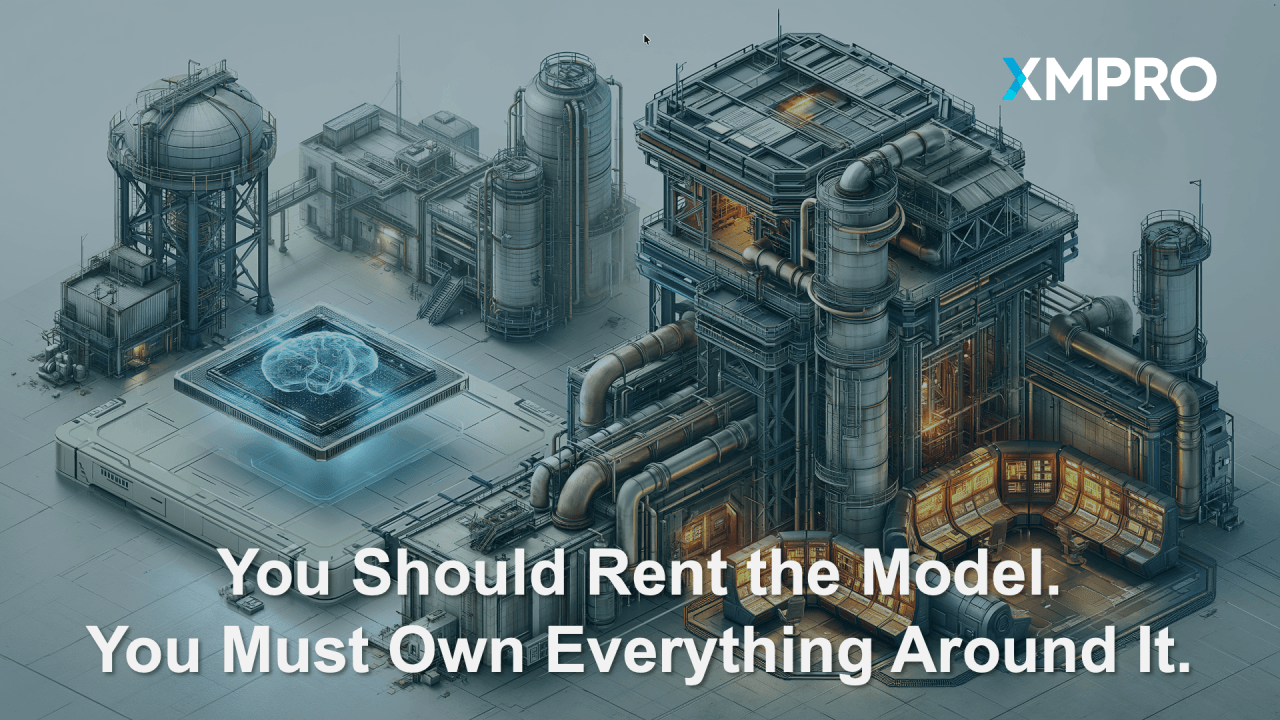
Satya Nadella argues that the lasting advantage in AI sits in the learning loop a company builds around the model: the system that holds how the company works and improves every time it runs. He is right. You should rent the model. You must own the loop. In industrial operations this is not a new idea, and the stakes are higher, because the loop has to survive an audit and act on a physical plant.
Microsoft CEO, Satya Nadella , published a short piece this month arguing that a frontier without an ecosystem is not stable. His claim is that the durable advantage is not access to the smartest model but the learning loop built on top of models, where two things compound over time: the judgment and know-how of a company’s people, and what he calls token capital, the AI capability the firm builds and owns. His test is simple. A company should be able to switch out a generalist model without losing the company-veteran expertise built into its own systems. He calls that the test of control and sovereignty in the era ahead.
I agree with all of it. The interesting part is what happens to that argument when you move it from a knowledge-work desk to a refinery.
In industrial operations the loop has physics.
Let’s start with what the loop is, because the rest depends on understanding it. Strip the jargon and the loop is the system that sits around the model and holds how your company actually works: the rules for what counts as a good decision, the record of what was done and why, and the hard-won knowledge of your most experienced people, all captured so the system gets better each time it runs. The model is rented from a lab. The loop is yours, or it should be.
The sovereignty test is stricter in a plant
Stuart Winter-Tear , who has been reading these moves more clearly than most, calls Nadella’s line the sovereignty test. The name fits. Can the organization keep its own judgment, workflows, traces, and accumulated expertise independently of whichever frontier model happens to be strongest this quarter? If the answer is no, the company does not own its advantage. It is renting it, and the rent resets every time a lab ships.
We have been building for that test for years, because in a plant you have no choice. The model cannot be the thing that decides. When the model is what decides, its behavior belongs to the model, and every update, swap, or retirement quietly changes how your operation makes calls and takes action. In a regulated plant, changing the thing that controls the process forces you to re-prove from scratch that the whole operation is still safe, the discipline engineers call management of change. That is not a software inconvenience. It is a safety and audit problem.
**So invert it.**Put the deciding into a set of rules your team owns, and let the model fill in only the parts that sit inside those rules. What counts as a good outcome, the limits it must never cross, the checks against other evidence, how competing options get scored, the moment a decision becomes a physical action: all of that lives in your system, not in the model. Swap the model and you test the new one against the same situations you already have on record. Same inputs, same decisions, or it does not ship. Swap the model, and the thing that decides never changes.
That is the industrial version of Nadella’s sovereignty test, and it is stricter than the knowledge-work version. A desk worker who loses a model loses some fluency. A plant that rests its control logic on a model can lose the plant.
What the loop is made of
Nadella lists the pieces of the loop: private evals, real traces, institutional memory you can query, knowledge that makes the system improve from use. Stuart’s version is blunter: all of this is the enterprise learning layer around the model, the agents, the workflows, the governance, the identity, the data, the security. In industrial operations every one of those words means more.
Private evals are not benchmark scores. They are whether an agent’s decision held up against what the plant actually did, recorded so it can be replayed exactly. Institutional memory is not a document store. It is the tacit knowledge of an experienced operator, what a historian tag, the cryptic label on a sensor feed, really means, which failure modes apply to this asset at this site, how a veteran reads a combination of alarms, encoded in a form an agent can reach and act on. Most of the meaning in an operation lives outside the structured data. Until you encode it, your AI is reasoning from a fraction of the signal, however large the model.
The traces, the recorded record of what an agent saw, why it acted, and what happened next, are the part most teams underestimate. Stuart put the warning better than I could: a loop is not a license, it is an operating design. You can buy every tool on the list and the loop will not appear, because the loop is the discipline of deciding what to capture, what stays human, what an agent is allowed to do, and what good looks like when a regulator asks why an agent opened a valve. Companies that assume the loop ships with the platform are going to spend a lot of money discovering that it does not, and they will discover it in production rather than in a design review, which is the most expensive place to learn anything.
Recommended by LinkedIn
The part of Nadella’s piece worth reading twice
Nadella is the CEO of Microsoft, so his “ecosystem” is not a neutral word. It is Azure, Fabric, Foundry, Copilot, identity, security, the layer through which a company’s whole AI operation is meant to run. The paradox, as Stuart puts it, is that an ecosystem can still be an enclosure. More value can be created on top of a platform than inside it while the platform still taxes, shapes, observes, and controls the terrain. The warning against a few models eating the economy is real. It is also a case for a different kind of concentration, in the operating layer around many models, and that layer is convenient territory for the company making the argument.
This matters for industrial operators specifically. The loop Nadella describes runs on documents, code, agreements, the corpus of a knowledge-work company. The loop in a plant runs on real-time operational data, physical safety consequences, and decades-old control systems that were built to be isolated. A general enterprise AI system, the kind that runs email, documents, and office workflows, does not have an opinion about a hydrocarbon release, a safety interlock, or a plant safety standard like IEC 62443. It was never built to.
There is also a supply risk that knowledge work can absorb and a plant cannot. Andrew Ng walked through the sequence this week: a frontier model was first quietly degraded for some users, then export-controlled by a government, and access was cut for every customer worldwide inside days. Not a competitor, not a technical fault, a policy decision the vendor had to comply with inside hours. If your operator’s behavior had been resting on that model, your plant inherited the disruption through no decision of your own. A control system you cannot count on being there next week is not a control system. When the value sits in the decision architecture and not in the model, you are largely insulated from both the arms race and its politics, and the system gets better as capable models get smaller, cheaper, and local.
That points to a practical choice for industrial sites. Where the work is critical, run a model you control, open-weight, version-pinned, deployed at the edge, so no vendor can silently change it, throttle it, or switch it off, and a model upgrade becomes a move you make on your own schedule rather than a disruption that arrives on someone else’s.
A model being pulled is the failure you can plan for. The quiet one is worse. A model can degrade without throwing an error, its outputs sliding a little each week, and on a knowledge-work desk someone eventually notices the writing got worse. In a plant that same drift rides straight into actions on equipment, and nobody asks why until something downstream breaks weeks later. A governed decision architecture catches the quiet failure that a model in the driver’s seat hides, because the decision is fixed by the goals and limits applied to recorded evidence, and a model sliding underneath you shows up as drift against a known baseline rather than as wrong moves nobody flagged.
What this means
Take Nadella’s test into the next budget conversation. Ask it directly. Can you swap the generalist model without losing your company veteran? If the answer depends on which model you happen to be running, you have not built the loop yet. You have a subscription.
The harder question sits underneath, and Stuart is right to raise it. A system that learns from your experts can amplify them or strip them for parts, and the people whose judgment is being encoded will reasonably ask which one is happening to them. In an industrial setting the answer has to be visible in the architecture, not promised in a slide. The human stays the authority, sets the bounds, and holds the stop while the agents work inside them. That is the only version of industrial autonomy worth putting near a plant, and it is also the version that keeps the people who run the plant on the right side of the machine.
The real frontier is not the model. It is the governed loop where work, judgment, and operational memory compound and stay yours. Nadella sees it from the top of enterprise software. We have been living it on the plant floor, where the loop has to survive an audit, act on physical equipment, and still be there next week.
Pieter van Schalkwyk is the CEO of XMPro, specializing in industrial AI agent orchestration and governance. Drawing on 30+ years of experience in industrial automation, he helps organizations implement practical AI solutions that deliver measurable business outcomes while ensuring responsible AI deployment at scale.
He authored the Industrial AI Agent Manifesto, published by the Digital Twin Consortium in February 2026, a governance framework for trustworthy autonomous operations.
Our GitHub Repo has more technical information. You can also contact myself or Gavin Green for more information.
Read more on agentic operations at The Digital Engineer
This article originally appeared on XMPro CEO’s LinkedIn blog, The Digital Engineer, on 21 June 2026.