
The Industrial AI Operating System Is Real. The Governance Layer Is a Different Job.
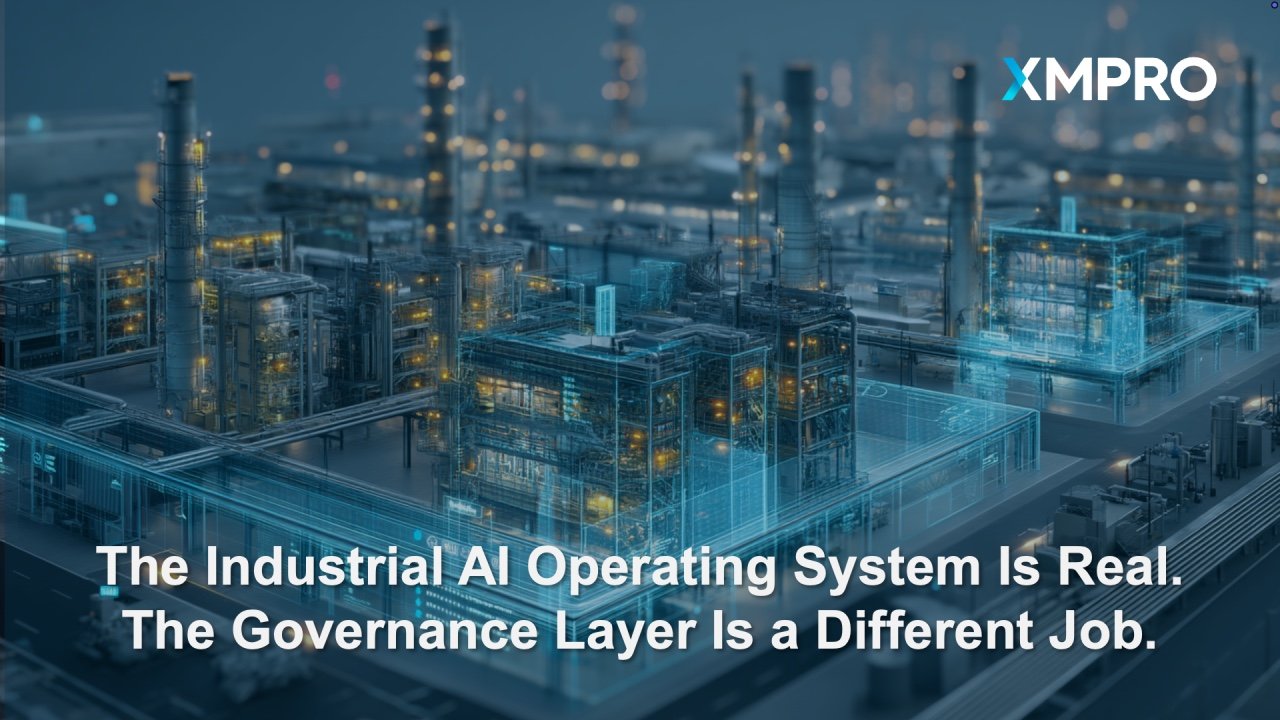
Siemens and NVIDIA announced at CES in January that they are building the Industrial AI operating system. Hannover Messe this week is the amplification.
For anyone building an agent strategy for industrial operations, the question is not whether that operating system exists. It is what sits above it, and whether the buying committee is procuring one layer or three.
Three claims, one name
Over the last six months, three distinct claims have been compressed into a single category label.
The substrate claim is a statement about infrastructure: AI runtime, digital twin runtime, local models, device connectivity, and the data fabric that industrial systems run on. This is the operating system layer. It is about what the AI runs on. The orchestration claim is a different statement: which agent does what, when, and how coordinated action produces an outcome. Tool invocation, context injection, workflow binding, multi-agent coordination. This is about how an outcome is produced. The governance claim is a third statement: whether every agent decision is classified for autonomy, traced for provenance, and defensible under audit. EU AI Act readiness, IEC 62443 validation, ISO 42001 conformance, decision provenance that survives a regulator post-mortem. This is about whether the outcome holds up when something goes wrong.
These three claims look adjacent from the vendor side. From the buyer side they are three different procurements, three different risk registers, and three different review cadences. The framing has not yet reached the buying committee.
The SIS and BPCS precedent
The clearest analogy for what is happening now is already written into industrial standards.
IEC 61511 is built around a widely adopted design principle: the Safety Instrumented System should be separate and independent from the Basic Process Control System to the extent that SIS integrity is not compromised. Not as a best practice. As a design requirement for safety-critical facilities. The reason is structural, not philosophical. A single system cannot be both the actor and the auditor of its own actions without losing the ability to fail safe. Many high-hazard process facilities are built on this separation.
The same logic applies one layer up.
The substrate that executes an agent’s decision and the governance layer that classifies, traces and approves that decision need to be independent for the same reason. An OS vendor whose revenue scales with agent throughput carries an incentive mismatch when asked to rate-limit its own agents against a cross-vendor risk register. This is the SIS and BPCS separation, translated into agentic operations.
Every plant manager understands this intuitively. Every auditor understands it formally. The conversation about agentic AI governance is finally reaching the point where the industrial discipline of separation can be stated out loud.
Read-path and write-path
There is a second distinction buried inside the Industrial AI OS pitch, and it matters for how you evaluate any vendor’s claims.
The read-path is simulation, analysis, planning and scenario generation. Digital twins running what-if. Agents proposing actions. Generative designs evaluated before anyone touches a PLC. This is where the headline pre-physical simulation numbers live. Those are read-path results, inside read-path systems, and the scope should be read carefully.
The write-path is where an agent’s decision becomes an actuation, a setpoint, a work order, or a procurement commitment. This is where governance stops being a nice-to-have and becomes the thing a regulator audits. A headline read-path result does not translate to an equivalent write-path autonomy claim. Different risk envelope, different control boundary, different audit trail.
Buyers who procure an OS for read-path work and assume the write-path governance arrives with it are conflating two layers that the standards have always kept apart.
What the data is saying
Three numbers are worth keeping in the same frame.
Gartner’s finding that more than 40% of agentic AI projects will be cancelled by the end of 2027. The stated causes are cost, unclear value, and inadequate risk controls. The OS layer solves substrate reliability. It does not, on its own, solve unclear value or inadequate risk controls. That is the orchestration and governance work.
Recommended by LinkedIn
IDC FutureScape’s projection that up to 20% of Global 1000 companies could face significant lawsuits, fines, or CIO dismissals by 2030 directly tied to AI agent misbehaviour. Analysts are already projecting meaningful legal and governance exposure. The governance layer is where that exposure is managed.
ARC’s latest Axis 3 research separates industrial operators into Pacesetters and mainstream. Pacesetters, roughly 13% of the sample, are operationalising agentic systems with explicit governance scaffolding. The remaining 87% are running pilots without it. OutSystems puts the same gap in a different frame: 97% of enterprises are exploring agents, 12% have a centralised platform for governing them. An 82-point gap is where the next three years of cancelled projects come from.
Six things a buyer actually needs
The Industrial AI OS satisfies the first. The other five are adjacent work, often by adjacent vendors.
A substrate that runs reliably, with the right primitives for industrial AI. An orchestration layer that spans multiple substrates and selects the right agent for the right decision, regardless of which substrate that agent happens to run on. An autonomy classification framework that separates decisions that may be automated from decisions that require supervision from decisions that must stay with a named human. A decision trace that survives a regulator audit. Structured provenance, not log files. Operational context with enough resolution that agents fail safely when they encounter a state they do not recognise. A compliance posture tied to the frameworks that actually apply: IEC 62443, ISO 42001, NIST AI RMF, and the EU AI Act as its provisions phase in over the next two to three years.
Every tier-one operator already separates PLC vendor from SCADA vendor from historian from MES. Layering agentic operations governance on top of the industrial AI OS is an extension of the same discipline.
The three-layer map
Name the layers, and attach them to the buyers.
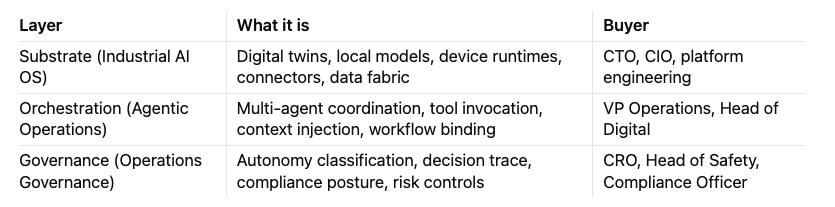
Three procurements, three buyers, three contracts. The same discipline the industry already applies to SIS and BPCS, historian and MES, PLC and DCS. Nothing new in the pattern. Only new in the layer.
What to do next week
When the Industrial AI OS proposal returns with you from Hannover Messe, read it as what it is: a substrate offer. Sign it for that scope. Then run orchestration and governance as adjacent procurements, with their own buyers, their own success criteria, and their own review cadence. The separation already implied by the OS vendor’s own governance partnership is the template.
For the systems integrators, the industrial AI agent governance practice is largely uncovered. Public evidence of dedicated industrial agent governance leads among the major SI firms is not yet prominent. That is white space, and it will not stay white space long.
For the analysts, do not let “Industrial AI Operating System” become the category name that absorbs all three layers. Forrester’s framing that physical AI matters more than humanoid robots is closer to the right shape. The category should be named at the layer where the buyer feels the pain, and that layer is not the OS.
The Industrial AI operating system is real. The governance layer is a different job, and it sits above it.
Pieter van Schalkwyk is the CEO of XMPro, the Agentic Operations platform for industrial enterprises. Pieter is lead author of the Digital Twin Consortium’s Industrial AI Agent Manifesto (2026).
If you want to explore what the orchestration and governance layers look like in your operations, reach out to Gavin Green or visit the XMPro GitHub repo for open-source resources.
Subscribe to The Digital Engineer newsletter for weekly perspectives on agentic operations and the future of industrial intelligence.
This article originally appeared on XMPro CEO’s LinkedIn blog, The Digital Engineer, on 23 April 2026.