
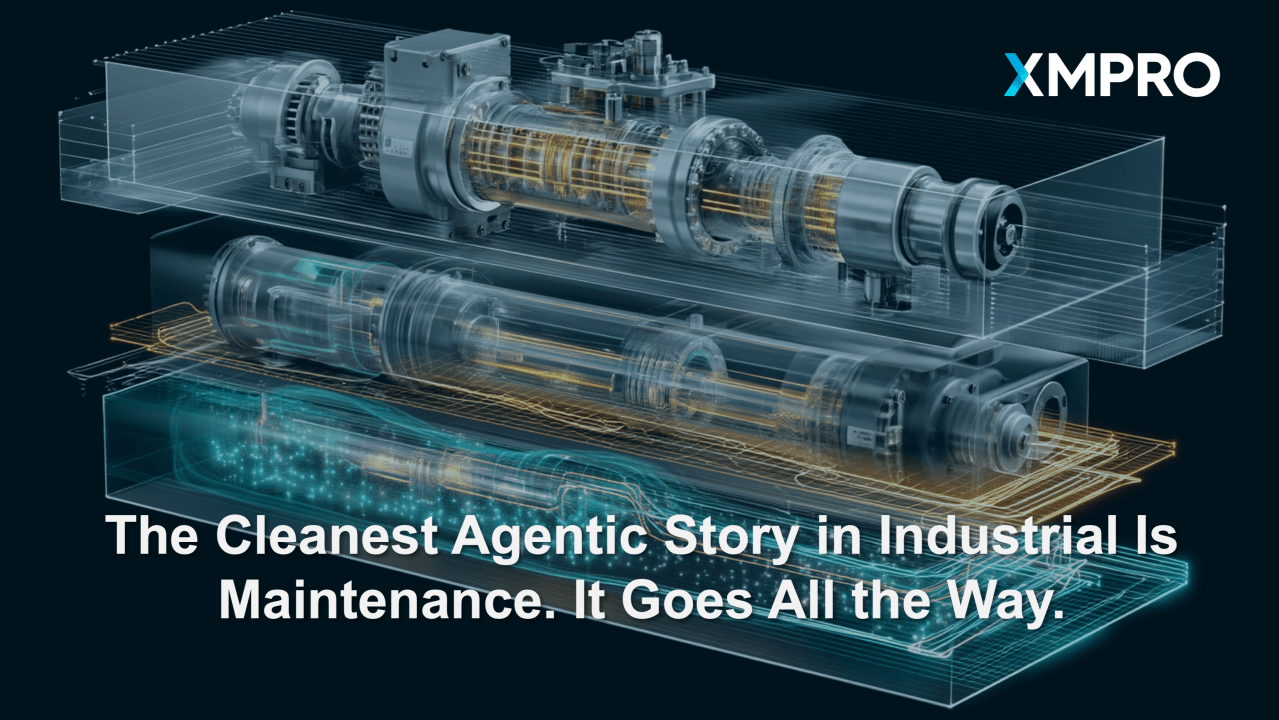
The Cleanest Agentic Story in Industrial Is Maintenance. It Goes All the Way.
Seema Amble at a16z published a piece this week arguing that software is losing its head. The thesis: agents do not need a UI, so the moat moves from the dashboard to the data, the action layer, and the operational context. The piece reads horizontal-SaaS shaped. CRM, ERP, Salesforce, SAP.
In industrial, the same word means something different.
The plant never had one head. It had many.
The reliability engineer reading vibration signatures. The maintenance planner working a queue. The scheduler coordinating against operations windows. The supervisor escalating when the alarm pattern looks wrong. The root cause analyst reconstructing what failed and why. Each is a different head, doing different work, carrying a different slice of institutional memory.
Going headless on the plant floor means replacing each of those heads with a governed agent team, one domain at a time, while keeping the audit trail a regulator will accept.
Most venture commentary on agentic operations describes one domain. The deployed work lives in another.
The domain that already reaches HAS 5
Process supervisory operations is the domain most industrial buyers picture when they hear agentic operations. The agent that opens the valve, sets the setpoint, takes the closed-loop action. IEC 61511, SIS/BPCS separation, regulator-grade audit. It is the headline of the category. It is also the slowest domain to scale, because the governance envelope is the strictest.
Maintenance is a different domain. It does not blow up a unit when it gets a call wrong. The worst case is a planned outage that did not need to happen, or an unplanned failure the team should have caught. Real money, real OEE impact, no fatality.
Because the safety envelope is lighter, maintenance is also the domain where multi-agent teams have reached HAS 5 in production. HAS is the Human Agency Scale. It runs from visibility at HAS 1 to full autonomy at HAS 5, with humans on the loop overseeing exceptions rather than driving every decision.
Detection of impending failure. Diagnosis of mode and severity. Work order generation with cost and risk weighting. Scheduling against operations windows and crew availability. Coordination across maintenance, operations, and supply chain agents that hold competing objectives. Root cause analysis after a failure, with a human on the loop for the conclusion.
That is HAS 5 work in a non-safety domain.
The reliability engineer’s pattern recognition lives in the system. The planner’s prioritisation logic lives in the system. The scheduler’s coordination calculus lives in the system. The supervisor’s escalation rules live in the system. Each of those heads was ten years of institutional memory walking around in a person. The agent team holds it permanently, applies it twenty-four hours a day, and tightens it every time a prediction proves out or fails.
The cleanest demonstration of agentic operations in industrial today is the planner who never retires.
What the maintenance domain actually contains
A deployed agentic maintenance capability runs as a portfolio of coordinated agent roles, not a single recommender. The roles are recognisable to anyone who has worked in a reliability function:
A detection agent watches sensor data, model outputs, and historical patterns. It calls a degradation when the signal pattern crosses a learned threshold for this asset class at this site. A diagnosis agent reasons about failure mode, severity, and confidence. It pulls in maintenance history, similar failures on sister assets, and the operational context that explains why the signal looks the way it does. A planning agent generates a work order, estimates the labour and parts requirement, and ranks the work against the existing queue. It carries the cost-of-deferral logic a planner would carry. A scheduling agent coordinates the work against operations windows, crew availability, parts availability, and other planned outages. It negotiates with the operations agent when production has a strong window of its own. A coordination agent stitches the work across maintenance, operations, and supply chain. It holds the multi-objective trade-off when those three want different things on the same day. A root cause agent reconstructs what happened after a failure. It pulls the decision trace, the prior diagnoses, the engineer overrides, and the eventual outcome. The conclusion goes to a human reliability lead, who validates or revises.
Six agent roles. All six talk to each other. All six produce decision traces. All six run under a single governance envelope. Six agents working collaboratively towards an Objective Function. Measurable. Traceable.
The agentic substrate is the team architecture itself.
What the substrate has to provide
Every domain needs the same six capabilities. Maintenance is the cleanest example because all six are visible in the deployed work.
The access graph. Historian, DCS, MES, CMMS, ERP exposing data through connectors that handle the semantics, not just the values. A pump tag is a number with an asset class, a service condition, a maintenance history, and an operating envelope. Without the semantic layer, the detection agent is reading noise.
The operational identity layer. The semantic mapping that says what a vibration signature means on this pump class at this site under this duty cycle. This is the data the system uniquely causes to exist, in Amble’s language. It is the institutional memory the engineer carried in their head, now living in a form an agent can read.
The decision intelligence layer. Objective functions, utility functions, multi-agent negotiation logic. The reason the scheduling agent and the operations agent do not deadlock when they want the same window. This is the layer that turns six agents into one team.
The governance envelope. Gating on what each agent is allowed to do, at what HAS level, with what approval. The maintenance team operates at HAS 4 or HAS 5 across most of the arc, and the root cause conclusion still has a human on the loop. The envelope enforces both.
Recommended by LinkedIn
The decision trace. Six-coordinate provenance on every agent decision. Goal, reasoning, constraint check, tool call, human input, outcome. This is what a reliability auditor or an insurer asks for when a prediction proves wrong, or when a failure was missed.
The rollback path. What happens when the agent team gets it wrong. The work order that releases if the diagnosis is overridden. The scheduling decision that returns the window to operations. The model adjustment that takes effect after the next cycle, with the change captured in the trace.
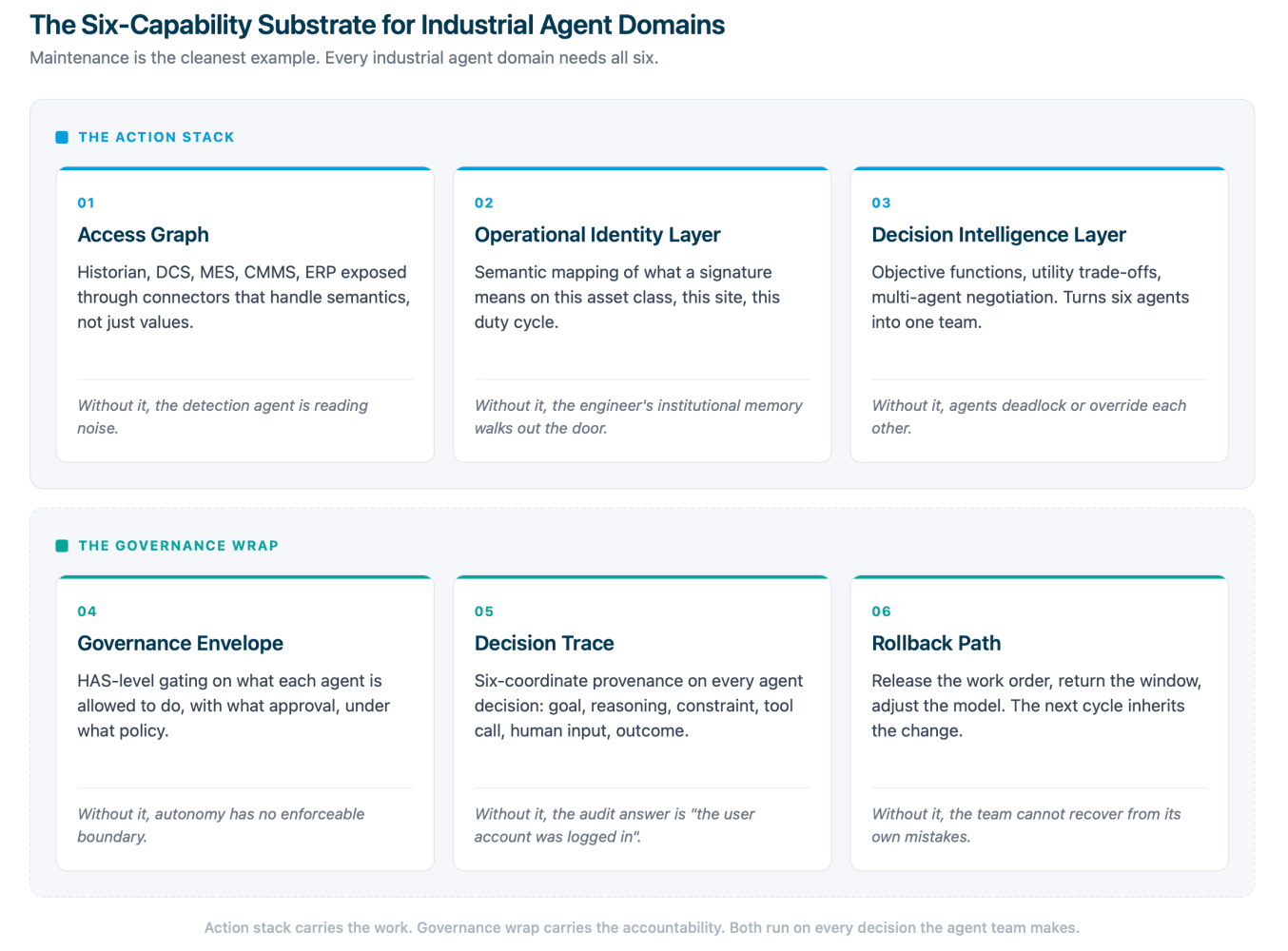 XMPro MAGS Agents Six Capabilities Substrate
Without all six, the maintenance domain stays at the recommendation layer. With all six, it runs end to end.
Why other domains follow
Once an operator has the substrate working for maintenance, the other domains are extensions of the same substrate.
Energy and yield optimisation uses the same access graph and the same operational identity layer. The objective function is different. The trade-offs are different. The governance envelope is the same architecture, configured for a different set of constraints.
Quality and safety surveillance uses the same trace architecture. The auditor changes, the audit format changes, the provenance pattern is identical.
Process supervisory operations is the hardest extension. The substrate stays the same. The governance envelope tightens. IEC 61511 enters. SIS/BPCS separation enters. The audit trail has to survive a regulator visit, not a reliability review.
That is why operators that have reached HAS 5 in maintenance often progress faster into other domains. The substrate is paid for. The team motion is established. The audit pattern is documented. The remaining work is per-domain envelope configuration.
Maintenance is the proof of substrate.
What this means for the buying conversation
Two questions separate the vendors that can do this from the vendors that cannot.
First: show me your decision trace on a prediction that proved wrong, and tell me how the trace fed back into the next cycle. A predictive recommendation engine cannot answer this, because the loop closes outside its boundary. A full agentic maintenance domain can, because the trace, the override, and the outcome all live in the same system. Second: show me how your maintenance agent team negotiates with your operations agent team when they want the same outage window. A single-purpose tool cannot answer this. A multi-agent operations capability can.
If the answer to either is hand-waving, the vendor is selling a recommendation engine and calling it agentic.
The customer who buys that hands the planning, scheduling, coordination, and root cause work to whoever comes next.
The category implication
Predictive maintenance is the first decision domain to reach HAS 5 in production at industrial scale. Its governance envelope is lighter than process operations, so the full arc runs today, not in 2028.
Operators framing predictive maintenance as “a recommendation engine that helps the engineer” are buying half a capability. Operators framing it as “an autonomous maintenance operations domain that runs end to end” are buying the substrate that carries every other domain on the plant.
The vendors that understand this difference will own the deals where the customer’s maintenance team is the budget holder. The vendors that do not will lose them to whoever can run a planner agent, a scheduler agent, and a coordination agent under a single governance envelope with a clean decision trace.
Going headless on the plant floor is a portfolio of agent domains, one substrate underneath all of them. Maintenance is the cleanest example in production today.
Pieter van Schalkwyk is the CEO of XMPro, specializing in industrial AI agent orchestration and governance. Drawing on 30+ years of experience in industrial automation, he helps organizations implement practical AI solutions that deliver measurable business outcomes while ensuring responsible AI deployment at scale.
He authored the Industrial AI Agent Manifesto, published by the Digital Twin Consortium in February 2026, a governance framework for trustworthy autonomous operations
Our GitHub Repo has more technical information. You can also contact myself or Gavin Green for more information.
Read more on MAGS at The Digital Engineer
This article originally appeared on XMPro CEO’s LinkedIn blog, The Digital Engineer, on 14 May 2026.