Should Multi-Agent Systems Negotiate?
Some decisions are negotiations. Almost no multi-agent system is built that way.
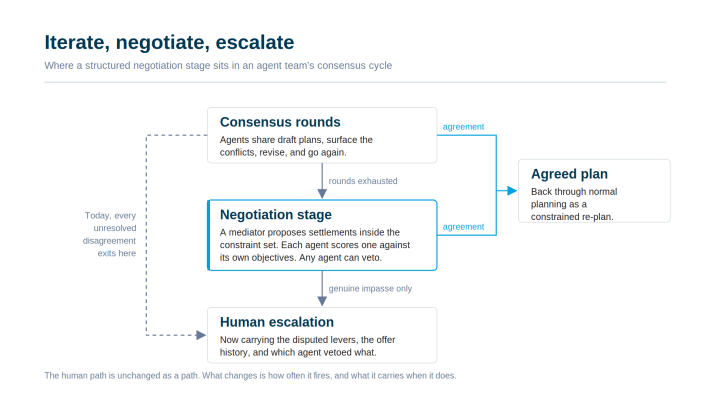
We put a consensus cycle into our MAGS agent teams from the start. When agents disagree about a plan they iterate: share draft plans, surface the conflicts, revise, go again. It settles many disagreements, though not all of them. When it cannot settle one, the system does the safe thing and escalates to a human.
The safe thing has a cost curve. One team escalating occasionally is governance. Fifty teams escalating every unresolved disagreement is a flooded queue, and flooded people approve by default. Human factors research calls the result automation bias, the tendency to accept the output of a system that is usually right without checking it. Parasuraman and Manzey pulled that research together in 2010, and the underlying vigilance work goes back to radar operators in the 1940s. A rubber stamp and a working control produce the same output while conditions are normal, so nobody sees the difference until the one case where it mattered. The EU AI Act names automation bias in Article 14, its article on human oversight, which makes an approver who clicks yes a compliance question rather than an ergonomic one.
Which puts the real constraint on autonomous operations somewhere most people are not looking. Agent capacity is cheap and getting cheaper, so you can run fifty teams. What you cannot scale is the handful of people who understand the operation well enough to settle an argument between two of them. Every disagreement that reaches one of those people spends a piece of the scarcest thing you have, and a system built so that every unresolved disagreement reaches them is a bottleneck with oversight written on the label.
I raised this on a call this week with Yasser Mohammad, Senior Research Scientist at NEC Corporation, Professor at Assiut University, and the researcher behind NegMAS, the open-source negotiation library that the international negotiation and supply-chain leagues run on. My hunch going in was that a good share of the disagreements we escalate today could be settled by negotiation. Structured negotiation, inside a rule set, with utility functions, walk-away floors and non-negotiable constraints, leaving an auditable trail. Agents bargaining within boundaries, never freelancing outside them.
He had long held that negotiation matters most across organizational boundaries, buyer and seller, where neither side can share everything. He now argues the internal case matters just as much. Inside one organization you could, in theory, replace negotiation with central optimization: pool all the data, solve for the optimum, tell everyone what to do. That requires an exact mathematical objective. In practice the objective is almost never exact, because nobody knows what tomorrow does to demand, yield, or a truck on the highway. His conclusion is that the negotiation process itself improves the objective.
The obvious objection is that agents you own bargaining with each other is central optimization with extra steps. It would be, if the optimum were computable. Optimization needs the weights to be right, and the weights are somebody’s estimate of what mattered at the last planning meeting: throughput counts for this much, energy cost for this much, a maintenance window deferred by a shift for this much. The limits are not estimates. A discharge temperature ceiling and a permit condition are written down and checkable, and they bound every settlement, which is why bargaining inside them cannot produce an unsafe answer, only a different one.
When two agents on the same team want different plans, the gap between them is information about where their shared objective is underspecified. Forcing consensus discards that information. Escalating dumps it, raw, on a person who then has to reconstruct why two machines could not agree. Negotiation puts it to work: each agent’s position carries what its own data, beliefs and constraints say matters, and the settlement exposes a trade-off nobody had written down.
That matters for triage, and triage is where a person’s day is won or lost. In our multi-agent systems (MAGS) each agent holds an explicit belief state, grounded in the sequential decision analytics Prof Warren Powell developed at Princeton for decisions under uncertainty: what it thinks its actions do to the measures it cares about, with an honest error bar, tightened every time a real outcome comes back. An agent’s position therefore moves for a reason you can read. And when two agents deadlock, the record shows whether their beliefs diverge, which more evidence can settle, or their objectives genuinely differ, which no amount of evidence will.
Run that distinction over your own escalation queue this week, with none of this machinery in place. Take the last twenty decisions your team pushed to a person and sort them into two piles. In the first pile the parties disagreed about what would happen: different data, different histories, different confidence in the same lever. In the second they agreed about what would happen and disagreed about what to want, throughput against energy cost, this customer’s order against that one’s. The first pile does not need a person’s judgment. It needs the two parties to see the same evidence. The second pile is the one a person should be spending the day on. If your queue is mostly the first pile, you are running an evidence problem through a governance process, and adding approvers will not fix it.
Repeatability is the harder objection. An operator agent cannot charge this price today and another price tomorrow with no explanation why. Yasser’s version on the call was blunter: this price to this counterparty, that price to that one, and now someone is explaining themselves to a regulator.
So the part that closes a deal has to be boring, and it has to be separable from the part that decides what to want. The agents strategize, the mathematics negotiates. We are testing exactly that split in the open, in the Automated Negotiation with Digital Twins and MAGS testbed that NEC leads with XMPro under the Digital Twin Consortium’s testbed program. In the supply chain scenario, one agent represents a just-in-time assembly line and another represents its battery supplier, renegotiating an eight-shift delivery schedule as market conditions move. Each agent decides two things: how much it values each delivery slot, and its walk-away floor. That is its whole input to the negotiation:
U(o) = w₁u₁(o₁) + w₂u₂(o₂) + … + w₈u₈(o₈), accept only if U(o) ≥ r
Eight weights saying what matters, and a floor below which no deal beats walking away. The deal itself is closed by the NegMAS bargaining engine running a well-studied alternating-offers protocol. No language model makes an offer, concedes a point, or declares a deal. There is no generative AI in the bargaining engine at all. We checked the source, and the machinery is game theory and classical statistics that was closing deals in research labs long before GenAI existed. Same positions in, same agreement out, auditable down to the individual offer. A full negotiation settles in about a second, and when there is genuinely nothing to trade the agents walk away, which is also the correct answer.
Recommended by LinkedIn
Supply chain is the obvious application and it is where we are proving the machinery. The internal case is the one I think is larger, because an agent team already holds everything a negotiation needs: weighted objectives, utility functions that say how much each lever matters, and hard constraints that mark what is never up for discussion. That is a negotiation domain. So where a team’s consensus rounds exhaust today, a third stage fits between forcing agreement and paging a person. A mediator proposes candidate settlements, filtered so that nothing breaching a constraint is ever offered. Each agent judges only whether a candidate beats the one on the table, by its own lights, and any agent can veto. Nobody has to reveal a weight.
 Your agents can scale, your approvers cannot
The change for the person on call is what arrives when it fails. Instead of a deadlock notice and two draft plans, they get the short list of what the team could not settle, the offers, and which agent vetoed what. That is a decision to make in minutes rather than an investigation to open, and it is the second pile rather than the first.
The human still gets the final word, and gets it for the cases that deserve a human’s judgment.
This is part of what separates operator agents from creator agents. A creator produces something and you inspect it. Operators work inside standard operating procedures and business rules, day after day, and their outcomes have to be repeatable, explainable and fair to every counterparty. For an operator, a settlement produced by deterministic game theory, steered by agents that can explain their positions, beats both a forced consensus and an exhausted approver.
Consensus assumes there is one right answer the team has not found yet. Sometimes there is no single right answer, only a trade that has to be made, and a team with no way to make it will keep handing that trade to the few people you could least afford to spend it on.
I think the next generation of multi-agent systems will be built by people who can tell which case they are in.
Pieter van Schalkwyk is the CEO of XMPro, specializing in industrial AI agent orchestration and governance. Drawing on 30+ years of experience in industrial automation, he helps organizations implement practical AI solutions that deliver measurable business outcomes while ensuring responsible AI deployment at scale.
He authored the Industrial AI Agent Manifesto, published by the Digital Twin Consortium in February 2026, a governance framework for trustworthy autonomous operations
Our GitHub Repo has more technical information. You can also contact myself or Gavin Green for more information.
Read more on MAGS at The Digital Engineer
How this was made: I worked with Claude to check sources, draft from my direction and edit. I do not publish anything I have not rewritten myself.
This article originally appeared on XMPro CEO’s LinkedIn blog, The Digital Engineer, on 3 September 2026.