
Physical AI Is Not New. The Decision Layer Is.
Oliver Hsu published a strong piece on a16z this week called “Frontier Systems for the Physical World.” His argument is that the dominant AI paradigm of language and code is extending into the physical world through three adjacent frontier domains: robotics, autonomous science, and new human-machine interfaces. He identifies five technical primitives that underpin all three: learned representations of physical dynamics, architectures for embodied action, simulation and synthetic data, an expanding sensory manifold, and closed-loop agentic systems.
It is a good essay. The primitives argument is correct. The cross-domain flywheel is real.
It is also framed as if physical AI is new. It is not.
The Industry That Has Been Doing This for Decades
Mining was among the first industries to deploy autonomous vehicles at scale. Caterpillar, Komatsu, and their operators have logged tens of millions of kilometres of driverless haul truck operation across Pilbara iron ore sites, Chilean copper pits, and Canadian oil sands. Not in prototypes. In 24-hour production, moving real tonnage, through real weather, with real consequences.
Car manufacturers and discrete manufacturers have been deploying robotics on assembly lines for forty years. Welding cells, pick-and-place, paint robots, vision-guided inspection. Tens of thousands of actuated systems running shift after shift, producing the vehicles and consumer goods that built the modern economy.
Oil and gas has been running closed-loop physical control through distributed control systems since the 1970s. Process plants have been running model-predictive control on reactors, distillation columns, and compressor networks for thirty years. Power generation has been running automated load-following with embedded physical models since before most of us finished school.
The actuation is not new. The sensors are not new. The closed-loop control is not new.
When the a16z essay lists its five primitives, industrial operators read that list and recognise most of it as their last three decades. Vision systems that guide robotic welding. Physics-based simulation models that tune process setpoints. Physical dynamics representations embedded in every advanced process control system. Expanded sensory modalities from vibration analysis to acoustic monitoring to hyperspectral imaging. Closed-loop control at millisecond frequency, running 24 hours a day across thousands of assets.
Industrial physical AI is not a new category being built by portfolio companies. It is a mature operational discipline that has been accumulating for four decades.
So if the actuation has existed at scale for this long, what actually changes now?
The Difference Is Not in the Action
A haul truck that drives itself is executing a motion plan. A welding robot that places a bead is executing a trajectory. A model-predictive controller that tunes a column is executing a control law. Each of these is a capable physical action. And each of them operates inside a narrow, pre-defined problem space where the decision about what to do has already been made by a human engineer during design or during shift planning.
The robot knows how to weld. A human decided which weld, on which part, in which sequence.
The truck knows how to drive the haul route. A human decided where the route goes, when to run it, and which pit it serves.
The controller knows how to hold the column at setpoint. A human decided what the setpoint should be, and when to change it.
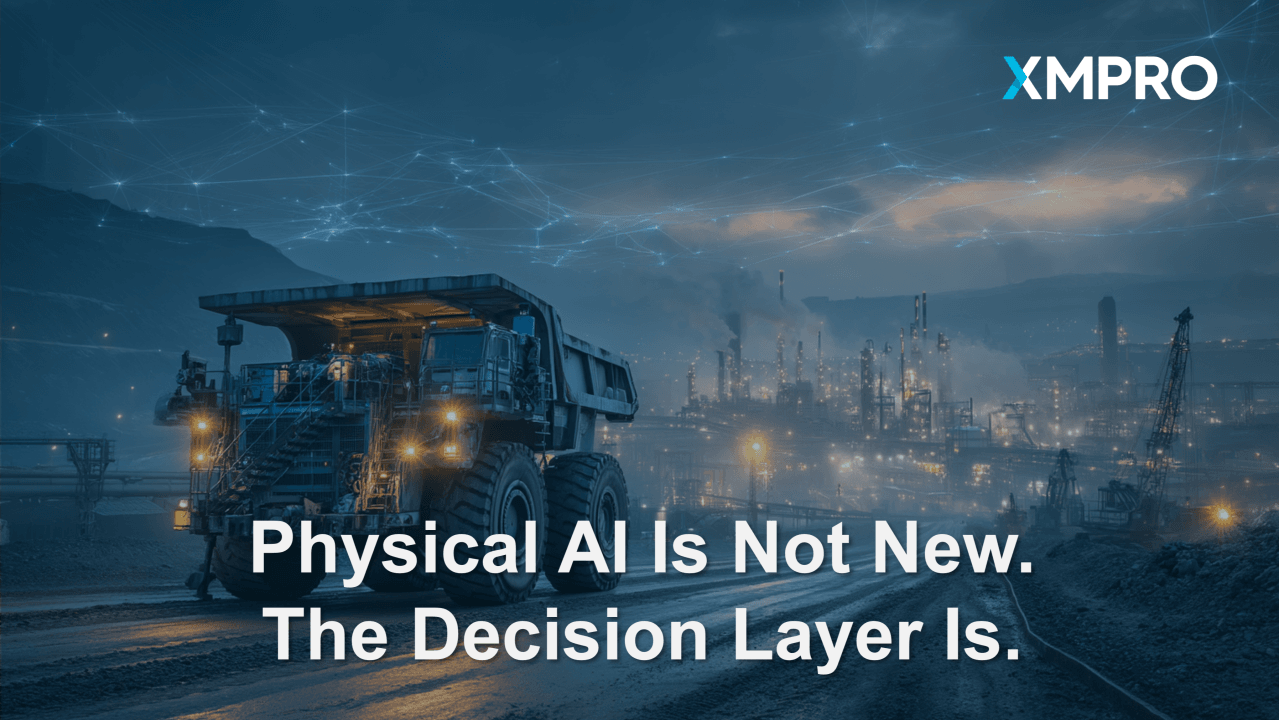
This is where the real frontier sits. Not in the act, but in the decision that determines what the act should be.
Agentic AI is the first technology category that can materially contribute to that decision layer in industrial operations. It is not the automation of action. It is the automation of the reasoning that determines which action to take, under what conditions, with what trade-offs, at what time. That is a structurally different problem from the one actuators and controllers have been solving.
The decision layer is where the real innovation is running right now. It is where the new primitives that a16z describes actually land in industrial operations. And it is the layer that forty years of PLCs, DCS, robotics, and autonomous vehicles never attempted to solve.
The Convergence That Makes the Decision Layer Possible
The mistake that a16z’s essay invites, without intending to, is the assumption that physical AI is the interesting thing. It is not. The interesting thing is the convergence.
You cannot look at physical AI in isolation. It only produces operational value when it runs inside a stack that also includes several other technology categories, each of which has matured independently, and each of which now composes with the others for the first time.
Five categories converge in an operational agentic system. Remove any one, and the system cannot make a reliable operational decision.
Digital twins. The physics-based simulation models and real-time asset representations that have been maturing in industrial operations for twenty years. A digital twin lets an agent test a proposed action before committing to it, reason about consequences across a coupled physical system, and validate the current state of the asset before issuing a command. Digital twins are the physical grounding layer. Classical AI. Predictive models, anomaly detection, condition monitoring, computer vision. The category of machine learning that has been running quietly in industrial operations for fifteen years, producing the early-warning signals and the pattern-recognition layer that feed into every operational decision. Classical AI does not get the headlines that generative AI gets. It is the workhorse. Agentic AI. The reasoning and coordination layer that can compose the above into a decision. An agent that can read the digital twin, consult the predictive model, interpret the anomaly alert, reason about the operational context, and decide whether to act, when to act, and how to coordinate with other agents doing related work. Physical AI. The new layer that a16z describes. Vision-language-action models, embodied architectures, learned representations of physical dynamics. The layer that extends what the actuators can be told to do, beyond what a hand-coded motion plan can express. Governance. The layer that makes the other four deployable in environments where mistakes have physical, safety, and regulatory consequences. Objective functions that state what each agent is optimising for. Utility functions that handle trade-offs when objectives conflict. Immutable audit trails that survive incident reviews. Human-on-the-loop oversight where autonomy meets risk.
No single one of these categories is the frontier. The frontier is the composition.
The reason operators could not previously automate the decision layer is not that they lacked capable actuators. They had those. The reason is that they lacked the four other layers in a form that could compose with each other. Digital twins existed, but agents could not read them. Classical AI produced alerts, but nothing reasoned about what to do with them. Physical AI models could control a manipulator, but not within a governed operational policy. Governance existed as procedure manuals and permit-to-work systems, but not as a machine-readable constraint on an autonomous system.
The compounding happens when all five run in the same stack. That is what is new.
Why This Matters for How the Essay Lands
The a16z essay is going to be read by every CTO and chief digital officer in industrial operations this week. It will be persuasive. It will be cited in strategy briefings. It will frame budget conversations for the next two quarters.
The framing that the essay invites, without stating it directly, is that physical AI is the next frontier and that the vendors named in the essay are the ones building it. That framing is incomplete in three specific ways.
First, it implies that physical AI is a new industrial capability. It is not. The industrial physical AI stack has been running at scale for decades. What is new is not the physical action. It is the decision architecture that sits above it.
Recommended by LinkedIn
Second, it implies that physical AI is the interesting technology layer. It is not. The interesting layer is the convergence of digital twins, classical AI, agentic AI, physical AI, and governance into a single operational stack. Any of these layers in isolation is a capability. Only the composition is an operational system.
Third, it is silent on governance. The word does not appear in the argument. Safety appears briefly, as a feature of closed-loop monitoring. Regulatory standards like IEC 62443, EU AI Act, and NERC CIP do not appear at all. This is the structural blind spot of the language-and-code AI industry moving into physical domains. It is also where the deployability gap lives. A capable system without governance is a demo. A governed system is an operational asset.
What the Decision Layer Looks Like in Practice
A mining haul truck drives itself across a pit. That has been true for fifteen years. The new question is not whether the truck can drive. It is whether the overall operation can reason about what the truck should do.
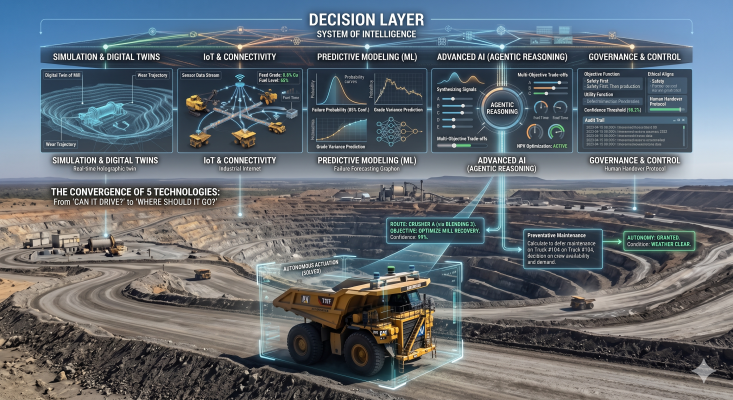 Created with Gemini
Which route serves the mill best given current feed grade? That is a decision about objective trade-offs between throughput, grade blending, and energy cost. It requires a digital twin of the mill, a predictive model of feed grade variance, a computer vision read on the stockpile, and an agent that can reason about all three at the same time.
When should the truck be taken out of service for maintenance? That is a decision about balancing availability risk against maintenance cost. It requires anomaly detection on component health, a digital twin of the wear trajectory, a classical predictive model on failure probability, and an agent that can weigh those signals against the operating schedule and the maintenance crew availability.
Under what conditions should the truck yield autonomy to a human driver? That is a governance decision. It requires an objective function that states what the operation values, a utility function that handles trade-offs, a confidence threshold calibrated to consequence severity, and an audit trail that records why the system made the call it made.
None of these decisions are actuation problems. The truck can drive itself. The decision layer is what determines whether it should, where it should go, how long it should run, when it should stop, and when to hand back control to a human. That is where the frontier lives. That is where the convergence of the five technology categories does actual work.
This is the layer industrial operators are starting to build. It is the layer that was not possible before agentic AI matured. And it is the layer that makes the last four decades of industrial physical AI compound into something structurally new.
The Industrial Innovation Is Decision Architecture
If you run an industrial operation, the question the a16z essay raises for you is not whether to invest in physical AI. You have been investing in physical AI for decades. Your assembly lines are physical AI. Your process control is physical AI. Your autonomous haul fleet is physical AI. Your condition monitoring is physical AI.
The question the essay should be raising, but does not, is what decision architecture sits above your physical AI stack.
Three questions to bring into any vendor conversation about agentic systems for industrial operations.
Can the agent see the whole stack. If the agent reasons only about its own layer without access to the digital twin, the classical AI, the anomaly signals, and the operational context, it is not a decision system. It is an isolated tool. The decision layer only produces value when it can compose across the five categories.
What does the agent optimise for, and how does it trade off when objectives conflict. Throughput versus yield versus safety margin versus energy cost. These are real-time multi-objective decisions. Without explicit objective functions and utility functions, an agent cannot make these trade-offs in a principled way. It will optimise for whatever the underlying model defaults to, which is nothing in particular.
What does the audit trail look like when something goes wrong. Industrial decisions are auditable not because governance is paperwork, but because consequential decisions in regulated environments require traceable reasoning. If the agent cannot produce a structured record of what it decided, why it decided it, what inputs it used, and what alternatives it considered, it is not deployable in a safety-critical operational environment.
The vendors that can answer all three are the ones building the decision layer. The vendors that treat these as configuration questions are selling you more physical AI capability on top of a stack that already had plenty of capability. The bottleneck is not capability. It has not been capability for a long time.
Physical AI Is a Solved Category. Decision Architecture Is the Frontier.
Oliver Hsu and the a16z team have written a useful essay about where physical AI primitives are heading. The five primitives are correct. The cross-domain flywheel is real. The investor-tier confidence is warranted for the categories they are describing.
For industrial operations, the frame is different.
The physical AI primitives have been maturing inside industrial operations for four decades. Robotics in manufacturing. Autonomous vehicles in mining. Advanced process control in oil and gas, chemicals, and power generation. Computer vision in quality inspection. Predictive models in condition monitoring. Digital twins in process optimisation.
The new thing is not any one of these categories. The new thing is that agentic AI has matured to the point where it can compose across all of them, produce operational decisions that were previously the exclusive domain of human engineers, and do so inside a governance framework that makes those decisions deployable in environments with physical, safety, and regulatory consequences.
That is the actual frontier. Not physical AI in isolation. Not agentic AI in isolation. The convergence of digital twins, classical AI, agentic AI, physical AI, and governance into a single operational stack that can reason about an industrial operation end to end.
The industrial operators who understand this are not buying physical AI as a new category. They are integrating it into a decision architecture that already includes the other four categories. They are asking what the agent can see, what it optimises for, and what its audit trail looks like. They are treating physical AI as the newest layer in a stack they have been building for decades, not as a category that replaces the stack.
The actuation has been running for forty years. The decision has not. That is where the innovation is. And the innovation only compounds when all five categories run together.
Pieter van Schalkwyk is the CEO of XMPro. He writes about the intersection of industrial operations, AI agent systems, and operational strategy at The Digital Engineer.
If you want to explore what the decision layer means for your operations, reach out to Gavin Green or visit the XMPro GitHub repo for open-source resources.
Subscribe to The Digital Engineer newsletter for weekly perspectives on agentic operations and the future of industrial intelligence.
This article originally appeared on XMPro CEO’s LinkedIn blog, The Digital Engineer, on 17 April 2026.