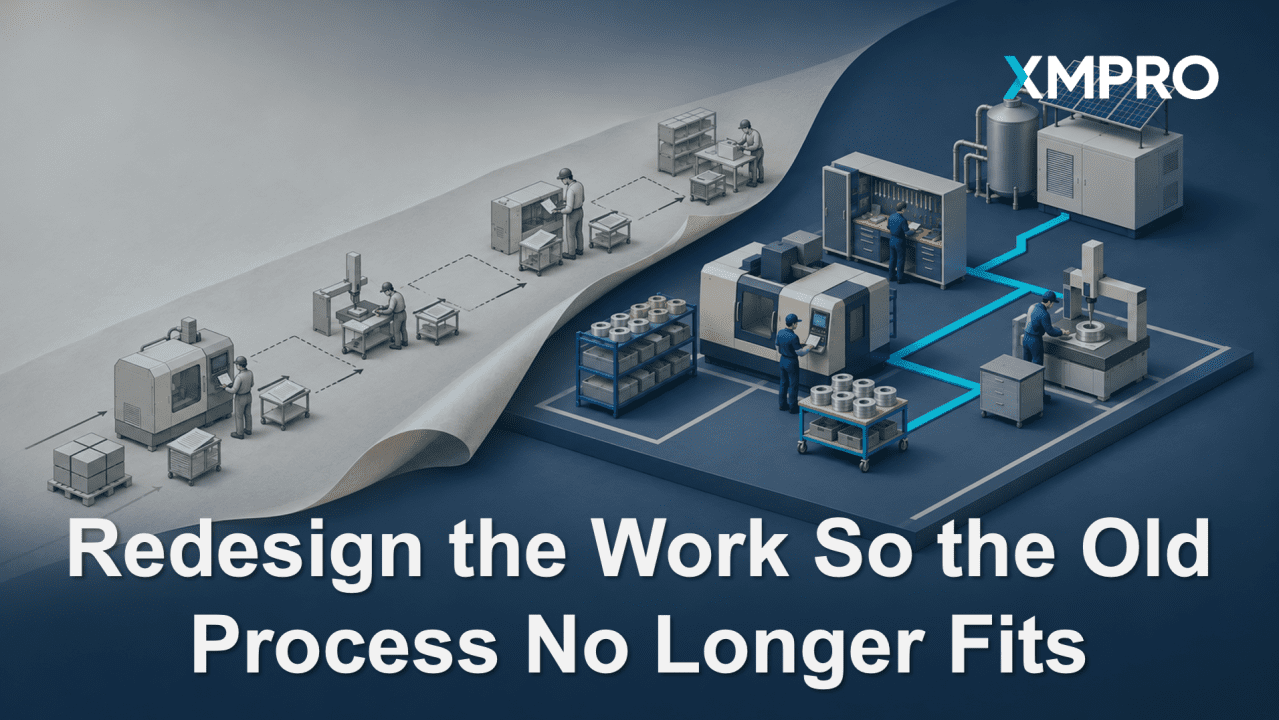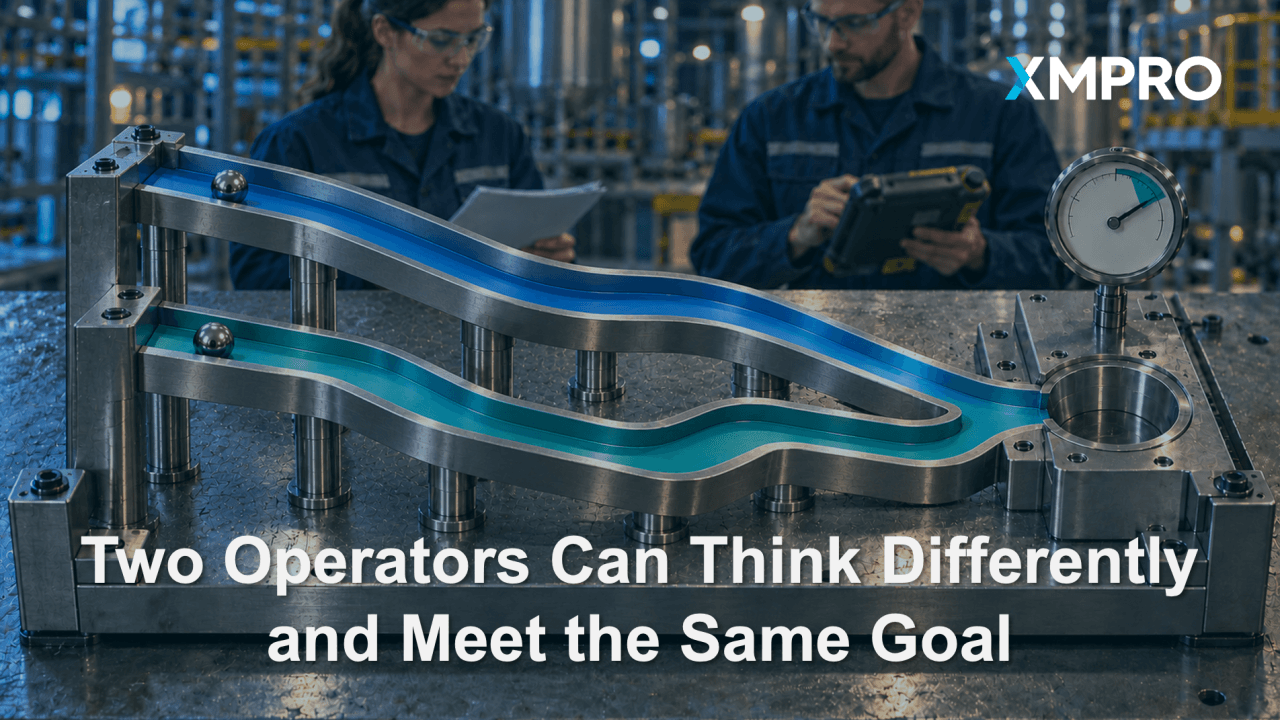

Model Selection Is the Easy Part. Agent Architecture Is Where the Work Is.
McKinsey’s chairman of Greater China, Joe Ngai, told Consensus Hong Kong in February that 98% of corporate executives report implementing some form of AI. When asked how much of that is deployed at scale, the number drops to less than 20%. When it comes to measurable profit impact, it’s 5%.
That gap doesn’t surprise me. I see it in every industrial sector we work in. The 93% sitting between “experimenting” and “profitable” aren’t failing because they chose the wrong model. ChatGPT, Gemini, and Claude are available to everyone. The gap exists because of how they architected their agents, or more precisely, because they didn’t architect them at all.
The Chatbot Over the Old System
Here’s the most common pattern I see. An operations team takes an existing workflow, a maintenance request process, a shift handover report, an anomaly notification, and puts a large language model on top of it. The interface looks different. The output is formatted better. The underlying decision logic hasn’t changed.
What they’ve built is a faster way to navigate a system that was already slow. The agent doesn’t reason about what the right action is. It helps users find what the old system already said.
This is process automation wearing an AI costume. And it explains why Gartner predicts over 40% of agentic AI projects will be canceled by 2027. It also explains why MIT’s GenAI Divide research found 95% of companies are seeing zero return despite $35 to $40 billion collectively spent. When you automate the wrong thing, scale doesn’t help. You just get to the wrong answer faster, at greater cost.
The 5% didn’t pick a better model. They asked a different question: not “how do we automate this workflow,” but “what is the decision that drives the outcome, and how do we architect an agent that can make it well?”
What Ngai’s China Observation Actually Tells Us
Ngai noted that Chinese companies have a different posture toward AI adoption. Unlike Western discourse, which focuses heavily on frontier models and AGI benchmarks, China’s approach is pragmatic: “There’s a lot less talk about the models. There’s a lot more talk around usage.”
That framing maps directly onto what separates the 5% from the 95%.
The organizations seeing bottom-line impact aren’t the ones with the most advanced language models. They’re the ones who spent their time on a harder problem: building agents that can observe real operational conditions, reason across competing variables, make decisions with consequences, and improve from outcomes.
The language model is one component in that architecture, and not the most important one. The decision logic, the memory structures, the objective functions, the governance boundaries: that’s the majority of what a production-grade industrial agent actually is. That’s also what most AI implementations skip entirely, because it requires understanding your operations deeply enough to encode them, and that work is harder than picking a model.
There is a second reason the pragmatic approach matters, and it doesn’t get discussed enough. **If your agent architecture is built on top of whatever a frontier lab ships next, you don’t own how your agents reason.**You inherit their design decisions, their priorities, and their constraints. Every model update changes agent behaviour in ways you didn’t choose. Every capability your competitors can access, you can also access, and vice versa. You have no moat.
The organizations building genuine competitive advantage in agentic operations are the ones treating the agent architecture itself as proprietary: the objective functions that encode their operational priorities, the memory structures that accumulate their institutional knowledge, the decision logic that reflects how their best engineers think. That’s not something OpenAI or Google can replicate for you. It has to be built deliberately, on a foundation you control.
At XMPro, when we look at what actually runs in production systems, the language model integration accounts for a small fraction of what makes an agent effective. The substantial majority is business process intelligence: how the agent coordinates decisions, manages memory, handles competing priorities, and integrates with the operational systems that hold the data that matters. That distribution isn’t unique to us. It’s the reality of what production-grade industrial agents require. The pragmatic approach Ngai describes is the one that invests in building that architecture rather than chasing the next model release.
The Three Decisions That Separate the 5% From the 95%
Looking at what industrial organizations with measurable results did differently, three architectural decisions come up consistently. These aren’t technology choices. They’re design commitments made before a line of code is written.
They designed for the decision, not the task.
The default instinct in most AI projects is to find repetitive tasks and automate them. That’s efficiency thinking, and it produces efficiency results: modest, incremental, rarely sufficient to show up in a P&L.
The organizations in the 5% reframed the question entirely. What are the decisions that actually drive our operational outcomes? A maintenance scheduling decision that balances equipment health, production continuity, spare parts availability, and technician utilization isn’t a task. It’s a multi-variable optimization problem with real financial consequences on both sides of every call. Building an agent that can hold all of those variables simultaneously, weight them according to your operational priorities, and act without waiting for a human to run the calculation is the design challenge worth solving.
Consider the difference in practice. A task-automated system sees a high vibration alert and creates a work order. A decision-architected agent sees the same alert and reasons: this bearing was replaced three months ago, a similar unit in the adjacent train failed at a slightly lower threshold last quarter, today’s production schedule has a four-hour maintenance window starting at 0600, and deferring beyond that window adds $180,000 in downtime risk. It recommends the 0600 window with a specific intervention approach, and it can show its reasoning. The task automation follows from getting the decision architecture right, not the other way around.
Recommended by LinkedIn
They gave agents the ability to reason, not just retrieve.
An agent that can only answer questions about what happened is a search interface. Industrial operations need agents that can reason about what is happening right now, what it means, what should be done, and what the consequences of different actions would be.
That requires a cognitive architecture built around four loops working together. Observation of current conditions from the actual systems that matter: sensors, historians, maintenance records, production schedules. Reflection using accumulated operational memory, so the agent can draw on what it has seen before rather than treating every situation as novel. Planning that accounts for system-wide effects, not just the local optimum. And execution that stays within defined safety boundaries while the agent acts.
Without all four working together, what you have is a sophisticated query tool, not an operational agent. Most of the AI implementations in the 95% stopped at observation. They can retrieve. They can summarize. They cannot reason. When conditions fall outside the patterns they were trained or prompted on, they fail silently, which is the worst kind of failure in an industrial environment.
They built in governance from the start, not as an afterthought.
Every decision an industrial agent makes is traceable to something: a sensor reading, a historical pattern, an objective function, a threshold. The organizations seeing results made those traces explicit and auditable before they deployed, not because compliance required it, but because an agent whose reasoning you cannot follow is an agent you cannot trust at higher autonomy levels.
Progressive autonomy, starting at “recommend, human approves” and moving toward “act, human monitors,” only works if the decision trail is legible at every stage. If you cannot see why an agent made a call, you cannot evaluate whether it was right. If you cannot evaluate whether it was right, you cannot justify giving it more autonomy. The governance architecture is how you earn the right to move up the autonomy scale. Organizations that bolt governance on after deployment rarely make it past the first level.
What “More Usage” Actually Means for Industrial Operations
Ngai’s pragmatic framing resonates because industrial agentic operations have always been about usage, not benchmarks.
A language model that scores at the top of reasoning benchmarks doesn’t automatically know how to balance throughput against equipment degradation at 2 AM when a bearing temperature is trending in the wrong direction. That judgment requires operational context that no general-purpose model arrives with preloaded. What does this equipment’s failure history look like? What are today’s production commitments and what is the cost of missing them? What does it cost if this fails unplanned at 3 AM versus taking a controlled shutdown now? Which maintenance crew is on call, and do they have the right parts in stock?
That context has to be deliberately architected into the agent’s memory and decision framework. It has to be structured, current, and retrievable at decision time. This is what makes Agentic Operations a distinct discipline from general-purpose AI deployment. The value isn’t in the model’s general capability. It’s in how precisely the agent’s architecture reflects the operational reality it is meant to navigate.
The organizations that outperform others build effective agents that genuinely knows their operations. Not through fine-tuning or prompt engineering alone, but through deliberate design of the memory structures that preserve operational history, the objective functions that encode what the organization actually optimizes for, the decision logic that mirrors how experienced operators actually think, and the governance boundaries that allow progressive trust to be established over time.
What This Means If You’re Evaluating AI Investment Right Now
The 98%/5% divide will not close by upgrading to the next model release. It will close when organizations stop asking “which AI vendor should we use” and start asking “what does the agent need to know, reason about, and decide in order to deliver operational value.”
That question produces a fundamentally different procurement conversation. Instead of evaluating demo quality and benchmark scores, you evaluate whether a platform gives you the architectural components to encode your operational knowledge: the decision logic specific to your assets, your production priorities, your risk tolerances, and your maintenance philosophy. You evaluate whether it supports progressive autonomy so you can build trust in agent judgment before you extend it. You evaluate whether every agent decision is traceable, reviewable, and improvable.
The success criteria shifts too. Instead of measuring how well the agent answers questions in a controlled demonstration, you measure whether it makes better decisions at the operational level where the financial impact actually lives: equipment reliability, production throughput, energy efficiency, safety performance.
The industrial enterprises that will be in the 5% two years from now are the ones making architectural decisions today. Not the ones with the most sophisticated AI strategy documents, but the ones who have sat down and asked: what are our highest-value operational decisions, what does an agent need to reason about them well, and what does it take to build that capability in a way we can trust and extend over time?
Less talk about models. More talk about that.
Pieter van Schalkwyk is the CEO of XMPro, specializing in industrial AI agent orchestration and governance. Drawing on 30+ years of experience in industrial automation, he helps organizations implement practical AI solutions that deliver measurable business outcomes while ensuring responsible AI deployment at scale.
About XMPro: We help industrial companies automate complex operational decisions. Our agent teams learn from your experts and keep improving, ensuring consistent operations even as your workforce changes.
Our GitHub Repo has more technical information. You can also contact me or Gavin Green for more information.
Read more at The Digital Engineer
This article originally appeared on XMPro CEO’s LinkedIn blog, The Digital Engineer, on 31 March 2026.