
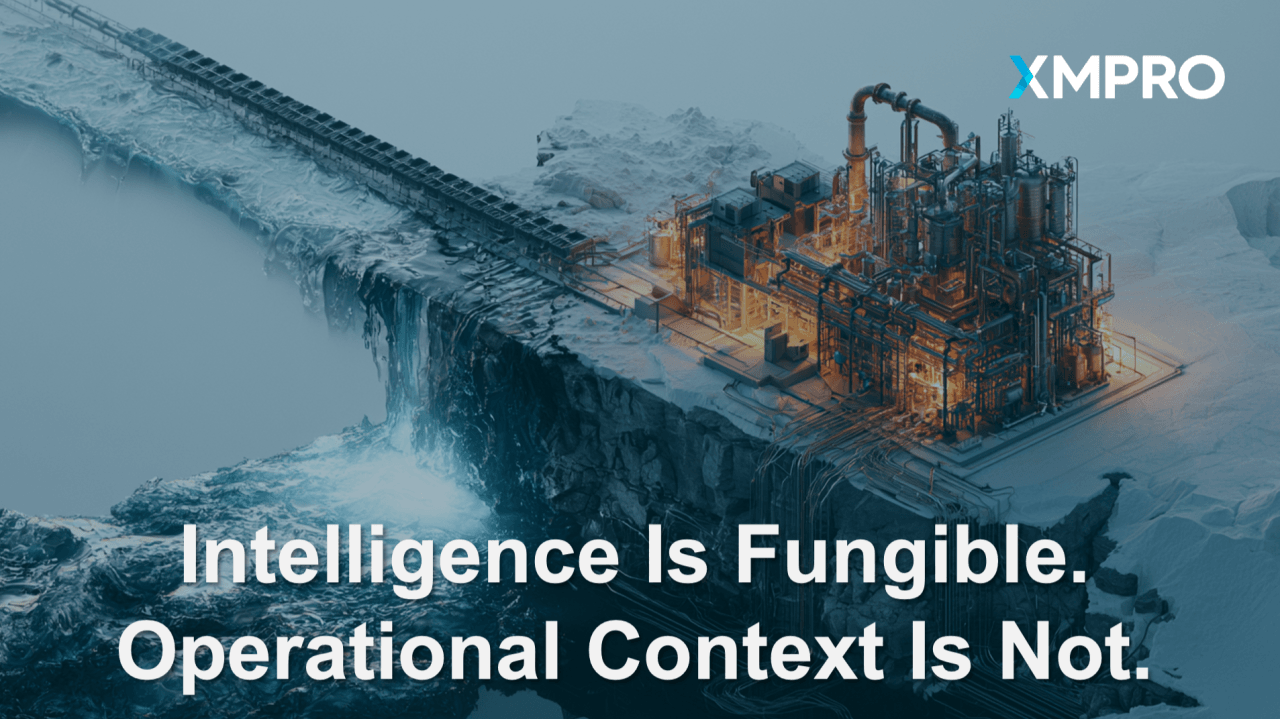
Intelligence Is Fungible. Operational Context Is Not.
For a model of equivalent performance, the price of intelligence falls about ten times a year. That figure is a16z’s own, from their analysis of inference pricing. The cost of knowing what your plant is doing right now has not moved.
Martin Casado , a general partner at the same firm, calls the shift underneath that first number the second of two modern miracles:
“AI has given us two modern miracles. The first one everyone knows, which is that we can turn electricity into intelligence. But the second one is more subtle but equally miraculous. It’s that we now have intelligence as a universal medium of exchange, in the form of tokens.”
Both are true. The second one is an economics claim, though, and economics claims can be tested.
A medium of exchange needs three things: a market, a unit, and a price. Tokens supply all three. I can buy a unit of intelligence this morning from any of a dozen suppliers, compare what each charges, and move to a cheaper one next quarter without changing what I am buying. Prices fall, supply grows, and quality converges toward the middle, which is what markets in commodities do.
Now carry that frame onto a plant.
Operating a plant takes two inputs, and it makes no difference whether the operator is a person or an agent. You need intelligence. You also need the true state, right now, of the physical thing you are operating. Only one of those two has a market.
This holds the whole length of the autonomy continuum. Monitor and predict, where people make every call. Advise and guide, where something proposes and a person disposes. Coordinate and autonomize, where the loop closes without waiting for anybody. Authority shifts as you move along it. The context requirement does not shift at all. A panel operator reading a stale value and an agent reasoning over the same stale value arrive at the same wrong conclusion, and the only thing that separates them is how fast it spreads.
There is no bid for the state of D-401
You can price intelligence. Nobody sells the current condition of a specific vessel in a specific plant, so there is no vendor, no unit, and no going rate for what D-401 is doing at this moment. Every operator instruments it, names and maps and reconciles it, and pays the full cost once per site. That cost does not transfer to the plant next door, even when the plant next door runs the same equipment from the same supplier.
Intelligence is fungible, because one supplier’s tokens substitute cleanly for another’s. Operational context is specific to one asset in one configuration under one set of operating conditions, and its value collapses the moment you move it.
Context has a half-life
The second difference gets less attention and costs more.
A token I buy today is worth the same tomorrow. I can cache it, batch it, and keep the answer it produced. A pressure reading has a useful life measured in seconds, and what it becomes afterward is wrong data wearing the costume of a fact. Operational context is the only input in an operator’s stack whose freshness cost never amortizes. You pay it again every cycle. Buying it well last month reduces nothing you owe this afternoon, and buying it well this afternoon buys you nothing at all by tonight.
That perishability, rather than scarcity, is why intelligence on tap has not compounded into industrial autonomy.
The two curves move in opposite directions
a16z’s own analysis of inference pricing found that for a model of equivalent performance, cost falls about ten times per year. Meanwhile the cost of trustworthy operational context is flat at best. More assets get instrumented, more standards arrive, and more people are needed who know what a tag means. I cannot put a curve on that the way a16z can put a curve on tokens, and I am reasoning here, not measuring.
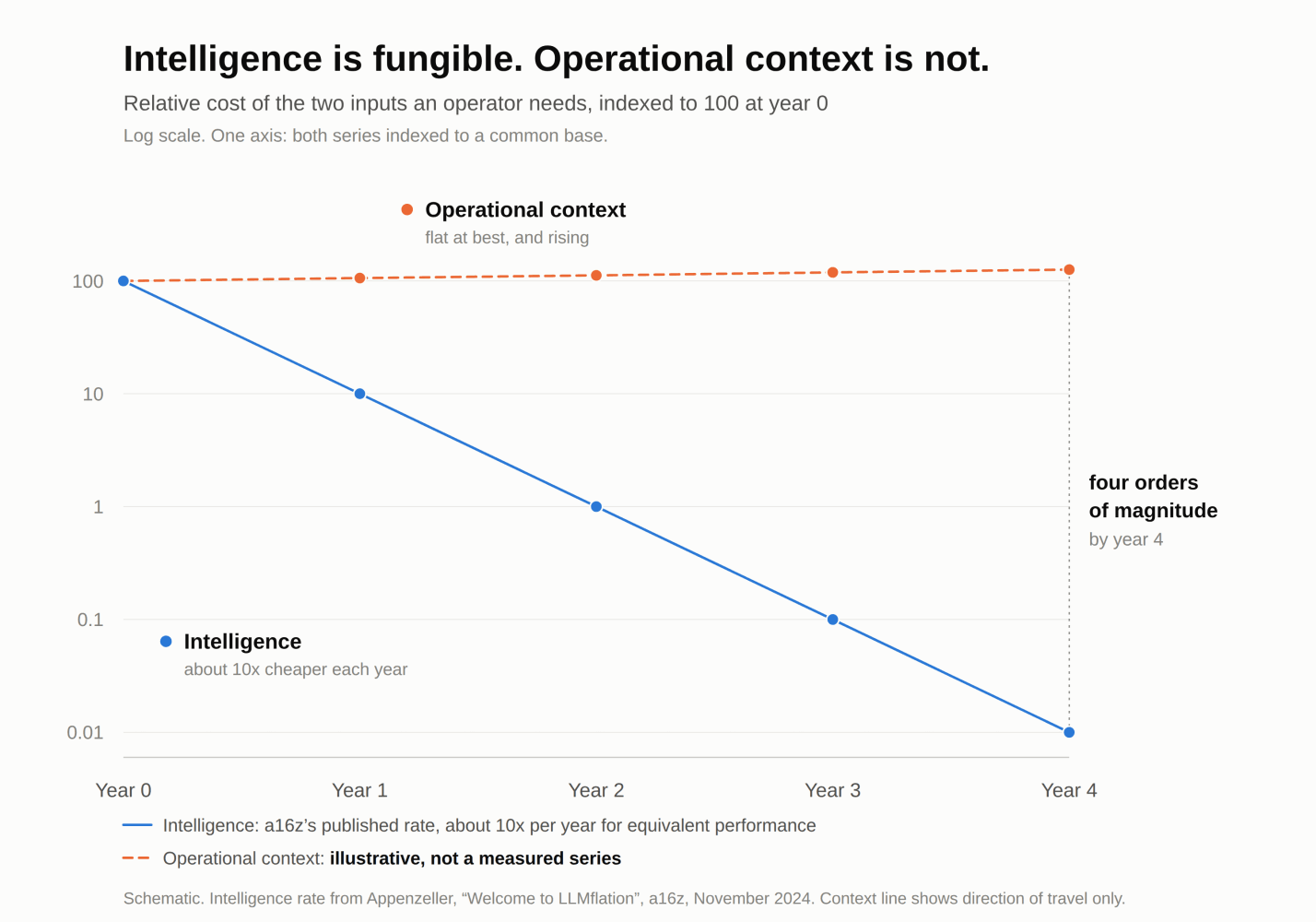 Future cost of context
The direction is not in doubt, and the direction is what matters. If intelligence gets ten times cheaper every year while the cost of knowing what is actually happening stays where it is, each model release widens the gap instead of closing it. Cheaper and better intelligence, put in front of an operator who cannot vouch for the state of the plant, does not produce better decisions. It produces wrong ones faster, more confidently, and at a lower unit cost.
That is worse than where we started, and it will arrive looking like progress.
Recommended by LinkedIn
What you can buy and what you have to climb
Ackoff’s knowledge hierarchy, set out in 1989, runs from data up through information and knowledge toward wisdom. People have argued about it ever since, reasonably, but its central assumption survives the argument: you climb it from the bottom, and each level is built out of the one below. What a16z describes is the first time anyone could purchase the upper levels without climbing to them. For an operator, the rungs that cannot be bought are the bottom ones, because data about this plant at this moment is not for sale anywhere. A person or an agent standing on a supplier’s summit with no base under it is the failure mode I keep being asked to explain.
What the code says
I counted, because I had asserted this before without measuring it.
Our MAGS agent runtime is about fifty-four thousand executable lines. Roughly four thousand eight hundred touch a language model at all, and most of that is seventeen or more supplier adapters at around a hundred and fifty lines each. The shape matters more than the ratio. We wrote almost no code in order to be intelligent. We wrote a great deal of code in order to stay indifferent to who supplies the intelligence, which is what you build when an input is fungible and you expect to keep switching suppliers.
The rest of the system does the other job. Getting current state out of historians, control systems, and equipment commissioned long before any of this existed, then keeping it current enough to decide on. In our stack that is the operational context engine and the data pipeline designer feeding it. The agent runs inside that layer and does not call it as a service.
I have written before that generative AI would become a general purpose utility, the way electricity did, and I still think so. A utility is a commodity by definition, and that is the point. A kilowatt-hour is identical everywhere, and that is exactly why it became a utility and exactly why plant state never will.
Standards will not make context fungible
The strongest push back is that operational context is becoming fungible too. Unified namespace, OPC UA, ISA 95, asset ontologies, and the whole standards effort exist to make plant data portable, so this reads as a transitional problem rather than a structural one.
Half of that is right. Standards commoditize the transport and the schema, and they are worth every hour invested. They do not commoditize the instance. Two refineries can implement identical standards perfectly and still share nothing that matters, because an operator needs to know what this specific unit will do in the next four minutes, and no schema carries that. The interface converges. The content cannot.
A narrower objection survives. Plenty of operator work tolerates context that is minutes or hours old, and cached state serves it fine. Agreed, and that narrows the claim without defeating it.
Three questions for your own stack
None of this applies to discovery work, where context is historical, intelligence really is the constraint, and the best available model earns its price. It applies to operating physical assets, whoever or whatever holds the authority, where reversing a decision is expensive.
If that is your situation, three questions are worth putting to whoever built it:
How old was the oldest piece of state your agent used in its last decision, and does anybody measure that number? If your model supplier halved its prices tomorrow, which blocked use cases would unblock? If the answer is none, intelligence was never your constraint. Who owns the freshness of operational context, and is that a named component with an owner, or an assumption nobody has written down?
Nobody is going to sell you the state of your own plant. Capturing it, though, is a known problem with known methods: working out which records across which systems refer to the same physical thing, recording what sits upstream and downstream of it, writing down the conditions under which its readings stop being trustworthy, and keeping track of who established each of those things and how far they should be trusted. The hard part is not the data. It is the knowledge your operation has never been able to write down. That is the problem our Operational Context Engine exists to solve, and it is the half of this I would rather talk about than the tokens.
The tokens will keep getting cheaper. That half is somebody else’s problem and they are solving it faster than anyone expected. Knowing what is true in your plant at three in the morning stays yours, it does not get cheaper because a model got better, and it is the half that decides whether any of the rest of it was worth buying.
Pieter van Schalkwyk is the CEO of XMPro, specializing in industrial AI agent orchestration and governance. Drawing on 30+ years of experience in industrial automation, he helps organizations implement practical AI solutions that deliver measurable business outcomes while ensuring responsible AI deployment at scale.
How this was made: the source, the thesis and the operational framing are mine, and I measured the code figures myself. I worked with Claude to check the argument against my back catalogue, which sent me looking for a sharper angle than the one I started with. Claude drafted from my direction and built the figure. I reviewed and rewrote the result before publishing.
This article originally appeared on XMPro CEO’s LinkedIn blog, The Digital Engineer, on 20 August 2026.