
Industrial Operations Solved AI's Measurement Problem in 1985
In the last few months, AI spend has started showing up on the operating review at most of the industrial firms I work with. The CFO asks the same question every time: what did each dollar of inference actually produce. In “The Token Budget Wars,” Jaya Gupta at Foundation Capital calls the answer the allocation layer: the discipline that maps token spend to completed outcomes, and then decides which workflows deserve more compute, which get capped, which run on cheaper models, and which stay human. The vendor who owns that layer, she argues, makes the allocation calls inside the customer’s operating model, which is where AI spend is actually decided.
She is right. And in industrial operations, that layer already exists.
That layer is older than most people realize. Total Quality Management forced it into every plant in heavy industry starting around 1985, the year I walked onto my first plant floor as a young mechanical engineer.
I made the upstream argument earlier this week in “Tokens Are Not the KPI”: the meter records input, and input is not work. Jaya’s allocation layer is what sits above that argument. It is what an operator does once the measurement is honest.
What Jaya is asking enterprises to build
Token-to-outcome attribution, in her framing, requires three things in sequence. The cost of completed work, including retries and corrections. The parts of an agent’s reasoning that mattered versus the parts that were thrashing. A clear signal on whether the work changed the operating model in a measurable way. Measurement becomes memory in this frame, where every agent trace becomes a durable record of how the organization actually decides under real conditions. That capability does not exist in most enterprises today.
Software companies are being asked to build it from scratch because the work being measured (PRs, commits, support tickets, deploy frequency) was only loosely instrumented before LLMs arrived in production. Jaya predicts those companies will experience the next phase of enterprise AI as a productivity measurement problem. The AI layoffs already underway in software are the early evidence.
Non-software enterprises, she argues, will experience the same transition as a transformation problem. The work itself (claims, underwriting, compliance reviews, supply chain exceptions, planning, dispatch) sits in different systems than the inference cost. Tying the two together requires multiple teams to agree on what they are measuring. That is exactly the problem industrial operations solved decades ago.
Industrial work was always priced in completed outcomes
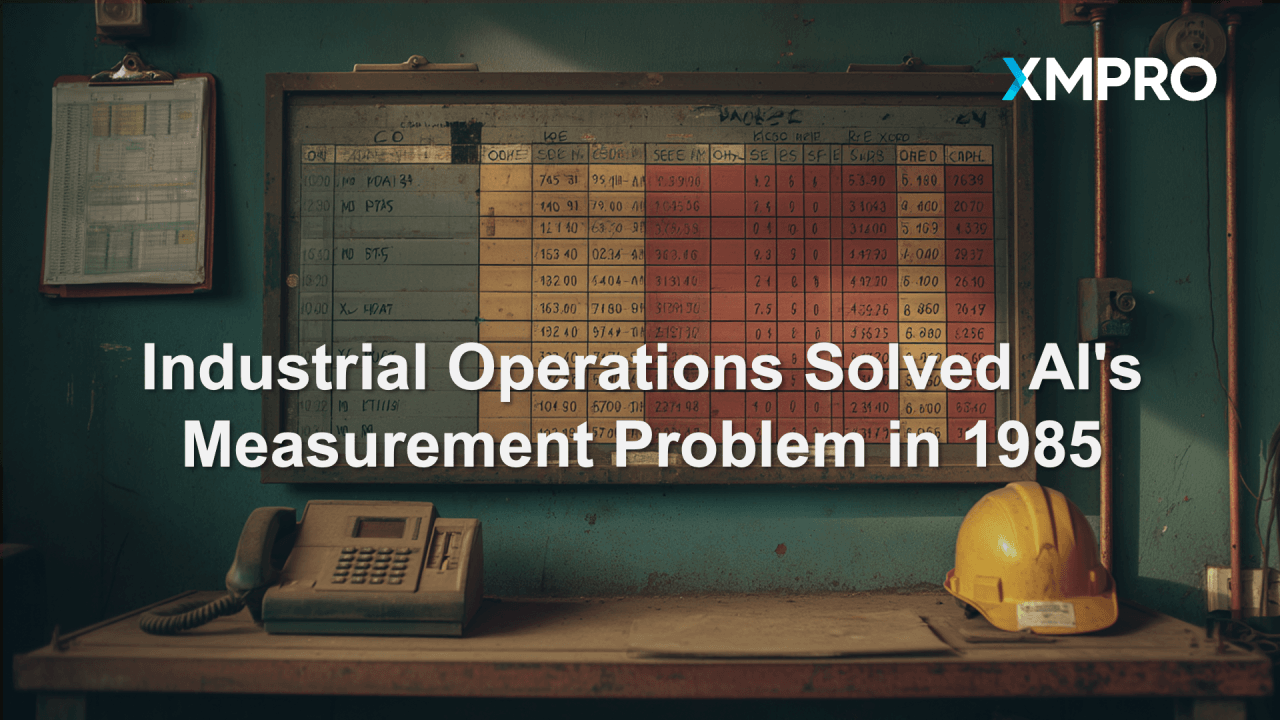
A maintenance work order is priced in completed units. So is a triaged alert, a production plan executed, a safety exception resolved, an inspection closed, and almost any other discrete piece of work the operations team can name on a shift handover. The OEE chart hanging over every plant floor is the original token-to-outcome attribution layer. It rolls up every action in the plant, whether human or machine, to availability, performance, and quality, and it puts a number on each of those dimensions every shift.
That discipline did not arrive with AI. It arrived around 1985, when Total Quality Management forced industrial enterprises to price every action against a measured outcome, and got reinforced by Six Sigma in the 1990s. Since then it has been sitting on the plant floor as Overall Equipment Effectiveness, predictive maintenance ROI, and reliability-centered maintenance. What industrial operators have always known, and what software companies are now relearning under financial pressure, is that the work has to be priced in the same unit as the outcome it produces.
Industrial enterprises did not need agents to teach them this. They needed insurers, regulators, and customers who paid for finished work rather than for inputs consumed along the way.
The allocation question, reframed for industrial AI
Jaya’s allocation question is the same question every operations center has been answering for human labor since the first refinery shift report was written. Which alarm goes to the L1 operator, which escalates to the engineer, and which triggers a callout in the middle of the night. Which inspection gets the experienced technician, which gets the apprentice, and which gets deferred until the next planned outage. These are allocation decisions, made every shift, in every plant, against a well-understood cost of being wrong.
Industrial AI does not introduce the allocation question. It changes the cast of available actors and the resource being allocated. The L1 alarm responder might now be an agent operating inside a defined safety envelope with a calibrated confidence threshold. The first-pass inspection might be a vision model that escalates anything below a defined confidence floor. The first draft of the production plan might be an optimizer-plus-agent stack that learns from how planners actually accept and revise its suggestions over time. The cost-per-completed-outcome lens Jaya is pushing software companies toward is the lens industrial operators already look through, with the additional discipline that the consequences of allocation errors are physical and sometimes irreversible.
The architecture difference
This is why the industrial AI version of Jaya’s transformation will not look like the McKinsey-plus-Palantir-alums playbook she describes for the Fortune 500 software stack. That playbook works when the transformation is fundamentally about getting an enterprise to agree on what to measure for the first time. Industrial enterprises already agreed. The agreement happened somewhere between 1985 and 2005 depending on the sector, and they wrote it into ISO 55000, NAMUR NA 138, IEC 61508, and the operational standards their insurers will not let them ignore.
Recommended by LinkedIn
The harder problem in industrial AI is governance. That means defining the boundaries inside which an agent can act and the conditions under which it must escalate to a human. It also means specifying the audit trail it must keep, the safety envelope it must never cross, and the regulatory regime it must operate inside on a continuous basis. The allocation layer in industrial AI sits inside the safety layer, which sits inside the regulatory layer, which sits on top of the physical reality of the plant itself. Those layers exist already, with decades of institutional memory and external accountability behind them.
A startup writing the token-to-outcome attribution layer for Fortune 500 software companies is building a measurement system. If the team is good, it delivers real value to its customers in twelve months. A startup writing the same layer for industrial AI is building a governance system that happens to also do measurement. It will take longer. The consequences of getting governance wrong include people getting hurt, plants getting damaged, and regulators getting involved. The two products are not the same product, and the industrial one cannot be retrofitted from the software one no matter how clean the underlying observability stack looks.
Where the trust to allocate actually comes from
Jaya’s closing claim is that the company owning token-to-outcome attribution makes the allocation calls, and once you make those calls you control where AI spend goes inside the enterprise. That claim is true. It is also a description of trust, and trust is earned in a different currency than measurement is.
In industrial operations the trust to allocate is earned by being right when the plant is down, by being honest when the cause is ambiguous, and by being conservative when the consequences are real and the recoverable failure modes are gone. Vendors who try to earn that trust by claiming to have token-to-outcome attribution will not earn it on the strength of that claim alone. Vendors earn it the slow way. They sit alongside operators through a real shift, take actions the operators can defend in the morning huddle, and absorb the embarrassment of being wrong well enough to improve the system the next time around.
The allocation layer is the prize. The trust to operate that layer is the asset. The asset compounds only when the system is anchored in outcomes that operators already measure and consequences that they already own.
The deeper version of the same thesis
This is the layer above the argument I made in “Tokens Are Not the KPI” earlier this week. That piece established the measurement problem: the meter records input, conflating that with work breaks the operating model, and dashboards built on token consumption cannot answer the CFO’s question. Jaya’s allocation layer is what sits above the measurement layer. It is where two disciplines come together: the measurement discipline of the upstream piece and the governance discipline of industrial operations. Between them sits the allocation decision, which is the call about which work goes where, at what cost, with what level of human oversight, and against what audit trail.
The software industry is about to discover what industrial operations has known since 1985. The first generation of that allocation layer will not come from a startup with the cleanest dashboard. It will come from the operators and engineers who have been doing this with human resources for decades, and who are now extending the same discipline to agentic ones. The allocation layer is the prize, as Jaya named it. In industrial AI, much of that layer has already been built. What is left is the agentic extension of a system that was running long before the token wars started.
The token wars are real. The deeper war is over who is trusted to allocate. In industrial operations the answer to that question is older than the question itself.
Related: Tokens Are Not the KPI
Pieter van Schalkwyk is the CEO of XMPro, specializing in industrial AI agent orchestration and governance. Drawing on 30+ years of experience in industrial automation, he helps organizations implement practical AI solutions that deliver measurable business outcomes while ensuring responsible AI deployment at scale.
He authored the Industrial AI Agent Manifesto, published by the Digital Twin Consortium in February 2026, a governance framework for trustworthy autonomous operations
Our GitHub Repo has more technical information. You can also contact myself or Gavin Green for more information.
Read more on MAGS at The Digital Engineer
This article originally appeared on XMPro CEO’s LinkedIn blog, The Digital Engineer, on 2 June 2026.