
Industrial Agents Will Fail the Volume Test
McKinsey’s cost model for agentic work is built on transaction volume. A plant does not run on transactions.
McKinsey put a number on something most agent programs have never measured. In the workflows they studied, tokens account for 20 to 25 percent of what it costs to run an agent. Human oversight accounts for 70 to 75 percent. Their advice follows from that arithmetic: stop tuning models and redesign the work so that fewer runs need a person to look at them. It is sound advice for a bank. In a refinery you cannot take it, because the reason a person reviews the decision is the same reason the decision is worth automating.
The piece is Where AI agents pay off, published on 24 August by Chandana Asif and four McKinsey colleagues. They are right about the ratio, and I have said much the same about token reporting myself. What does not translate to industrial operations, in my view, is the conclusion they draw from it, and that is the part industrial leaders will be asked about by their CFO this quarter.
The five minute review in their footnote
Look at the footnote under their first chart. The model assumes 10 to 20 percent of agent runs get reviewed by a person, and that each review takes about five minutes, at a fully loaded cost of around $100,000 per year per reviewer.
Five minutes at $100,000 a year is roughly four dollars.
So oversight is three quarters of the variable cost of running an agent, at four dollars a review. That tells you how thin everything else in the model is. It also names the kind of work being measured. A five minute review is a person checking that a system did the obvious thing on a form. It is the review you can do without leaving your desk, without calling anyone, and without asking what the plant was doing at the time.
Now price a review in a process operation. A proposed setpoint change comes back for approval. The process engineer pulls historian trends for the last two shifts. She checks whether the constraint that triggered it was the compressor or the ambient temperature, because those lead to different answers. She calls the shift supervisor to find out whether the unit was already coming down for a filter change. Someone asks whether the existing management of change covers this or whether a new one is needed. That review consumes several people and somewhere between hours and days of elapsed time, and it does not resemble four dollars at any point.
I have no audited figure for what that costs, and I am not going to invent one. The direction is not in doubt, though.
Their value test excludes most industrial work
McKinsey’s test for whether a workflow deserves an agent is scale. They look for high-value work with large pools of repeatable activity, where small improvements compound over thousands or millions of transactions. Their worked example is customer onboarding: 2,500 new customers a year costs $10,000 to $15,000 to run, and doubling the volume raises it only to $15,000 to $20,000. Fixed costs amortize. That is the whole engine of the argument, and inside a bank it works.
A gas plant does not have millions of runs. It has a turnaround planning cycle, a few blend changes a week, an equipment isolation call when something starts drifting, and a compressor decision that comes up when it comes up. Tens of consequential decisions a month, each one different enough that the last one is a poor template.
Apply the test as written and it tells you not to build the agent.
That conclusion is wrong, and it will be reached in a lot of operating companies this quarter, by capable people using a good framework on work it was not built for. The fixed costs in the McKinsey model never amortize in a plant, because the volume that does the amortizing is not there and never will be.
The same exhibit, drawn for a plant
Their Exhibit 3 counts the parts behind one completed onboarding: five to seven agents, more than three deterministic rules engines, and two to four teams of people providing oversight. Draw the same picture for one industrial operating decision and the first tile does not move. Across the themes we build for, maintenance coordination, scheduling, supply chain planning and process optimization, five to seven agents is the usual range there too.
Everything else is different from there. Three or so rules engines pulling from APIs become eight or more systems of record that were never built to agree on what the equipment is called (the context problem). The two to four teams become one process engineer who understands that unit, a supervisor, and whoever signs the management of change. The 2,500 onboardings a year, with a business case resting on doubling them, become tens of decisions a month.
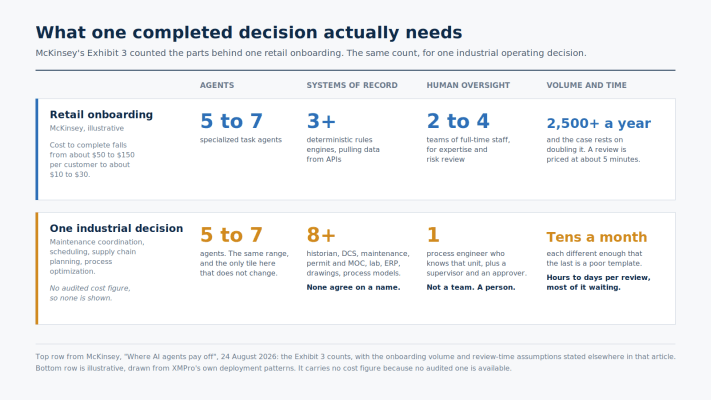
Figure 1. What one completed decision actually needs, McKinsey’s retail onboarding against one industrial operating decision.
The identical agent count is the useful part of that comparison. Whatever makes industrial agent economics different, it is not the number of agents.
Consequence is the industrial denominator
Industrial work has one advantage over generic knowledge work. **Its output is bound to physics and to a value stream.**A maintenance recommendation either reduces unplanned downtime or it does not. Nobody has to argue about whether the email was better written.
That changes what goes under the line. In a bank, a thousand small improvements add up to the business case. In a refinery, one avoided unplanned shutdown pays for the entire program, and the second one is profit. The compounding McKinsey wants across a million transactions happens in industrial operations across a handful of events that did not occur.
Which leaves industrial leaders with one lever they can pull. They cannot raise the run count. They can change what a single review costs.
Most of a review is spent assembling data
Watch what a reviewer actually does with the time. Very little of it goes on the decision. Most of it goes on rebuilding the situation the system was in when it decided.
That rebuilding has a pattern, and anyone who has done it knows the sequence. Open the historian and pull trends for the right two shifts. Open the maintenance system to see whether that pump was worked on last month, and open the permit register to find out whether the isolation is still in force. Find the current revision of the P&ID, which may or may not be the one on the wall. Check whether the tag in front of you means what you think it means, given that two sites named the same pump differently in 2019 and nobody ever reconciled it. Then call the one person who remembers why that valve was left in manual, and wait for them to come out of a meeting.
None of that is engineering. It is data assembly, and it is where the 75 percent goes.
Recommended by LinkedIn
The reviewer is not the only one paying for it. **An agent asked to make the same decision has to do the same assembly, from the same systems, with the same ambiguity about what a tag means.**Automate the decision without solving the assembly and the cost moves somewhere else. This is why we keep saying that the work is to engineer the decision and not the process. Assemble what the decision needs once, in front of the person and the agent both, and the white space between the systems stops being paid for twice.
A review gets cheaper under conditions that have nothing to do with model choice:
The signals, records and constraints the decision depends on are brought together before anyone asks for a decision, so the review starts from an assembled picture and not from six log-ins. The identity and meaning of the data are resolved first, so the review does not begin with an argument about whether two tags refer to the same asset. The reasoning path is recorded as it happens, so the reviewer reads what occurred instead of reassembling it from logs and memory. Constraints are carried as constraints, so the reviewer can see what the agent was not permitted to do. A proposed action can be tested against a validated model of the process before a person has to carry the risk of approving it.
None of that reduces the number of reviews. All of it reduces what a review costs, which is the only variable in the McKinsey model that industrial operations can move.
Reviewers are not interchangeable
That five minute footnote carries a second assumption, and it matters more than the five minutes. Pricing oversight at around $100,000 a year per reviewer treats reviewers as interchangeable, which is fair enough in a function where a hundred people can perform the same check.
A plant does not work that way. The person who can approve a change on that unit is the process engineer who understands that unit, and there is often exactly one of her, with a rotation to cover, a turnaround to plan and a graduate to supervise. You cannot buy a second one at any price the CFO would recognize.
So oversight in industrial operations is rationed by capacity and not by budget, and a queue that is capacity-limited does not clear by spending more money on it. It clears by making each item in it cost less of her time. Every hour that engineer spends assembling data is an hour she is not spending on the decisions only she can make, which is a cost that never appears on any agent cost model, McKinsey’s included.
That also changes what the agent is for. Its value does not show up as fewer engineers. It shows up as engineers who spend their week on exceptions and on judgment, because the routine work reaches them already assembled and already checked.
The trap in the 75 percent
That number has an obvious reading, and it is dangerous. If oversight is three quarters of the cost, remove the oversight.
McKinsey do not say this. They say the productive move is to redesign workflows to reduce exception rates and simplify the reviews that need costly human intervention, which is right. What they do not say is what makes a review simple, and in the absence of an answer, the cheapest interpretation wins. In high-consequence work the cheapest interpretation gets someone hurt.
The cost driver is the exception rate and the price of each review. Both are design outputs. Neither is a headcount decision.
The share of runs needing a human does fall over time, but it falls because evidence accumulated and someone made a considered decision to widen the agent’s authority, on the same architecture that was recording the evidence all along. This is the part of the McKinsey argument I would extend rather than contest. They are right that the economics are dynamic and need a standing review. The thing being reviewed, in an industrial setting, is how much authority the evidence now supports.
Four questions for the next review
For anyone holding a business case that has to survive a CFO who has read the McKinsey piece:
What does one review of this decision cost today, counted in people and elapsed days rather than in minutes. How many separate systems does the reviewer open before they can form a view, and how much of the elapsed time is waiting on a person. Whose time is it. If the answer is the one engineer who understands that unit, you have a capacity problem wearing a cost problem’s clothes. What would have to be in front of them for the approval to happen in one pass.
None of those need a vendor to answer. All four will tell you more about your agent economics than a token report will.
We build for the fourth question at XMPro, which is why the platform keeps a Decision Trace of what was observed, which constraints applied and who approved, and can front-run a proposed action against physics, economics and safety limits before anyone commits it. The argument holds without us. The questions are the point.
McKinsey have given business leaders a way to ask whether a workflow still justifies its spend, and that discipline is overdue. In a plant, the more useful question is what it currently costs to trust a single decision, and whether that number is going down.
Pieter van Schalkwyk is the CEO of XMPro, specializing in industrial AI agent orchestration and governance. Drawing on 30+ years of experience in industrial automation, he helps organizations implement practical AI solutions that deliver measurable business outcomes while ensuring responsible AI deployment at scale.
He authored the Industrial AI Agent Manifesto, published by the Digital Twin Consortium in February 2026, a governance framework for trustworthy autonomous operations
Our GitHub Repo has more technical information. You can also contact myself or Gavin Green for more information.
Read more on MAGS at The Digital Engineer
How this was made: I worked with Claude to check sources, draft from my direction and edit. I do not publish anything I have not rewritten myself.
This article originally appeared on XMPro CEO’s LinkedIn blog, The Digital Engineer, on 25 August 2026.