

Australia Cannot Afford to Fall Behind on AI
Australia cannot sustain a high-wage economy without becoming more productive. Yet our debate about artificial intelligence keeps returning to the jobs it might replace. We need to be equally direct about the businesses and jobs Australia could lose by moving too slowly.
This article was prompted by Ben Graham’s October 23 news.com.au report, ‘Hundreds of millions of people will lose their jobs’: Leading Aussie economist puts Canberra on notice. In his parliamentary evidence, Dr. Richard Denniss said that “the business model of AI is to generate mass unemployment.”
I consider that a dangerous framing. It moves from employers replacing paid labor to a conclusion about unemployment across an entire economy, without establishing what happens to demand, investment, new businesses, or new work. Denniss also acknowledges AI’s benefits and supports some Australian data-center investment. His questions about costs and displaced workers deserve answers. His testimony does not demonstrate that mass unemployment is the necessary result.
Some jobs will disappear. People affected will need practical support, and new jobs are not guaranteed to offset losses. I have argued in The Disaggregation of Labor that technology creates new areas of specialization across a wider economy. That gives me reason for optimism, but no reason to assume that the new work will be created in Australia.
The productivity problem is already here.
In February 2026, the Reserve Bank of Australia reported that labor productivity was around its 2019 level. Output per hour worked had made little net progress. The bank identified slower technology adoption, weaker business dynamism, and slower growth in the capital available to workers among the factors associated with the longer slowdown, while acknowledging that its causes are not fully understood.
The slowdown predates generative AI. The Reserve Bank documented weak productivity growth before the pandemic in Australia and other advanced economies. That means slower growth, not a continuous decline in output per hour.
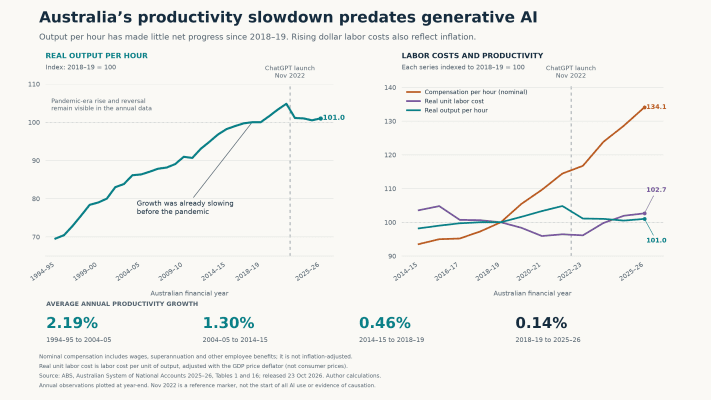 Australia’s productivity slowdown predates the generative AI boom. Real output per hour in 2025–26 was only about 1% above 2018–19. Higher wages need sustained productivity growth to support them. Source: ABS Australian System of National Accounts 20
I want Australians to earn more. High wages need productive businesses to sustain them. An experienced engineer dealing with fragmented information, unreliable equipment, and slow approvals needs better tools and systems. Asking that person to work harder leaves the constraints in place.
My work gives me the opportunity to travel the world and speak with industrial executives across North America, South America, Europe, the United Kingdom, and Asia. We work with some of the world’s leading resources and manufacturing organizations. I see what they are choosing to invest in and hear directly why they are doing it.
They are investing in generative AI alongside other AI approaches to improve productivity. They are using these tools to better understand the chemistry, geology, and physics of their operations: how materials behave, how resources are processed, and how equipment performs. Reducing that work to chatbots replacing people misses much of the opportunity.
Consider a maintenance team responsible for more equipment than it can inspect thoroughly. Better analysis could help it identify which assets need attention first, preventing failures and improving production. The team still has to establish whether the system works and whether the gains exceed its costs. Counting only the people removed would miss much of the potential value.
I find this message harder to get across locally in Australia. That is my experience of these conversations, and it concerns me. The decisions being made now will influence where expertise, investment, and future work develop.
I’m originally from South Africa. We learned to build things and find ways around constraints because we had to. Being resourceful was part of how we survived. That experience has shaped how I think about innovation: identify the problem, work out what is needed, and get on with building a solution.
Australia has its own record of doing exactly that. The Commonwealth Scientific and Industrial Research Organisation, known as CSIRO, invented and patented technology underpinning modern Wi-Fi. We should be proud of that achievement and expect to keep producing work of that significance.
The resources required for AI give us another opportunity to apply that attitude. Electricity, grid connections, cooling, computing capacity, and skilled people all require investment. The consequences of failing to coordinate them are already visible.
On October 21, 2026, NEXTDC said the next increase in grid power supply to its M3 Melbourne data center was now expected during the financial year ending June 2028, following delays to electricity network works. It cut its net revenue guidance for the year ending June 2027, excluding affected contracts whose contribution it could not reliably estimate. It also put new development projects and land acquisitions on hold. The delayed capacity remained contracted, subject to customer rights.
In its September 30 update, Jemena had confirmed that the proposed installation of larger power poles remained paused while it engaged with the community. Residents’ concerns and construction impacts need to be resolved as part of delivering the infrastructure.
Customers can contract for capacity that cannot be delivered on schedule. That creates a commercial problem well beyond the construction site. It does not prove every AI investment is sound, and developers remain responsible for their delivery risks. An investment bubble and a genuine infrastructure shortage can exist at the same time. We need to assess both.
The International Energy Agency reported that global data-center electricity demand grew 17% in 2025 and identified constraints in transformers, generation equipment, grid connections, and planning systems. These are international problems. Australia has to compete in its ability to solve them.
The purpose of that investment is to make Australian industry more productive and give new businesses the resources to grow. First-principles thinking means examining what limits an operation, separating physical constraints from inherited working practices, and testing a different design.
Australia should set its ambition higher than adopting the same tools everyone else can buy. I want us developing better ways to produce, manufacture, and operate. That requires business leaders and government to ask harder questions.
Which limits on productivity have we stopped questioning? Start with a specific constraint: production lost to equipment failures, material discarded during processing, or energy consumed for each unit produced. Challenge whether that limit comes from the physics, the equipment, or a working practice nobody has reconsidered. Fund teams to test how far they can improve the result while maintaining safety and quality. Can we use AI to improve the underlying process itself? In my conversations with industrial organizations overseas, the ambition includes improving the chemistry, geology, and physics of their work. Australia should back similar efforts to investigate better material recovery, different manufacturing methods, and more efficient use of energy and water. The test is whether we can produce a better physical result at a lower total cost. How would we design the operation if we were building it today? Examine the whole process, including how people recognize a problem, decide what to do, and put that decision into practice. Give engineers and operators room to redesign work around better information and new capabilities, with clear responsibility for the outcome. A trial should measure improvements in production, reliability, quality, or service, including the cost of achieving them. How do we turn an Australian breakthrough into an Australian business? Give promising teams access to real operating environments, paid trials, and customers prepared to buy when the technology meets agreed requirements. Government and industry can specify difficult problems and invite competing approaches, with funding tied to demonstrated progress. Support should extend through the difficult transition from a successful experiment to a product that customers will repeatedly pay to use.
The government has a National AI Plan, released in December 2025, covering investment, adoption, skills, and safety. The test is whether it helps businesses turn investment into better performance and commercially useful inventions.
Measure industrial productivity, successful commercial applications, and improvements in public services, alongside the infrastructure needed to support them. Businesses should measure their own results too. Buying AI software while preserving every operating process gives little reason to expect productivity gains.
Domestic data centers alone will not secure the next generation of Australian businesses. We also need skills, capital, customers, and the ability to turn expertise into products others will buy. The opportunity includes companies that develop better industrial processes and engineering methods, alongside those that supply the technology.
My concern is where that work will develop. When other countries offer investment, infrastructure, and customers ready to adopt new technology, Australian technology entrepreneurs have practical reasons to pursue opportunities there. I want Australia to give them compelling reasons to build here.
Australia can move slowly and still experience job losses as competitors become more productive. The next generation of businesses has a choice about where to grow. Our response will help determine whether Australians participate in creating those businesses and share in the work they generate.
I want Australia back among the countries that people look to for new solutions. That requires the can-do attitude we take pride in, backed by investment and the ability to build. We should be creating the next Australian technology success while we are still celebrating the last one.
The views expressed in this article are my own and do not necessarily reflect those of my employer, XMPro.
This article was prepared with the assistance of artificial intelligence tools. The content has been reviewed by Pieter van Schalkwyk, who remains accountable for its accuracy, completeness, and suitability for its intended purpose.
This article originally appeared on XMPro CEO’s LinkedIn blog, The Digital Engineer, on 25 October 2026.