
Agents Are Context Hungry
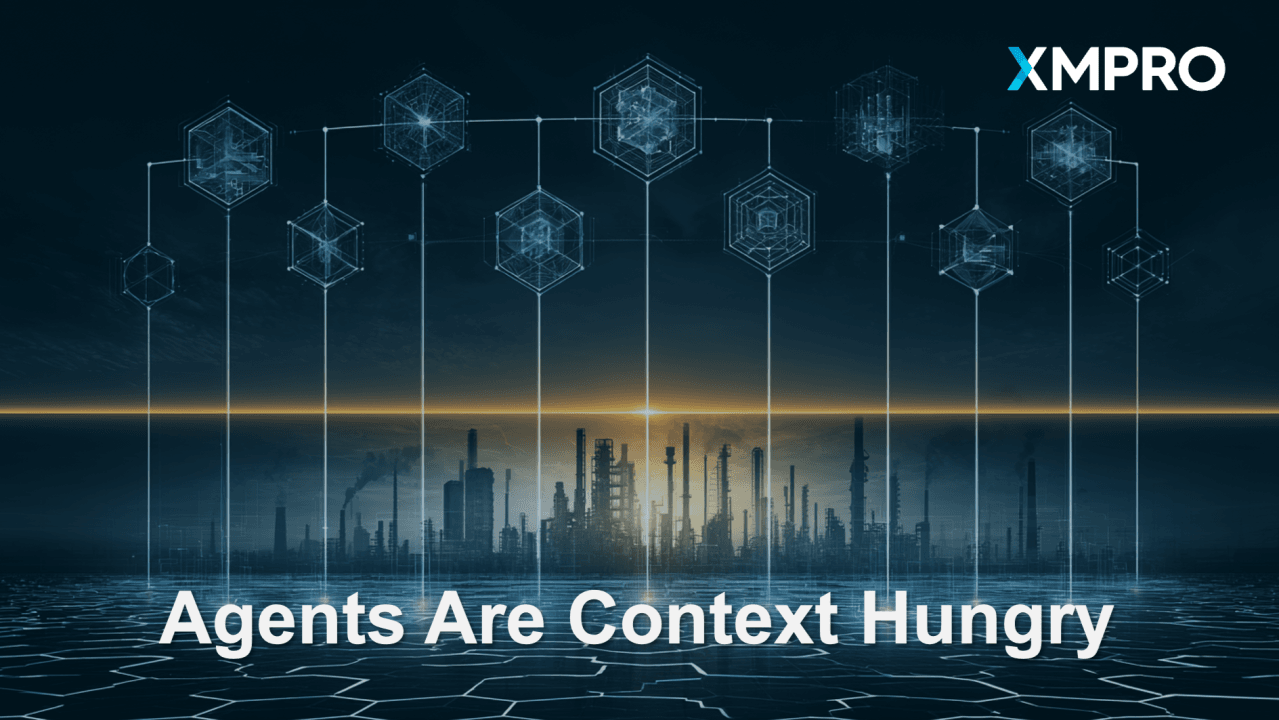
The better the agent, the more it demands of the context beneath it. Build that foundation now, open and governed, before you scale the agents on top of it.
The industrial software market has decided that context is the prize. The recent consolidation says so, the analysts say so, and they are right. What most of the conversation misses is the finish line. Owning the biggest context platform is not the objective. The objective is a context layer that the agents you have not chosen yet can act on, safely, for the next twenty years.
That reframes the whole decision, and it makes the timing obvious.
Context is a now decision. So are the first agents.
The advice reaching operators from every serious analyst is the same: build the context foundation now, because it is the prerequisite for everything agentic that follows. Context comes first in the build order. That is not a reason to delay the agents. You lay the foundation and put your first agents on it in the same program, with the context running just ahead of what those agents need to act on. An agent is only ever as good as the context it can reach, and the operations that stand agents up on nothing end up with confident, expensive mistakes.
This is not only an analyst position. We see it in every deployment we build. Agents are context hungry. To make a decision that holds up on a plant, an agent has to understand what sits upstream of it, what sits downstream, and what its decision will do to both. An agent that trims a compressor without knowing what feeds it and what depends on it is guessing, however confident it sounds. Answering those three questions is not a lookup. It is a semantic and ontological problem: the relationships between assets, processes, and constraints, modeled well enough that an agent can traverse them and reason about consequence. And the more capable the agent, the more it demands of that model. Better agents raise the bar on the context layer.
Building the context layer is the one piece of work that pays off no matter which agents win, which is exactly why it is the thing to start on today.
You will run more than one agent framework
Here is the fact the single-platform pitches leave out. A large industrial operation will not run one kind of agent. It will run several. Your own teams will build some. Your OEMs will ship some inside their equipment. Your integrators will bring others, and general-purpose frameworks will cover the edges. A single refinery can end up running an OEM’s combustion-optimization agent, a third party’s emissions-monitoring agent, and the operator’s own reliability agents, all acting on the same plant at the same time. In a refinery, a mine, or a grid, that mix is permanent. Plan for it as the steady state, because anyone promising that the whole estate will standardize on their single agent has never run a plant.
So the context layer cannot be built for one framework’s convenience, including ours. It has to be legible to all of them.
Which means standards-native, on commercial stores
This is where an architecture choice becomes a strategic one. Context expressed in a vendor’s proprietary schema can only be read natively by that vendor’s agents, and every other framework needs a translator the vendor controls. Context expressed in the open semantic standards, OWL, RDF, SHACL, SPARQL, PROV-O, and the asset models the industry already publishes, can be consumed directly by any competent agent framework, because those standards are what agents are built to read. Put the same discipline under the stores. Commercial off-the-shelf and open-source databases, procured by you, mean the foundation runs on infrastructure your own people operate and a model your own engineers extend. Open standards do the real work here: they make the context agent-agnostic, and agent-agnostic is what carries it through the framework churn that is certain to come. This is the same point the ownership argument reaches from the other side, that standards are what let you keep the meaning when the stores, or the agents, change underneath it.
Governance lives in the harness, not the model
Open and standards-native gets an agent to the context. It does not make the action safe, and this is where most of the market points at the wrong layer. The context layer governs the data and the meaning. It checks a reading before an agent ingests it and holds the shared view of what the operation actually looks like. That work is necessary, and it is not where an agent’s decisions are governed.
The decisions are governed in the agent harness, the control structure that sits around the model. The model reasons. The harness decides what the agent is allowed to conclude, what it is allowed to do, the operating envelope it has to stay inside, the point where authority reverts to a person, and the signed record it leaves behind. A drifting sensor reporting a believable but wrong number is caught by the context layer at ingest. Two agents issuing individually sensible commands that collide on the same line are caught by the harness before either reaches the plant. Two gates, in two places, and neither one is the model.
That separation is the whole value proposition, and I have written about it at length. Take the decision out of the model and make it an explicit control structure around the model, and governance becomes something you can inspect, certify, and put in front of an underwriter, instead of a behavior you hope the model learned. A model with governance baked in governs only itself. A harness built outside the model can wrap any model, and any agent framework. So governance, like the context beneath it, stays open: the same bounded operation, the same non-repudiable decision trace, the same assurance evidence apply whether the agent is ours, an OEM’s, or a general-purpose framework’s. That is what lets a large operation run many agents and still hold all of them to one standard of safety.
Recommended by LinkedIn
This is the stable stack
Put those together and you can see the industrial stack that is settling into place. An open, standards-native context foundation the operator owns. An agent harness that governs decisions and actions around any model, separate from the model itself. Operator agents that act on the context through that harness, running alongside whatever other agents the operation chooses. When the context engine and the harness come together, and both stay open to other frameworks, the stack is stable, because no single part is a lock-in and no one vendor’s model or roadmap can strand it. That is the strategic objective worth building toward, and it is what the serious industrial players are working out how to assemble as they form their own agentic strategy. They are looking for a foundation that is theirs, an assurance layer they can stand behind, and agents, theirs and ours, that both act inside it under evidence a regulator will accept.
What this means
For the operator, this ordering takes the risk out of the biggest decision in an agentic program. When the foundation is open and owned, the agent choice becomes reversible. You can run a pilot on one framework, swap it, add a second, and let an OEM’s agents in, without rebuilding the foundation underneath. The slow, expensive work of modeling the operation gets done once and reused, while the fast-moving, commoditizing work, the agents and the models, stays swappable. The durable investment sits where it compounds, and the disposable investment sits where it can churn. Most agentic pilots today are scoped the other way around: they start from a chosen agent and reach back for whatever context it can grab, which is a large part of why so many of them stall the moment they leave the demo.
For anyone building the platform, and the incumbents assembling their agentic strategy after the recent consolidation are exactly that audience, the instinct is to buy or build a closed context platform and make it the moat. That secures the layer and misreads the demand. An operator is never going to run only your agents, so a context platform that only your agents can act on is worth less to them than an open foundation their whole estate can act on. The durable position is the open, governed foundation plus the model-independent harness, because that is the shape operators actually buy and run.
For the market, capital and attention are pouring into the context layer, and context is necessary enough to deserve some of it. The defensibility sits one layer up, in the harness that turns context into governed action, because that is the hard part and the part that stays relevant while models and frameworks turn over beneath it. Context is the entry. Governed action is what it is for.
And the ordering protects you over time, which is the part that is easy to miss in a fast market. Now you build the foundation. Next you run agents on it, more than one kind. Later, when the agents and the models have turned over a few times, and they will turn over far faster than the operation itself does, the foundation and the harness are what remain. Whatever the industry ends up calling this stack in three years, the operator who owns an open governed foundation and a model-independent harness adopts the next wave without re-platforming. The one who bet the foundation on a single agent, or a single closed platform, buys it again.
What to do now
Build the context foundation now, and put your first agents on it now. Both are near-term moves. The foundation leads by a step, so the agents have something solid to stand on from day one instead of bolting context on after a pilot stalls. The technology is ready and waiting buys you nothing, and starting this way keeps your options open rather than betting the whole operation on one framework as though there is a single winner to back. Assemble the context from fit-for-purpose commercial stores. Bind them with open standards agents read natively. Put the data gate in the context layer and the decision governance in a harness that sits outside any model, so it holds for every agent you run. Own both. Do that and the agents you deploy today, and the ones you add or swap tomorrow, have somewhere solid to stand and a single standard to answer to. Foundation first, agents on it now, open for the many more that are coming. That order is most of the strategy.
Pieter van Schalkwyk is the CEO of XMPro, specializing in industrial AI agent orchestration and governance. Drawing on 30+ years of experience in industrial automation, he helps organizations implement practical AI solutions that deliver measurable business outcomes while ensuring responsible AI deployment at scale.
He authored the Industrial AI Agent Manifesto, published by the Digital Twin Consortium in February 2026, a governance framework for trustworthy autonomous operations.
Our GitHub Repo has more technical information. You can also contact myself or Gavin Green for more information.
Read more on agentic operations at The Digital Engineer
This article originally appeared on XMPro CEO’s LinkedIn blog, The Digital Engineer, on 10 July 2026.