

Agent Skills Are the New Spreadsheets
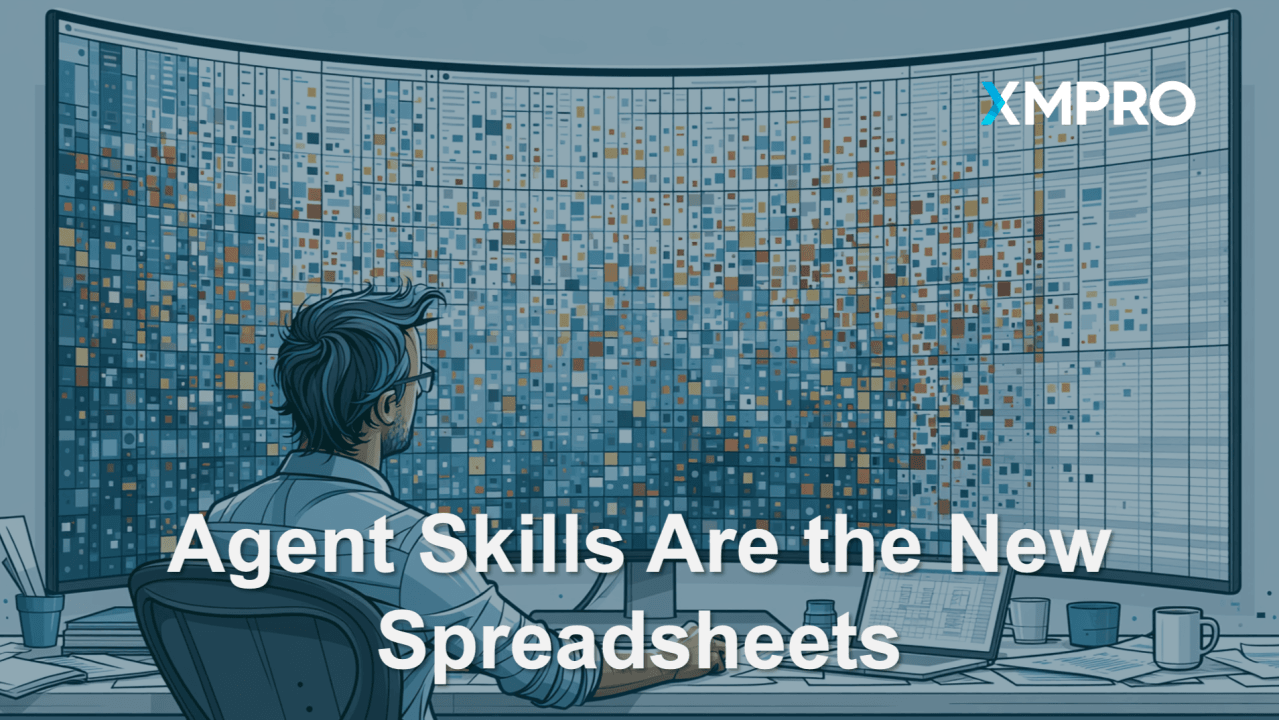
A week or so ago I joined a call with the IT division of a large organization who thought they had figured out its agent strategy. They walked me through it with some pride: AI assistants loaded with skill files written by their subject matter experts, ready to answer questions across the business. A skill file is captured knowledge in plain text: the procedures, rules, and judgment an assistant reads so it can answer the way the expert would.
I asked where the skill files live. The answer, once we dug into it, was configuration folders on individual laptops. Not a governed repository. Not even SharePoint, which at least would have been visible to someone. Local settings on local machines, copied from a colleague or a forum, with no record of which version anyone was running, where it came from, or what source control sat around it. They called these agents. Each was a set of instructions telling an assistant on one machine how to do one person’s version of a task. I told them what I was looking at: spreadsheets of the old days.
Agent skill files are the new spreadsheets.
In the 1990s, business logic migrated out of governed systems and into Excel because Excel was fast and nobody had to wait for IT. The pricing model lived in a workbook on someone’s C: drive. The maintenance budget ran on a macro one planner understood. There were forty copies of the forecast and nobody could say which one was current. When the person who built the model resigned, the understanding walked out with them, and when auditors asked who approved a formula change, the room went quiet. It took most companies two decades, a wave of regulation, and some expensive archaeology to pull that logic back into systems with owners, versions, and audit trails.
Skill files are on the same path, moving faster, and they have already found their way back to the C: drive. They are plain text, so they fork the moment someone saves a copy. There is no record of which version answered yesterday’s question. There is no identity binding the person asking to the knowledge being served, so anyone who can reach the assistant can ask it anything it knows. And the intellectual property exposure is sharper than it ever was with spreadsheets, because a skill file is your best process engineer’s judgment written down in clear text. Your operating knowledge is now portable in a way your best engineer never was. A spreadsheet leaving the building took a model. A skill file leaving the building takes thirty years of how we run this plant.
**The spreadsheet comparison actually understates the risk.**A bad spreadsheet hurt one team at a time: someone had to open the workbook, read the wrong number, and act on it. A skill file feeds an assistant that answers everyone in the organization, all day. If the file holds a stale procedure, every person who asks gets the wrong procedure back, stated confidently, at machine speed. One ungoverned spreadsheet was a local problem. One ungoverned skill file is a broadcast.
None of that is an argument against capturing the knowledge.
Writing down expert knowledge before the gray beards retire is exactly what industrial companies should be doing, and the new tooling makes that easier than it has ever been. That is also what made spreadsheets dangerous: very easy capture with no governance around it.
Compare this with how a plant treats a human stranger. Nobody walks through the gate without ID, an induction, a permit to work, and a record of what they did on site. An agent carrying your process knowledge deserves the same treatment, and the machinery for it already exists:
An identity in the corporate directory. The agent authenticates the way an employee does (Entra ID or equivalent), so you know which agent acted and on whose behalf it acted. An agent card. A machine-readable description of what the agent is and what it is for, the way an asset administration shell describes a piece of equipment. A software bill of materials. An SPDX manifest of the models, tools, and components inside the agent, so you know what you are actually running when it runs. Obligations, permissions, and prohibitions that travel with every request. More than a security token: what the agent must do, may do, and must never do, expressed as policy a system can enforce rather than prose a person has to remember. A decision record. What it decided, on what data, under which version of the rules, kept somewhere tamper-evident enough to survive a dispute.
None of this is exotic. Identity directories, asset administration shells, SBOMs, and policy engines are mature technology, and the formal foundations exist too: Zoran Milosevic ‘s Governed Autonomy series shows how permissions, obligations, and delegation chains can be specified formally and enforced before an agent acts, rather than reconstructed from audit logs after the harm. What is missing in most agent programs is the decision to apply any of this to agents at all.
Recommended by LinkedIn
The way out is also already known, because the spreadsheet cleanup wrote the playbook. Regulators forced banks to inventory their spreadsheets, name an owner for each one, and put the ones that mattered under version control, and model risk management grew from there. The same first moves work here. Inventory the skill files people are actually using, including the ones sitting in configuration folders on laptops. Give each one an owner and a home in source control. Then bind the knowledge to identity: which agents may use this file, on whose behalf, under what permissions. That work can start this quarter, and the organizations that did the spreadsheet version of it will recognize every step.
They will also recognize its weakness, because it is the weakness of every retrofit: it relies on people finding every file, keeping every owner current, and never letting the inventory drift, which is the discipline that failed the first time around. The other path is to build the governance in. In a parametric agent design, the knowledge never lives in loose files at all. It is configured into the agent as versioned parameters: its knowledge collections, its objective function, its tools, its authority boundaries, each carrying an owner, a version, and the identity machinery above as properties of the architecture rather than as a cleanup project. This is how we build MAGS, our multi-agent system at XMPro, and the difference lands exactly where the spreadsheet parallel predicts: there is nothing to inventory, because nothing is loose.
Gartner predicts that through 2028, over 50% of AI initiatives will halt because organizations cannot solve agentic identity challenges. Read that prediction next to the skill-file story. The models will keep improving on their own, without any effort from you. What halts an initiative is the moment a regulator, an insurer, or your own security team asks an agent the two questions every gatekeeper asks and gets silence back.
This is the problem we work on at XMPro: the model is a small part of an agent, and the harness of identity, permissions, and decision records around it is what makes an agent safe to put near operations. Whatever platform you build on, hold your agents to the standard you hold a stranger at the plant gate. Who are you, and who said you could do that? If the answer is a text file in a configuration folder on somebody’s laptop, you already know how this decade ends.
Pieter van Schalkwyk is the CEO of XMPro, specializing in industrial AI agent orchestration and governance. Drawing on 30+ years of experience in industrial automation, he helps organizations implement practical AI solutions that deliver measurable business outcomes while ensuring responsible AI deployment at scale.
He authored the Industrial AI Agent Manifesto, published by the Digital Twin Consortium in February 2026, a governance framework for trustworthy autonomous operations.
Our GitHub Repo has more technical information. You can also contact myself or Gavin Green for more information.
Read more on agentic operations at The Digital Engineer
This article originally appeared on XMPro CEO’s LinkedIn blog, The Digital Engineer, on 14 July 2026.