
The Build-or-Buy Question Looks Different When the Stakes Are a Mine Shutdown, Not a Missed Sales Email
Bernard Marr published an important piece this week on the AI agents build-or-buy decision. **He is right that the debate has moved on.**The question is no longer whether to use AI agents. It is how to deploy them, and that choice shapes costs, capabilities, and competitive position for years.
His framework is useful for business workflows. But it presents a binary that does not exist in industrial operations, and choosing the wrong path based on it will cost companies far more than a failed pilot.
The binary is this: either you buy an off-the-shelf platform and accept someone else’s logic running your operations, or you build your own agents using developers who write scripts and prompts from scratch. For mining, oil and gas, manufacturing, and utilities, both options are a strategic mistake. The reason comes down to where operational knowledge actually lives and who should encode it.
Where Marr’s Framework Works
**For business workflows, Marr’s framework is sound.**If you are automating sales follow-ups, CRM updates, or marketing workflows, off-the-shelf tools like Salesforce Agentforce or HubSpot Breeze give you speed and convenience at low cost. You do not need proprietary logic for tasks that every business in your industry performs the same way.
The DIY path makes sense where data sensitivity, legacy system constraints, or genuine competitive differentiation justify the investment and complexity. His decision matrix, anchored around niche specificity, data sensitivity, in-house skills, and speed to value, is a useful starting point for that context.
The problem is that industrial operations are not that context. The environment, the stakes, and the nature of the knowledge involved are categorically different. What this means in practice is that applying Marr’s framework to an industrial AI agent decision is like using a residential building code to design a refinery. The questions look similar. The requirements are not.
The Category Marr’s Framework Does Not Cover
Mining, oil and gas, manufacturing, and utilities are now deploying AI agents at scale. But the environment those agents operate in changes every dimension of the build-or-buy decision. Three realities set industrial operations apart from every business workflow scenario Marr describes:
The consequence of a wrong decision is physical, not financial. A missed sales follow-up means lost revenue. An agent that makes the wrong call in a refinery control loop, or in a mine’s ventilation system, creates safety incidents. This is not a data protection consideration. It is a safety engineering consideration. The platform you choose is not just a technology decision. It is a safety-critical infrastructure decision, and it needs to be treated as one. The systems agents need to connect to are not APIs. Marr notes that off-the-shelf tools can struggle with legacy systems. In industrial operations, this is not an edge case. It is the entire environment. Real-time OT protocols, edge deployments with intermittent connectivity, and control systems running on 30-year-old architectures are the baseline. A platform that cannot natively speak those protocols is not an industrial platform. It is a business platform with an industrial logo. Agents must coordinate, not just execute individually. A single agent giving a recommendation is useful. But real industrial operations require teams of agents working together across the same physical asset simultaneously. A monitoring agent, a diagnostic agent, a planning agent, and an execution agent need to share context, resolve conflicts, and maintain coherent operational state. What this means is that single-agent frameworks, even well-built ones, are the wrong unit of architecture for industrial operations. The team is the unit, not the agent.
The Problem with Both Options
Buying off-the-shelf gives you speed and convenience. It also means vendor logic runs your operations. The decision patterns encoded in that platform reflect what the vendor’s engineers thought industrial operations look like, not what your operations actually are. A copper mine in Chile does not behave like a lithium operation in Australia. A refinery configured for light crude does not have the same failure signatures as one running heavy feedstocks. Generic platforms cannot encode that specificity. Your engineers’ knowledge stays locked in their heads, and the platform runs on approximations.
Building with developers solves the specificity problem but creates a different one. Your developers translate what your process engineers know into code, scripts, and prompts. This translation is lossy. Developers who do not understand operations make assumptions. The resulting agents encode those assumptions, not the original engineering knowledge. You also create a fragile dependency: when those developers leave, so does the logic they built.
The IP risk goes further than most organizations realize. **With script-based agent development, an employee walking out the door can take your entire agentic logic with them.**Every prompt, every decision tree, every workflow you spent months building can be copied into a personal folder in minutes. This is not theoretical. It is a practical vulnerability that script-based agent development creates by design. What it means is that the knowledge asset you think you are building is actually sitting in files that belong to whoever holds them, not to your organization.
Neither option protects your most valuable asset: the institutional knowledge your engineers have built over decades of operating complex physical systems.
The Third Option
There is a different approach, and it is the one that many industrial enterprises running AI agents in production have converged on.
Your reliability engineers, process engineers, and operations specialists are the people who understand how your assets actually behave. They know which early warning signatures precede a specific failure mode on a specific piece of equipment in your specific environment. That knowledge is your competitive advantage. It took years to accumulate. No vendor has it. No developer can invent it.
Recommended by LinkedIn
The question is whether your engineers need to become developers to encode it.
On a parametric agentic platform, they do not. Instead of writing scripts and prompts, engineers configure agents through structured design environments built around operational concepts they already understand: thresholds, decision logic, escalation paths, coordination rules between agents, and intervention boundaries. The agentic process is built in the platform, not in code that lives on someone’s laptop.
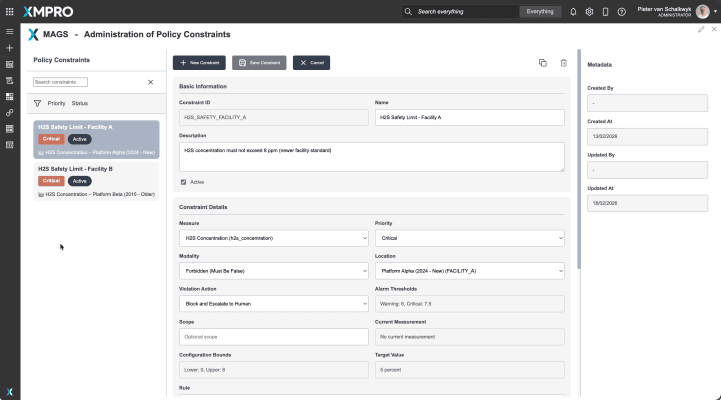 MAGS Team Policy Constraints configured with parameters, not code
What this means organizationally is significant. You are not buying vendor logic. You are not hiring developers to approximate what your engineers know. You are giving your engineers a platform where they can encode their own knowledge directly, in a form that runs at scale and stays owned by the organization.
When agentic logic lives in a parametric platform, IP is protected by architecture. The logic is encoded in the platform’s structure, not in portable files. Engineers build within a governed environment where institutional knowledge is stored, versioned, and owned by the organization, not by the individuals who configured it. The platform becomes the repository of operational intelligence, compounding in value as more engineers encode more knowledge over time. This is the same reason serious industrial enterprises do not let engineers store critical process knowledge in personal spreadsheets. The knowledge belongs to the organization. The platform enforces that.
The Platform Must Earn the Trust
Not every platform that calls itself industrial can actually operate there. Choosing the wrong one does not just slow you down. In a safety-critical environment, it can cause real physical harm.
The bar a platform must clear comes down to four things. Each one is a hard requirement, not a preference:
Safety architecture built in from day one, not bolted on later. Generic business workflow platforms were designed to automate tasks, not to operate in environments where a wrong decision trips a safety interlock or shuts down a production line. Industrial agents need audit trails by default, configurable human oversight boundaries, escalation paths that hold under pressure, and governance frameworks that regulators can validate. If a vendor cannot show you where these sit in their architecture, they are telling you what you need to know. Native OT connectivity, not API adapters. Your agents need to reach OPC UA historians, SCADA systems, PLCs running on decades-old protocols, and edge deployments with intermittent connectivity. API adapters that translate industrial protocols into cloud-friendly formats introduce latency, failure points, and data fidelity problems that process engineers will not tolerate. A platform without deep OT integration built over years of real industrial deployment is not ready for your environment. No-code configuration that your engineers can actually use without a developer in the loop. The value of the parametric approach disappears the moment a process engineer needs to file a ticket to change a threshold. Your reliability engineers should be able to build, adjust, and refine agents directly. If the platform requires programming skills to operate, you have recreated the dependency problem you were trying to eliminate. A single foundation that scales from monitoring to full autonomy. The monitoring agents your engineers build today should run on the same platform coordinating fully autonomous operations in five years. Platforms that require migration between maturity levels do not just create cost. They destroy the institutional knowledge encoded at each stage. Every migration is a knowledge loss event, and in industrial operations, that knowledge took years to build.
The Right Question for Industrial Operations Leaders
Marr’s build-or-buy framework is the right question for business workflows. For industrial operations, the question that actually matters is: who encodes the operational knowledge, and where does it live?
If the answer is “a vendor’s platform encodes generic logic,” you are buying convenience and sacrificing the specificity that creates real operational advantage. If the answer is “our developers translate what our engineers know into scripts,” you are paying for approximation and building IP that can walk out the door in a folder. If the answer is “our engineers encode their own knowledge directly into a governed platform built for industrial operations,” you are building a compounding institutional asset that no competitor can replicate, no departing employee can copy, and no vendor can commoditize.
**That is the third option.**It is the one many industrial enterprises running agents at scale have converged on. And it is the only one that creates defensible competitive advantage that compounds over time.
Pieter van Schalkwyk is the CEO of XMPro, specializing in industrial AI agent orchestration and governance. XMPro MAGS with APEX provides cognitive architecture and DecisionGraph capabilities for agent networks operating on existing industrial systems.
Our GitHub Repo has more technical information. You can also contact myself or Gavin Green for more information.
Read more on MAGS at The Digital Engineer
This article originally appeared on XMPro CEO’s LinkedIn blog, The Digital Engineer, on 23 February 2026.