
The Architecture of a Cognitive Agent Team: Why Workflows Kill Intelligence
Every time we work with an operations team to configure a cognitive agent team, we have to remind them of the same thing: don’t start with the workflow.
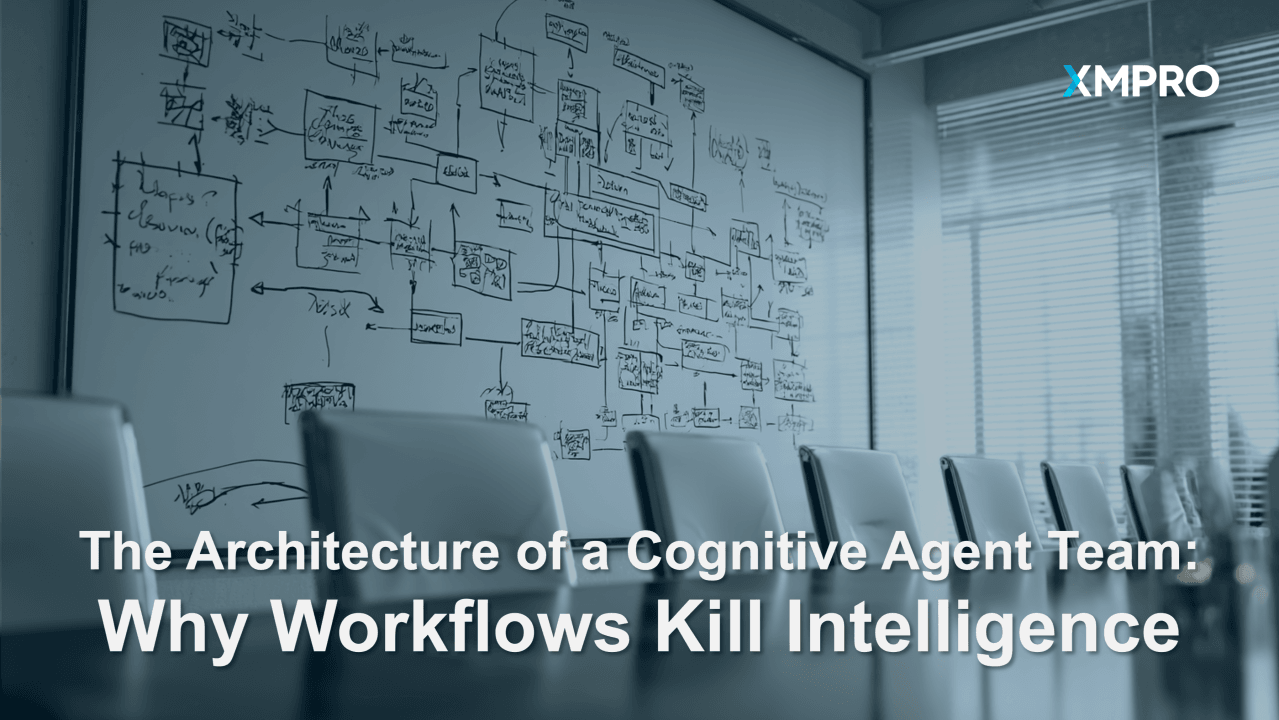
It’s a natural instinct. The team sketches out a flowchart:
“The Monitor agent detects the anomaly. It passes that to the Analyst, who interprets the root cause. The Analyst passes its findings to the Decision-Maker, who proposes an action. The Guardian validates it. The Executor implements it.”
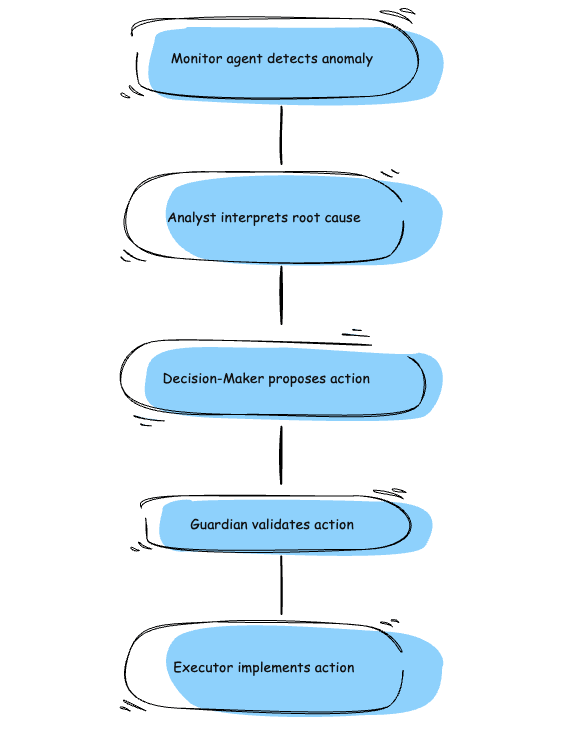 “The Process”
Clean. Logical. Easy to follow on a whiteboard.
Also the wrong place to start.
We still get this wrong ourselves sometimes. Most recently, configuring a cognitive agent team for a depropaniser unit running against a process simulator, the team sketched the flow first. The agents ended up in a serial queue, each waiting for the previous one to finish. The process simulator didn’t wait. The testing didn’t go well. The fix was straightforward once we identified it, but the instinct to draw the sequence first had caused the problem.
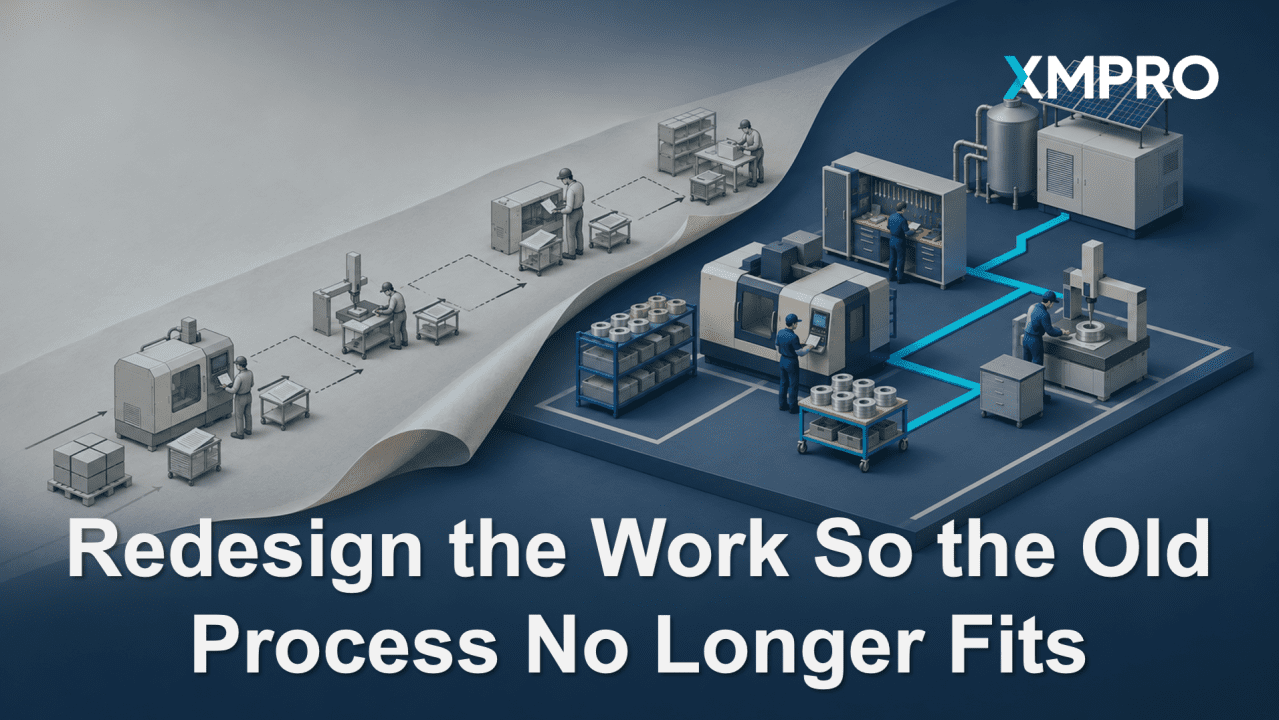
The right place to start is with the business objectives, the rules and constraints, the tools and actions available to the team. Define what “good” looks like. Define the boundaries that must never be crossed. Define what each agent can do. Then let the agents work out the flow.
The role of a cognitive agent is to make decisions. Specifically, to make operational decisions the way experienced operators do: continuously, in context, with judgment about when the situation requires action. Our job as designers is to engineer the decisions, not the processes. What information does the agent need to decide well? What constraints bound its choices? What does a good outcome look like? What authority does the agent have to act? These are the questions that matter. The sequence of steps is something the agents figure out for themselves.
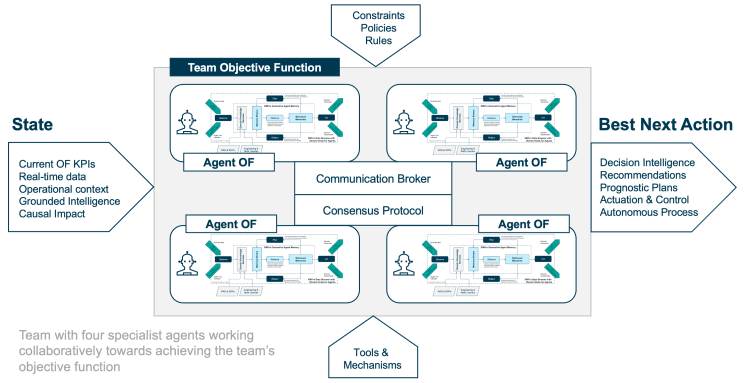
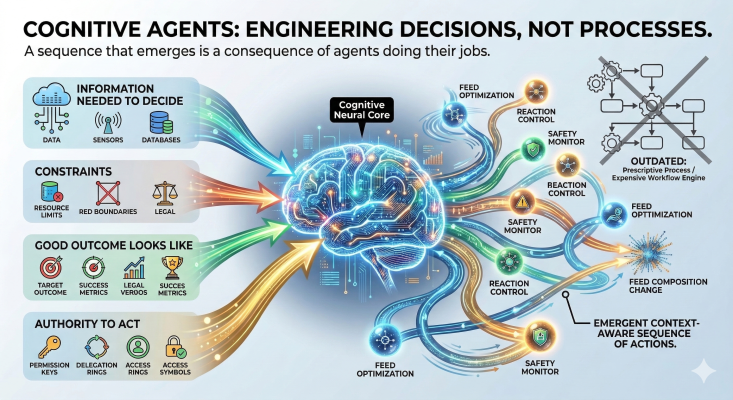 Cogntive MAGS agents - created with Gemini
The flow isn’t always sequential, even when events trigger a sequence of responses. A feed composition change might trigger a cascade of activity across multiple agents simultaneously. Each agent handles its own role, at its own frequency, with its own judgment about what matters. The sequence that emerges is a consequence of the agents doing their jobs, not a prescription baked into the architecture.
The moment the flowchart becomes the architecture, you’ve built something that looks like AI but behaves like a very expensive workflow engine.
The Workflow Trap
When you prescribe the flow, here is what happens:
One observation enters the pipeline. It waits for Agent A to finish before Agent B starts. Agent B waits for Agent C. The process doesn’t wait. Conditions are shifting. Temperatures are drifting. The window for a good decision is closing, and your agents are queued up, processing one step at a time.
This is the workflow trap. It happens for a completely understandable reason: we explain agent systems as sequences because that’s how humans follow a story. The sequence makes sense to the audience. Then it becomes the design. Then it becomes the constraint.
The same pattern has caused problems for decades. RPA projects encode the process as it was explained in the meeting room, not as it actually needs to work on the plant floor. The result is brittle automation that breaks when conditions change. Most agentic frameworks on the market today repeat the same mistake: workflow engines with LLMs in the nodes, presented as “agents.” The LLM generates content or makes a classification at each step. The workflow routes the output to the next step. Some platforms call these sequential handoffs “subagents.” The reasoning process inside your favourite frontier LLM, the one that shows its thinking step by step in a chat window, is also sequential and deterministic. It’s useful for a single query. It’s the wrong model for continuous operations.
The deeper issue is this: most operational processes are not prescribed. **They are emergent.**The next step isn’t determined in advance. It emerges from the information, context, and rules at the current state. A skilled operator doesn’t follow a script. They read the situation and decide what to do next based on what they know right now. We’ve understood this since the early days of intelligent business process management, and it’s still true for AI agents today.
Sequential, workflow-based tooling with LLM capabilities is useful for transactional tasks: document generation, content classification, structured data extraction. It hits a ceiling when the problem is continuous. When you’re not generating a document but managing a process.
When the right answer at 2pm is different from the right answer at 2am, and the system needs to know why.
**That’s the domain of cognitive agent teams.**The mental model that fits it isn’t a workflow. It’s the OODA loop.
The OODA Loop: The Right Mental Model for Continuous Operations
John Boyd developed the OODA loop to explain why fighter pilots win: not because they’re stronger, but because they cycle through the loop faster than their adversary. The pilot who adapts faster wins.
Flying a fighter jet is not a sequential workflow. You don’t finish observing before you start orienting. You don’t finish orienting before you start deciding. The loops overlap, run in parallel, and feed back on each other continuously. The environment doesn’t pause while you process.
Neither does an industrial process.
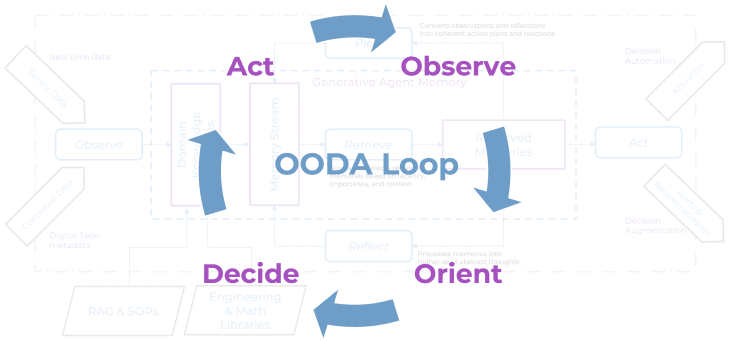 The OODA Loop overlaid on XMPro MAGS Cogntive Agents
Managing a chemical plant, a power grid, a mining operation: these are continuous, multivariate environments where conditions shift constantly and the right decision depends on the current state of dozens of interacting variables simultaneously. The operator who waits for a complete sequential analysis before acting will always be behind the process.
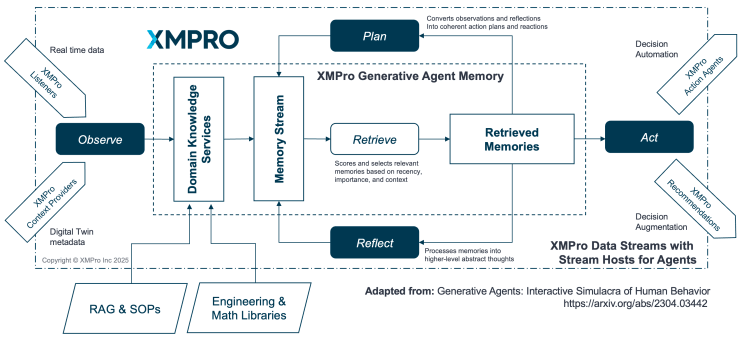 XMPro ORPA Cognive Cycle per agent
This is why the OODA loop, not the workflow, is the right mental model for cognitive agent teams. In practice, cognitive agents implement this through a cycle drawn from research into generative agents and human cognitive behaviour: Observe, Reflect, Plan, Act (ORPA).
Observe: monitoring its domain, receiving data streams, detecting changes Reflect: building context, comparing current state to historical patterns, assessing significance. This is the Orient phase made explicit. Plan: determining whether to act, what to communicate, and how to respond Act: communicating significant findings, proposing actions, or executing approved changes
ORPA maps directly to OODA, but Reflect makes the orientation step explicit. Good decisions require more than fast reactions. They require judgment built from experience. That’s what the Reflect phase provides.
 In a MAGS team each agents has its own ORPA cycle
Multiple agents run their ORPA cycles simultaneously, each oriented to their own domain, each contributing to the team’s shared situational awareness. The ORPA cycle also handles both known and novel situations. A fixed workflow can only handle what it was designed for. An agent that observes, reflects, and plans can adapt when conditions change.
How a Real Control Room Actually Works
Walk into a petrochemical control room during a process disturbance.
The process operator is watching column temperatures and pressures. The quality analyst is watching the analyser output. The shift supervisor is watching the economic dashboard. The safety officer is watching the alarm system. All simultaneously. All independently.
Nobody is waiting for the process operator to finish before the quality analyst starts looking. Nobody triggers the safety officer by completing their analysis. Each person has their own instruments, their own mental model, their own responsibility, their own sense of urgency.
When the process operator notices something significant, such as temperatures trending in an unexpected direction, they say something. Not because it’s their turn in the sequence. Because the significance threshold in their own judgment has been crossed.
The quality analyst immediately connects it to what they’re seeing in their data. The shift supervisor starts evaluating the economic implications. The safety officer checks the margin to limits. All of this happens in parallel, triggered by significance, not by sequence.
This is what a cognitive team looks like. Parallel, event-driven, significance-triggered collaboration. Not a workflow.
The question for AI system designers is: are you building the workflow, or are you building the control room?
Recommended by LinkedIn
The Anatomy of a Cognitive Agent
Each agent in a properly designed cognitive team runs its own continuous ORPA cycle, and has four independent components that make that cycle meaningful. This model draws from research into generative agents and human cognitive behaviour: the idea that intelligent agents don’t just react, they reflect before they act.
Its own observation domain. The Process Engineer agent watches separation efficiency, tray temperatures, and reflux ratios. The Economic Analyst watches product prices, energy costs, and margin calculations. Neither waits to be told what to look at. Each has its own data streams, its own domain, its own instruments. This is the Observe phase, and it never stops. Its own clock. Agents don’t observe on a shared schedule. Each agent’s reflection cycle is driven by the significance of what it’s seeing. A quiet period means less frequent reflection. A significant change triggers immediate attention. The process doesn’t care about your polling interval, and neither should your agents. This is the Reflect phase: continuous, not triggered by another agent completing. Its own objective. The Safety Guardian is optimising for constraint margins, maximum distance from every safety limit. The Economic Analyst is optimising for profit per hour. These objectives are genuinely different, and that tension is a feature, not a bug. It’s what creates the checks and balances that make autonomous operation trustworthy. This shapes the Plan phase: each agent plans from its own perspective. Its own memory. Each agent accumulates experience: what it observed, what it inferred, what happened as a result. This memory is not shared state. It’s the agent’s own experience, built over time, informing its reflection. An agent that has seen a similar disturbance before recognises the pattern faster the second time. Memory is what makes reflection intelligent rather than reactive.
The ORPA cycle runs independently per agent. Not as a shared pipeline. Not triggered by another agent completing. Each agent is always in some phase of its own cycle, simultaneously with every other agent. The team’s intelligence is the sum of these parallel, overlapping cycles, not a sequence of handoffs.
Three Types, Three Cognitive Roles
The three-type model (Guardian, Orchestrator, Expert) reflects three fundamentally different cognitive roles that mirror how expert teams actually work.
Expert Agents observe and interpret their domain continuously. They don’t wait to be asked. They’re always watching, always building context, always ready to communicate when something significant crosses their threshold. Think of them as the domain specialists: each with deep expertise in their area, each contributing independent observations to the team.
Orchestrator Agents synthesise inputs and propose or execute actions. They listen to what Expert Agents are communicating, combine it with their own observations, and propose actions that optimise the team’s shared objective. They’re the shift supervisors: synthesising the picture, making calls, managing the response.
Guardian Agents enforce boundaries independently. Guardian Agents are never triggered by Orchestrators. They run continuously. They observe independently. They validate every proposed action against constraints without being asked, and without being influenced by economic pressure.
This independence is what makes safety validation meaningful. A Guardian that only activates when the Orchestrator asks it to validate is not a Guardian. It’s a rubber stamp.
Each type can have multiple profiles (different expertise configurations) and multiple instances running simultaneously in a team. A team might have two Expert Agents with different domain expertise, one Orchestrator synthesising their inputs, and one Guardian enforcing safety boundaries. The composition depends on the complexity of the problem, not on a fixed template.
Collaborative Toward a Shared Objective
The team shares a team objective function: a mathematical expression of what “good” looks like for this operation. Safety margins. Product quality. Economic performance. Energy efficiency. Each weighted according to the team’s priorities.
Each agent contributes to this objective from their domain. Expert Agents provide the observations that inform each component. The Orchestrator synthesises these contributions and proposes actions that move the team objective in the right direction. The Guardian validates independently.
No agent waits for another to finish. They communicate when they have something significant to say. The team’s intelligence emerges from this parallel, significance-driven collaboration, not from a workflow that routes information from one box to the next.
What You Actually Get
When you build cognitive agent teams instead of AI-wrapped workflows, three things change fundamentally.
Infinite memory. Every observation, every decision, every outcome is remembered: across shifts, across seasons, across years. The agent that saw a similar disturbance six months ago recognises the pattern. The agent that learned from a near-miss in February applies that learning in August. No human operator can carry this kind of institutional memory. No shift handover note captures it.
Pattern recognition at scale. Multiple agents watching simultaneously, each processing their domain continuously, each building context in parallel. This isn’t just faster than one agent, it’s qualitatively different. Patterns that span multiple domains — a subtle interaction between feed composition, energy cost, and product quality that only becomes visible when you’re watching all three simultaneously — become visible to the team in ways they never could to any individual.
Deep technical expertise on tap. Each agent carries the knowledge of a domain expert, available every second of every shift. The 3am shift doesn’t get a less experienced process engineer. The Friday afternoon doesn’t get a distracted economic analyst. The expertise is always there, always current, always engaged.
There’s a fourth benefit that’s harder to quantify but perhaps most important: cognitive continuity. Human operators get tired. They anchor on yesterday’s problem. They miss things after a long shift. They hand over context imperfectly. Cognitive agents observe continuously, reflect without fatigue, and carry full context from the moment they started.
What This Means for How You Design
If you’re designing a cognitive agent team, stop drawing flowcharts. Draw observation domains instead.
For each agent, define: what does it watch? What data flows to it? What is its domain of expertise? What significance threshold triggers it to communicate?
Don’t define sequences. Define significance thresholds. When does the Process Engineer communicate to the team? Not “after the Monitor finishes,” but “when separation efficiency has been declining for more than 10 minutes.”
Don’t create Coordinator agents. If your design requires a coordinator to route information from one agent to another, you’ve designed a workflow, not a team. The routing should emerge from significance thresholds and communication rules, not from a dedicated routing agent.
Here’s the test: remove all the sequence arrows from your diagram. Does the team still make sense? Can each agent still observe its domain and communicate significant findings without the arrows? If yes, you have a cognitive team. If no, you have a workflow with agent-shaped boxes.
There is a deeper implication here. If you give cognitive agents the right objectives, constraints, and measures, they will find a better process than you could design. The process emerges from their reasoning. You discover it afterward by mining the decision traces: what patterns of observation consistently preceded action, what significance thresholds were actually crossed in practice, what the agents learned from previous situations. That emergent process is more accurate than any flowchart drawn in advance, because it reflects what actually happens under real conditions, not what you thought would happen.
The Hardest Part
The hardest part of building cognitive agent teams isn’t the technology. It’s unlearning workflow thinking.
We’ve spent decades designing systems as sequences. Requirements flow through stages. Data flows through pipelines. Approvals flow through hierarchies. The flowchart is so deeply embedded in how we think about systems that it takes deliberate effort to think differently.
Plant operators don’t process one instance at a time. They don’t wait for the previous step to complete before looking at their instruments. They run their own ORPA cycles continuously: observing their domain, reflecting on what they’re seeing, planning their response, acting when their judgment says it’s time. They deal with the reflection on one issue while still continuing to observe everything else.
That’s the cognitive model worth emulating. Not the workflow. Not the pipeline. The parallel, expert, continuously-cycling ORPA loops of a team of people who know their domain deeply and trust each other to do their part.
One practical note before the close: if your use case genuinely is a sequential workflow, don’t use a cognitive agent team to do it. Set up an LLM in a datastream. It’s faster, cheaper, and more predictable for transactional tasks. Cognitive agents are for decisions in continuous, multivariate environments where the right answer changes with conditions. Using a cognitive agent team to run a fixed sequence is overkill, and it will underperform a well-designed workflow every time. Use the right tool for the job.
The goal isn’t to replace operators. It’s to give every operator the cognitive support of a team of domain experts, each running their own continuous ORPA cycle, with infinite memory, continuous attention, and deep technical knowledge, available every second of every shift.
That’s what a cognitive agent team is. It doesn’t look like a flowchart. It looks like a control room where everyone is always watching, always thinking, following SOPs, and always ready to act.
What’s your experience with the workflow trap in AI agent design? Have you seen sequential thinking limit what your agent systems can do? I’d be interested to hear what patterns you’ve found.
Pieter van Schalkwyk is the CEO of XMPro, specializing in industrial AI agent orchestration and governance. Drawing on 30+ years of experience in industrial automation, he helps organizations implement practical AI solutions that deliver measurable business outcomes while ensuring responsible AI deployment at scale.
He authored the Industrial AI Agent Manifesto, published by the Digital Twin Consortium in February 2026, a governance framework for trustworthy autonomous operations
Our GitHub Repo has more technical information. You can also contact myself or Gavin Green for more information.
Read more on MAGS at The Digital Engineer
This article originally appeared on XMPro CEO’s LinkedIn blog, The Digital Engineer, on 8 March 2026.