
An Ontology Is Not a Graph Database
The most common mistake in industrial AI right now is treating “ontology” and “graph database” as the same thing. A team buys a graph database, loads their assets into it, and believes they have built the context layer their agents need. Months later the agents are still making confident and wrong decisions, the graph is straining under sensor volume, and the context that was promised never arrived.
The problem is not the ontology. The problem is the assumption that one database can be the ontology.
An ontology is a schema, not a store
Start with what an ontology actually is. In the semantic-web literature an ontology is understood as a type of schema for a knowledge graph, a formal layer of classes, properties, and constraints that sits above the data rather than being the data [1]. The description-logic tradition draws the same line: the ontology is the terminology, the TBox, and the instances are a separate assertion layer. An ontology is the meaning. The store is where the values live. They are not the same object.
This is not only an academic distinction. It is how operational ontologies are built in practice. The systems that deliver them are not single databases. They are multi-component systems that unify many fragmented and heterogeneous sources of record, from ERP and CRM systems to industrial historians, geospatial repositories, real-time sensors, and document stores, into one model. The database is a part. The ontology is the whole.
No single store fits every industrial workload
The reason follows from the workloads. Industrial context has to answer questions that pull in different directions at once. Traverse an asset hierarchy in milliseconds. Hold millions of time-series points per second at the edge. Reason over standards and constraints. Retrieve similar precedent. Keep years of history for machine learning. Even the graph-database vendors accept that no single model is best for all of this: the RDF and labeled-property-graph camps are optimized for different priorities, RDF for semantic precision, formal reasoning, and interoperability, and property graphs for traversal, analytics, and real-time performance [16]. Contemporary practice is to combine paradigms rather than force one to do every job.
That is the definition of polyglot persistence, and it is now a documented architecture rather than a theory. Working systems combine document stores, graph databases, key-value caches, and relational or lakehouse stores, each chosen for a job, and expose them through one unifying query interface [6]. The semantic layer does not have to swallow the data to give it meaning. Ontology-based data access, established by systems such as Ontop, keeps the data in its source stores and answers semantic queries by translating them down to the underlying databases through declared mappings. The knowledge graph is virtual: the meaning is unified even though the data was never copied into one place [7].
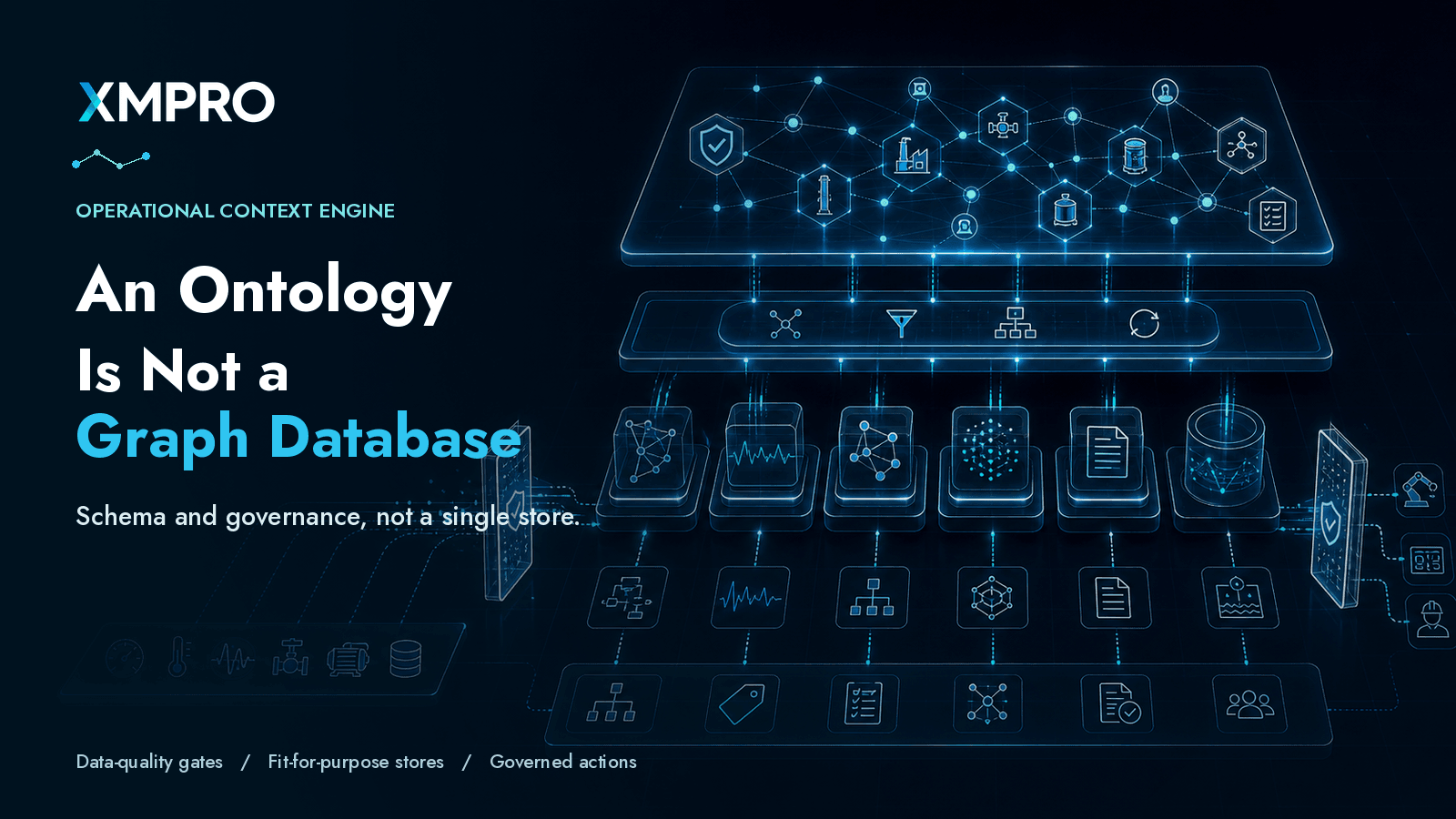
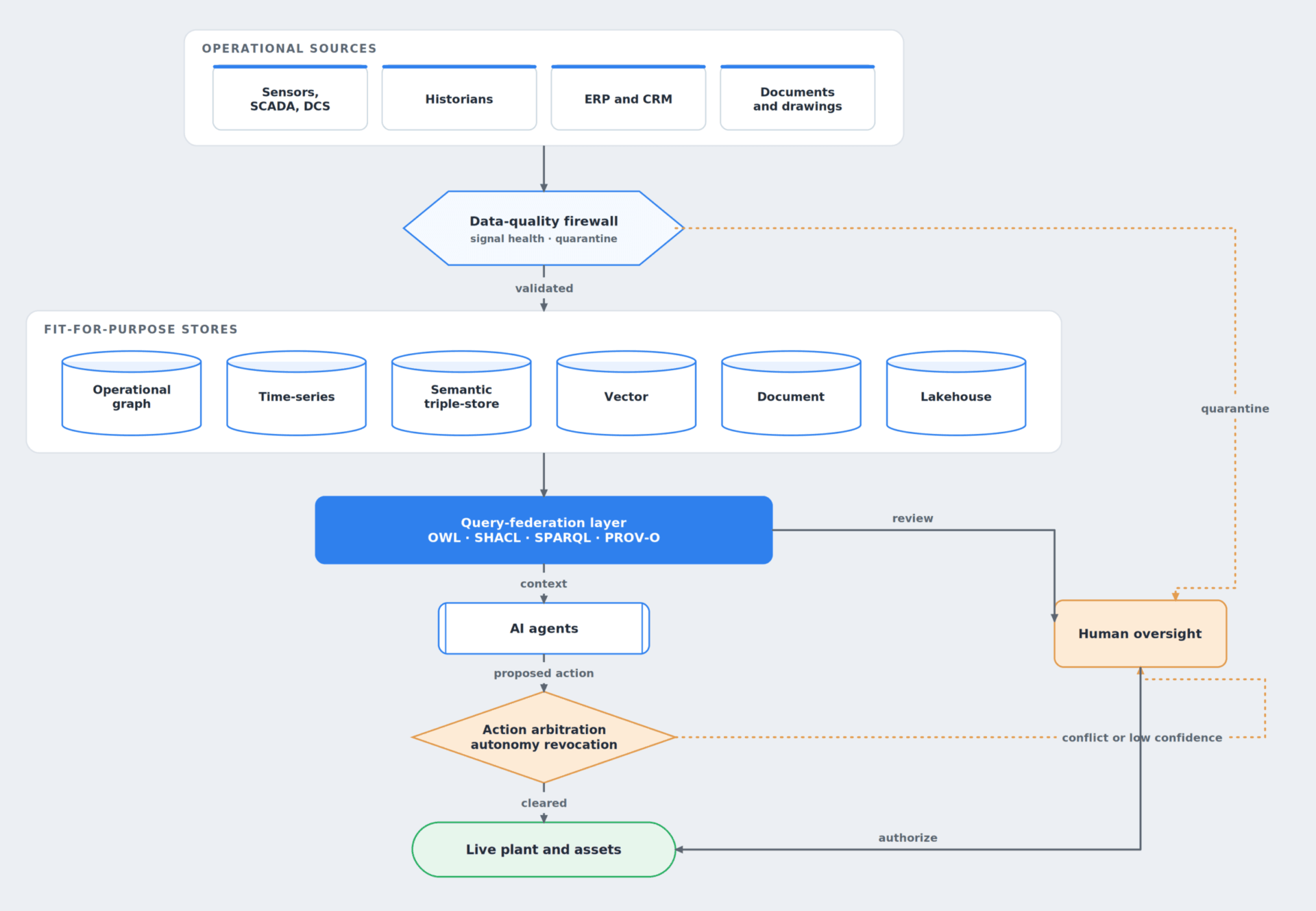
This is the shape of an industrial ontology. It is a governed system of fit-for-purpose stores, each doing the one job it is best at, bound into a single model through open standards and a query-federation layer. The word that matters is standardized. A pile of databases is just the swamp with more steps. What turns fit-for-purpose stores into an ontology is that the binding between them is open standards, OWL, SHACL, SPARQL, PROV-O, rather than a vendor’s proprietary schema. That is also what keeps the model portable, because the stores underneath can be replaced without losing the meaning above them. Analysts have started to treat this semantic layer as the backbone of a data fabric rather than an optional extra, and no longer as a nice-to-have [14][15].
Fit for purpose is not enough. It has to be a gatekeeper.
A system of the right stores solves the structure problem. On its own it does not solve the trust problem. For agents to act on this context safely, the system has to do two things a passive database never does.
First, it has to check the data before an agent ingests it. Data quality is not a reporting concern here, it is the thing that determines whether an autonomous decision is safe, and the industry has begun to say so directly: bad and unvalidated data is what turns an autonomous agent into a confident source of wrong actions [17]. Commercial industrial platforms now run this check at ingest. One time-series data-quality platform detects, validates, and resolves data defects before they reach downstream systems, and separates data-pipeline faults from physical sensor and asset faults, so a drifting or frozen sensor is caught rather than trusted [8]. That is the ingestion firewall in practice: a quality signal computed for every reading, carried with the value, and used to hold bad data at the boundary before it can reach a model. A sensor reporting a believable but wrong number is exactly the input that poisons an autonomous decision, and it is invisible to a store that only checks structure.
Second, it has to check the actions before they reach the plant. When several agents act on the same shared context, two individually reasonable actions can collide. One agent shuts a turbine for maintenance while another raises throughput on the same line. A passive store cannot see the collision, because it never holds the collective view of what every agent intends. The safety literature has a long-standing answer to this in the Simplex runtime-assurance architecture, which keeps a cyber-physical system safe by switching control authority away from an unverified controller to a verified backup [10]. The same idea is now appearing in agentic governance designs, which route every external, side-effecting operation through a single gateway and can cut an agent’s authority on a critical trigger [11]. More broadly, guidance for overseeing agentic systems calls for predefined interrupt conditions that pause execution for human review before an action proceeds [12], and one ontology-constrained agentic architecture makes actions available only when their quality score clears a governance threshold and requires human authorization for sensitive operations before execution [9].
Neither of these is possible for a lone graph database. The quality signal and the collective view do not exist inside a single store. They exist only when the ontology is a governed system.
This is no longer only a research position. In December 2025 a multinational body led by the United States CISA, with agencies from the United Kingdom, Germany, the Netherlands, Canada, New Zealand, and Australia, issued guidance for integrating AI into operational technology that calls for dedicated governance and human authorization before high-impact or irreversible actions in critical infrastructure [13]. Human-in-the-loop before write-back is becoming an expectation at the standards and government level, not a matter of taste.
Generate, then govern
Once the ontology is a system rather than a store, it becomes something you manage, not just something you hold. At industrial scale a model runs to thousands of classes and tens of thousands of mappings, and it has to be built, changed, and kept healthy by people who are not ontologists.
Language models help here, but under one rule that the evidence is consistent about: the model proposes, and a person governs. Across the current literature, ontology and knowledge-graph construction works best as a semi-automated pipeline in which a model drafts the artifacts and human experts verify at critical checkpoints [2][3]. Full automation is not sufficient for fidelity-critical work. One controlled study found that a hybrid approach combining human review with model assistance produced the best validation results, while letting a model validate on its own reduced quality outright [4]. The pattern that is emerging for keeping a model current is exactly generate-then-govern: the system auto-proposes extensions from what it sees, a domain expert approves them, and the change is merged with its provenance recorded [5]. A domain expert can then build and maintain the context far faster than manual authoring allowed, without the model ever writing an unvalidated fact into the graph. The same discipline that governs an agent’s actions governs an agent’s contributions to the model itself.
What this means for buyers
The practical stance follows from the argument.
Assemble the foundation deliberately. Treat context and data quality as a system to be assembled from fit-for-purpose parts, not a single product to be bought. The plant floor is too heterogeneous for one engine to cover it, and the working architectures in the field are polyglot by design [6][7].
Insist on open standards. If the binding between the stores is a proprietary schema, the meaning is locked to a vendor. If it is OWL, SHACL, and open protocols, the meaning is yours, and the stores under it can change as the technology does.
Never let an agent write to a live asset unchecked. Require the quality check at ingest [8] and the human-in-the-loop recovery path at write-back [12][13] as conditions of deployment, not as features to add later.
The databases are the commodity, and they are increasingly interchangeable. The engine is the governed, standardized system that turns them into meaning an agent can act on. It was, it is, and it will remain a question of data quality and context. The mistake is believing a graph database delivers either one on its own.
This is the architecture behind a commercial question I have written about separately: Who Owns Your Context Layer? For how XMPro implements the governed system described here, see the Operational Context Engine.
Sources
- M. K. Shimizu and P. Hitzler, “Accelerating Knowledge Graph and Ontology Engineering with Large Language Models,” Journal of Web Semantics, 2025. arXiv:2411.09601
- N. Kommineni et al., “From human experts to machines: an LLM-supported approach to ontology and knowledge graph construction,” 2024. arXiv:2403.08345
- Survey, “LLM-assisted knowledge graph and ontology construction,” 2025. arXiv:2510.20345
- Hybrid human-in-the-loop and LLM knowledge-graph validation study, Information Processing & Management, Vol. 62, 2025. ScienceDirect
- Oyewale and Soru, enterprise knowledge-graph copilot with expert-approved, provenance-tracked ontology evolution, 2026. arXiv:2602.01276
- “Polyglot Persistence with Large Language Models,” Semantic Web Journal. semantic-web-journal.net
- D. Calvanese et al., “Ontop: Answering SPARQL queries over relational databases,” Semantic Web Journal, 2017, doi:10.3233/SW-160217. ResearchGate
- Timeseer.AI, industrial time-series data-quality platform (detect / validate / resolve; pipeline-fault vs sensor-fault separation). timeseer.ai/platform
- Tuan and Sanyal, ontology-constrained enterprise agentic architecture with quality-gated actions and block-first human approval, 2026. arXiv:2604.00555
- The Simplex Architecture for runtime assurance of cyber-physical systems, 2021. arXiv:2102.12981
- AAGATE, a NIST AI RMF-aligned agentic governance platform (single tool-gateway chokepoint and kill-switch), 2025. arXiv:2510.25863
- Cloud Security Alliance, agentic governance guidance aligned to NIST AI agent standards (interrupt conditions for human review), 2026. cloudsecurityalliance.org
- CISA and partner agencies, “Principles for the Secure Integration of AI in Operational Technology,” December 3, 2025. cisa.gov
- “Gartner’s 2026 predictions confirm the semantic layer is no longer optional” (reporting Gartner). ontoforce.com
- “Knowledge graph emerges as the secret ingredient of a data fabric” (Gartner Data & Analytics Summit coverage). stardog.com
- Neo4j, “RDF Triple Stores vs. Property Graphs: What’s the Difference?” neo4j.com
- “Garbage in, agentic out: why data and document quality is critical to autonomous AI’s success,” TechRadar Pro. techradar.com