
Will You Trust IT, HR, or Sales to Run Your Plant or Factory?


Pieter van Schalkwyk — CEO, XMPro
Why Generic Corporate Agents Can't Replace Professional Engineering Intelligence
Would you let your IT help desk operator start up your $50 million production line? Would you trust your HR chatbot to decide when to shut down a reactor? These questions sound absurd because they reveal a basic truth about professional skills.
Enterprise software companies suggest their corporate agents can handle industrial operations. Microsoft's Build 2025 conference showcased Copilot agents that schedule meetings and summarize documents well. Salesforce promotes Agentforce for customer conversations. Google Gemini Agents now crawls behind your web searches to improve the user experience. These companies create a dangerous illusion that content-generation chatbots can manage complex professional decisions.
Most current "AI agents" are sophisticated chatbots with language models. They excel at content creation but cannot make professional decisions. This is like asking a talented writer to perform brain surgery.
Professional Skills Don't Transfer Both Ways
Engineering, medicine, and similar professional disciplines require years of formal education which includes mathematics, physics, chemistry, and other specialist skills. These fields often maintain licensing requirements because general intelligence isn't enough for specialized decisions. Professional competency cannot be replaced by better language processing.
Engineers regularly move into IT, sales, and management roles successfully. The reverse rarely happens without formal education and years of practice. This shows that professional expertise requires more than general intelligence.
Mathematical Requirements Matter
Engineering decisions involve differential equations, thermodynamic calculations, and materials science. Control system mathematics and statistical process control demand precision. These skills cannot be generated through language processing, no matter how sophisticated.

Example of an Engineering Calculation done by an XMPro MAGS Agent team
Professional judgment develops through years of observing how theory works in practice. Engineers learn to balance competing factors like safety versus efficiency. This judgment comes from what Michael Carroll calls "elasticity of understanding." This means flexing professional principles across different conditions without losing their core integrity.
The Knowledge Crisis Gets Worse
Carroll identifies a critical problem: "the loss of something far more vital...The ability to apply knowledge when it matters most." Industrial worker tenure is dropping dramatically as experienced professionals retire. This eliminates the experience needed to build professional skills.
Generic corporate agents make this crisis worse instead of solving it. They provide quick answers that skip the learning process needed for professional judgment. They create false confidence in automated solutions while removing the learning cycles that develop real expertise.
Chatbots Accelerate the Problem
When Microsoft Copilot writes a maintenance report, it creates text without understanding stress cycles or failure modes. When Salesforce agents handle customer complaints, they optimize conversations without knowing the difference between service issues and safety problems. These systems look competent but have no real substance.
Corporate agents eliminate what Carroll calls "application cycles." These are the repeated experiences across different conditions that build professional judgment. Without these cycles, organizations lose the ability to adapt when conditions change.
Why Chatbots Can't Do Engineering
Current corporate agents excel at content creation tasks. They write reports, summarize information, and follow conversation patterns. These skills help with productivity tasks but become dangerous for professional decisions.
Engineering decisions require mathematical verification, not just good writing. A chatbot can explain thermodynamic concepts clearly but cannot perform heat transfer calculations. It can generate maintenance documentation but cannot determine the remaining life of pressure equipment. It can write process optimization reports but cannot use control algorithms for safe operations.
Engineering Tools vs. IT Code
Engineering agents that follow engineering principles should be viewed as engineering tools, not IT applications. IT should provide the technology platform and computing environment, but engineers should design the solution logic and decision frameworks.
Carroll notes that IT should not be gatekeepers to business value. When IT departments build "solutions" for engineering problems, they create systems that look sophisticated but lack engineering substance. This approach puts technology deployment ahead of engineering competency.
The better approach treats cognitive engineering agents as advanced engineering tools. Engineers design the decision logic, mathematical models, and safety constraints. IT provides the computing infrastructure to run these engineering solutions reliably and securely.
Decision Intelligence vs. Process Automation
The fundamental difference between XMPro MAGS and corporate agents lies in their approach to optimization. Corporate agents focus on process efficiency, doing existing tasks faster or with fewer resources. XMPro MAGS focuses on decision intelligence, determining the right actions based on current conditions, historical data, and defined objective functions.
Decision intelligence recognizes that the highest value in complex operations comes from making better choices, not just executing tasks more efficiently. Engineering agent teams collaboratively optimize toward mathematical objective functions that represent what the organization wants to achieve, preventing local optimization that undermines system-wide performance.
"><img id="ember89" class="ivm-view-attr__img--centered reader-image-block__img evi-image lazy-image ember-view" src="https://media.licdn.com/dms/image/v2/D5612AQE4jEGqaOfjdQ/article-inline_image-shrink_1500_2232/B56ZcGVmhdHwAU-/0/1748158016044?e=1753920000&v=beta&t=xmCiaFdsHz6C_8KuxNW0ffFz42gXHw9TVQrWvQC1UdU" alt="Article content" /></div>This approach enables organizations to move beyond fragmented optimization typical of traditional approaches, creating coherence across operations where decisions in one area support objectives in others rather than creating conflicts.
Physical Assets Require Engineering Context
A fundamental difference between corporate and industrial environments lies in physical assets. Corporate agents work with information systems, documents, and communication flows. Engineering decisions affect physical equipment, process conditions, and safety systems that can cause real-world consequences.
Industrial operations involve complex physical assets like reactors, turbines, compressors, and production lines. These assets have specific operating parameters, failure modes, and maintenance requirements that require engineering expertise to understand and manage.
Digital Twins Provide Engineering Context
Digital twins create virtual representations of physical assets with full engineering context. These models incorporate thermodynamic properties, mechanical stress patterns, process flow dynamics, and equipment degradation characteristics. Digital twins bridge the gap between physical reality and cognitive decision-making.
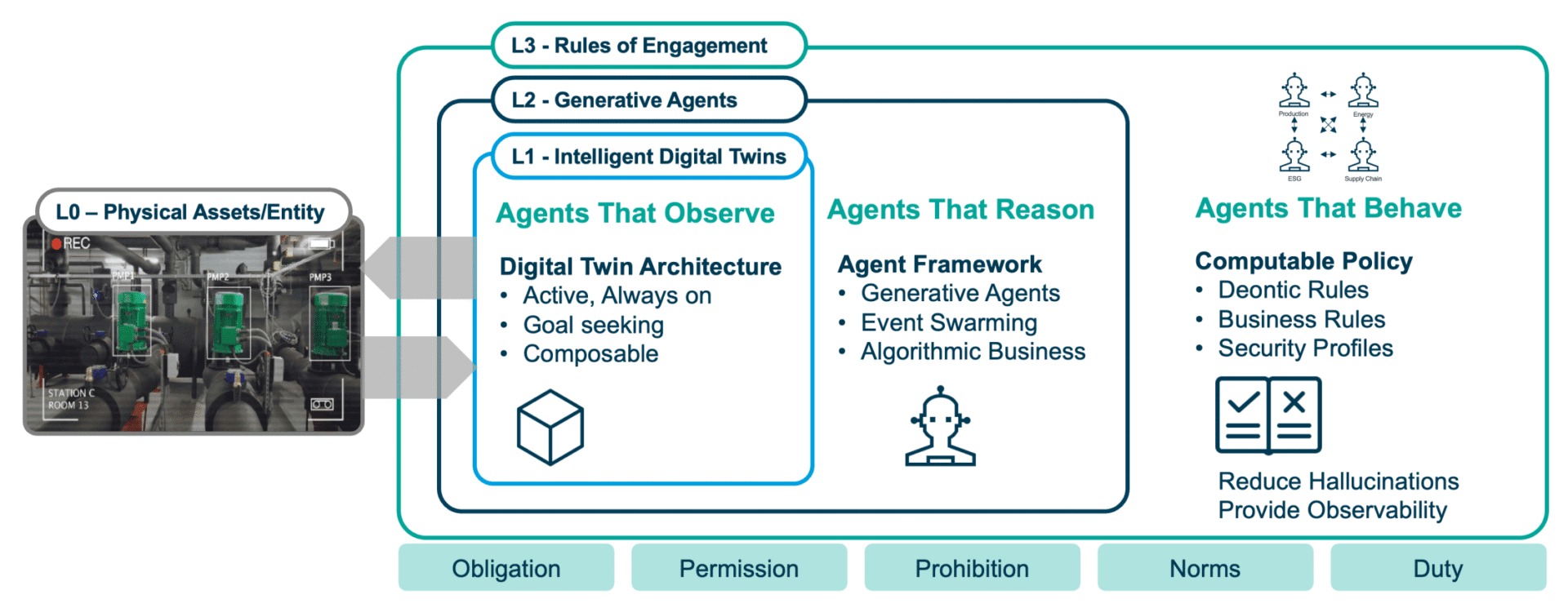
Intelligent Digital Twins as a proxy for agents to observe physical assets
XMPro MAGS agents use digital twins at their core as a model-based approach to complex problem-solving. This engineering-centric approach enables agent teams to understand how their decisions affect physical systems. The agents can simulate operational changes, predict equipment behavior, and optimize performance within safe operating boundaries.
Corporate agents lack this physical context entirely. They cannot understand the difference between a temperature reading in an office building and a reactor vessel. They have no concept of equipment stress, process dynamics, or the engineering principles that determine safe and efficient operations.
A Better Approach: Teams of Engineering Agents
Engineering agents don't work alone and they don't wait for chat requests. XMPro MAGS deploys teams of cognitive engineering agents, each with deep specialized expertise that work together toward shared Objective Functions for the processes they manage.
"> </div>
A team of four XMPro MAGS Agents working to optimize the team's objective function
Unlike corporate chatbots that respond to user queries, engineering agent teams are event-driven. They act continuously on real-time operational data and changing context. A maintenance optimization agent might work with a production scheduling agent and a quality control agent to balance competing objectives automatically.
Event-Driven Intelligence
These agent teams monitor operations continuously, not just when someone asks a question. They process sensor data, equipment status, production metrics, and environmental conditions in real-time. When conditions change or anomalies occur, the appropriate agents activate and coordinate their response.
This event-driven approach means engineering decisions happen at operational speed. The agents don't wait for human requests or follow predetermined chat scripts. They respond to actual operational conditions as they develop.
Shared Engineering Knowledge Space
Engineering agent teams maintain a shared knowledge and decision space that differs completely from generic corporate knowledge bases. This shared space includes:
- Real-time operational data and historical patterns
- Engineering calculations and mathematical models
- Equipment-specific behavior and failure modes
- Process optimization parameters and constraints
- Safety limits and operational boundaries
Engineering agent teams also maintain sophisticated communication protocols designed for industrial environments. Unlike corporate agents that rely on simple chat interfaces, XMPro MAGS uses industrial-grade communication protocols like MQTT for IoT integration, OPC UA for SCADA systems, and DDS for real-time control applications. This multi-protocol approach enables agent teams to communicate directly with operational technology systems while coordinating decisions across the team using hierarchical message routing and enterprise-grade monitoring.
The agents can access corporate knowledge bases when needed, but their primary intelligence comes from engineering-specific content, mathematical models, and operational experience. This creates agent teams that understand both the engineering fundamentals and the specific operational context.
Human-Agent Collaboration Models
Engineering agent teams operate across different collaboration models depending on the situation:
- Fully Autonomous: For well-understood routine decisions within defined parameters
- Human-Agent Teams: For complex situations requiring both agent analysis and human judgment
- Escalation Mode: When conditions exceed defined boundaries, agents defer to human engineers for guidance and learn from the decision
This flexibility means agents handle routine engineering decisions automatically while ensuring human expertise guides complex or unusual situations. The agents learn from human decisions to expand their autonomous capabilities over time.
Consensus-Driven Decision Making
When engineering agent teams face complex decisions with competing objectives, they employ a sophisticated three-phase consensus mechanism. First, agents attempt collaborative iteration to resolve conflicts through structured negotiation around resource constraints and operational dependencies.
If collaboration doesn't achieve consensus, the system transitions to formal voting protocols weighted by agent expertise and confidence scores. Engineering agents must understand not just what happened, but why it happened and how different decisions could lead to different outcomes - moving beyond correlation to true causal reasoning that can simulate interventions and test counterfactuals against possible futures.
When automated consensus fails or confidence falls below defined thresholds, the system seamlessly escalates to human engineering oversight with complete visibility into the decision-making process.
Building Agent Teams the Right Way
Cognitive engineering agent teams should be designed by engineers who understand operational requirements, not IT departments focused on corporate productivity.

Example of a Parametric Design approach
They need parametric design instead of thousands of lines of Python code that create management problems.

Explainable, scaleable DataStreams provide engineering grounding before passing data and context to Agents
The system must be explainable and grounded in mathematics that engineers can verify.
The ORPA Cognitive Architecture
Each agent in the team uses structured reasoning that mirrors how experienced engineers make decisions:
- Observe: Monitor real-time conditions with full engineering context
- Reflect: Analyze observations against engineering principles and past patterns
- Plan: Develop strategies based on professional methodology
- Act: Execute decisions within defined safety boundaries
"> </div>
XMPro ORPA cycle similar to OODA loop
This cognitive architecture enables agent teams to preserve existing engineering expertise while adapting to changing operational conditions. Most importantly, the agents incorporate causal analysis that understands why events occur, not just what patterns appear in data.

XMPro's Causal Reasoning Service informs MAGS Agents of the causal impact
Engineering agents must understand not just what happened, but why it happened and how different decisions could lead to different outcomes - moving beyond correlation to true causal reasoning that can simulate interventions and test counterfactuals against possible futures. Michael Carroll's "Bearing the Weight of Intention and Goodwill" explains this and other agentic concepts brilliantly.
Separation of Concerns for Safety
XMPro MAGS maintains a separation between decision logic and execution control. The cognitive agent teams can observe, reflect, plan, and recommend, but the control system determines what actually happens.

Agents can only actuate what is allowed in XMPro DataStream intelligence levels
This creates safety layers that prevent dangerous actions even if agent logic encounters unexpected conditions.
Scalable Intelligence Levels
The XMPro DataStreams platform supports five levels of decision intelligence, allowing agent teams to operate at appropriate complexity levels:
- Level 1: Rule-based automation for standard procedures and compliance
- Level 2: Model-based control for well-understood processes
- Level 3: Predictive optimization for resource allocation and scheduling
- Level 4: Adaptive systems that learn from operational experience
- Level 5: Cognitive networks for complex operational challenges

XMPro Event-driven DataStreams at the "Core of Control"
This layered approach provides fail-safe mechanisms. If higher-level cognitive agent teams encounter problems, operations can fall back to simpler, more reliable control methods. Each level builds on engineering principles while adding appropriate intelligence for the operational context.
Microsoft, Salesforce, Google . . . Productivity vs. Professional Decisions
Microsoft's Build 2025 conference showed impressive capabilities for office productivity. Copilot agents handle document creation, meeting management, and information summaries well. These skills prove valuable for office work but become hazardous for industrial decisions. Here is a Document Processor Agent

Microsoft Document Processor Agent (source: Microsoft)
The Document Processor Agent is a robust, out-of-the-box solution for automating document workflows. Once installed, it monitors an email inbox for attachments, extracts key information from incoming files, and exports structured data to a target system. When needed, it seamlessly requests human validation, routing documents to assigned reviewers and tracking progress through an integrated monitoring app. Notifications are sent via Teams or Outlook, and validators can view, correct, or approve extracted content in just a few clicks. (source: Microsoft)
The marketing around corporate agents avoids claiming direct industrial application while creating the impression that such use is natural. This creates a "competency illusion" where better language processing appears to equal professional capability. Organizations implement solutions that provide false confidence while accelerating expertise loss.

Example of 3 Agent XMPro MAGS team for Transformer optimization in a Power Utilities Substation
Different Tools for Different Jobs
Salesforce Agentforce excels at customer interactions and sales processes within its designed context. However, a system built to maximize customer satisfaction cannot distinguish between service complaints and safety-critical issues. It cannot understand production delays' impact on downstream processes or weigh operational trade-offs for safe industrial operations.
The problem lies not in what these systems do well, but in the dangerous expansion of their perceived capabilities. Corporate agents work within their designed domains but fail catastrophically when applied to professional contexts requiring specialized knowledge and accountability for physical consequences.
Using Corporate Agents as Contractors
XMPro MAGS takes a different approach to corporate agent capabilities. Instead of trying to make generic agents handle engineering decisions, MAGS can use Microsoft, Salesforce, and similar agents as "contractors" for specific tasks through A2A (Agent-to-Agent) and MCP (Model Context Protocol) communication protocols.
Just as engineers might ask IT for system information, HR for personnel data, or sales for customer requirements, cognitive engineering agent teams can request specific information or tasks from corporate agents. The engineering agents maintain decision authority while leveraging corporate agents for their designed strengths.
This contractor model preserves the distinction between professional engineering decisions and corporate productivity tasks. Corporate agents handle what they do well while engineering agent teams make the operational decisions that require professional competency and engineering judgment.
Engineering Intelligence vs. Corporate Chatbots
Industrial operations need AI systems that complement professional engineering practice, not replace it. XMPro MAGS provides cognitive engineering agents that incorporate mathematical competency, causal analysis, and professional decision-making frameworks. These agent teams work within regulatory requirements because they are built around engineering principles from the ground up.
The distinction matters because engineering decisions require AI systems designed by engineers who understand the professional requirements, mathematical foundations, and safety implications of industrial operations. These systems support professional engineering practice rather than attempting to replace professional accountability.
Making the Right Choice
Industrial leaders face a critical decision about implementing AI systems for operational decisions. They can choose generic corporate productivity systems or implement cognitive engineering agents designed specifically for industrial environments.
Organizations that implement generic corporate agents may achieve short-term productivity gains while creating dangerous dependencies. These systems fail when engineering judgment becomes most critical during unexpected conditions and system variations.
XMPro MAGS: Cognitive Engineering Intelligence
The alternative requires implementing systems designed around engineering principles and mathematical accuracy. XMPro MAGS provides cognitive engineering agents that preserve and extend professional expertise in ways that generic corporate agents fundamentally cannot.
These cognitive agents understand causality, perform mathematical verification, and adapt professional principles to changing conditions. They work within safety frameworks and regulatory requirements because they are built by engineers for engineering decisions.
Professional operational decisions require professional-grade AI systems. XMPro MAGS delivers cognitive engineering intelligence designed around professional principles rather than corporate convenience.
The future belongs to organizations that implement appropriate AI technology for their operational reality. Those who choose corporate productivity tools for engineering decisions will discover the critical difference when their systems fail under conditions where professional judgment proves most essential.
See an XMPro Transformer MAGS team in action here:
Pieter van Schalkwyk is the CEO of XMPro, specializing in industrial AI agent orchestration and governance. With 30+ years of experience in industrial automation, he helps organizations implement practical AI solutions that deliver measurable business outcomes.
About XMPro: We help industrial companies automate complex operational decisions. Our cognitive agents learn from your experts and keep improving, ensuring consistent operations even as your workforce changes.
Our GitHub Repo has more technical information if you are interested. You can also contact myself or Gavin Green for more information.
Read more on MAGS at The Digital Engineer