
Decision Automation: Trusted, Reliable & Explainable Autonomous Operations

Wouter Beneke
Marketing Lead at XMPRO
The Final Stage of Decision Intelligence That Separates Substance from Hype
This article concludes our Decision Intelligence Continuum series, exploring how organizations move from AI-augmented to fully autonomous operations.
Missed the previous articles?
Read Part 2: Decision Support: The Foundation That Transforms Alert Overload Into Orchestrated Action
Read Part 3: Decision Augmentation: From Knowing What's Happening to Knowing What to Do With AI Augmented Guidance.
🔍 What You'll Discover in This Article:
- Why 96% of organizations need AI agents, yet 67% refuse to give them full control, and how to bridge this trust gap
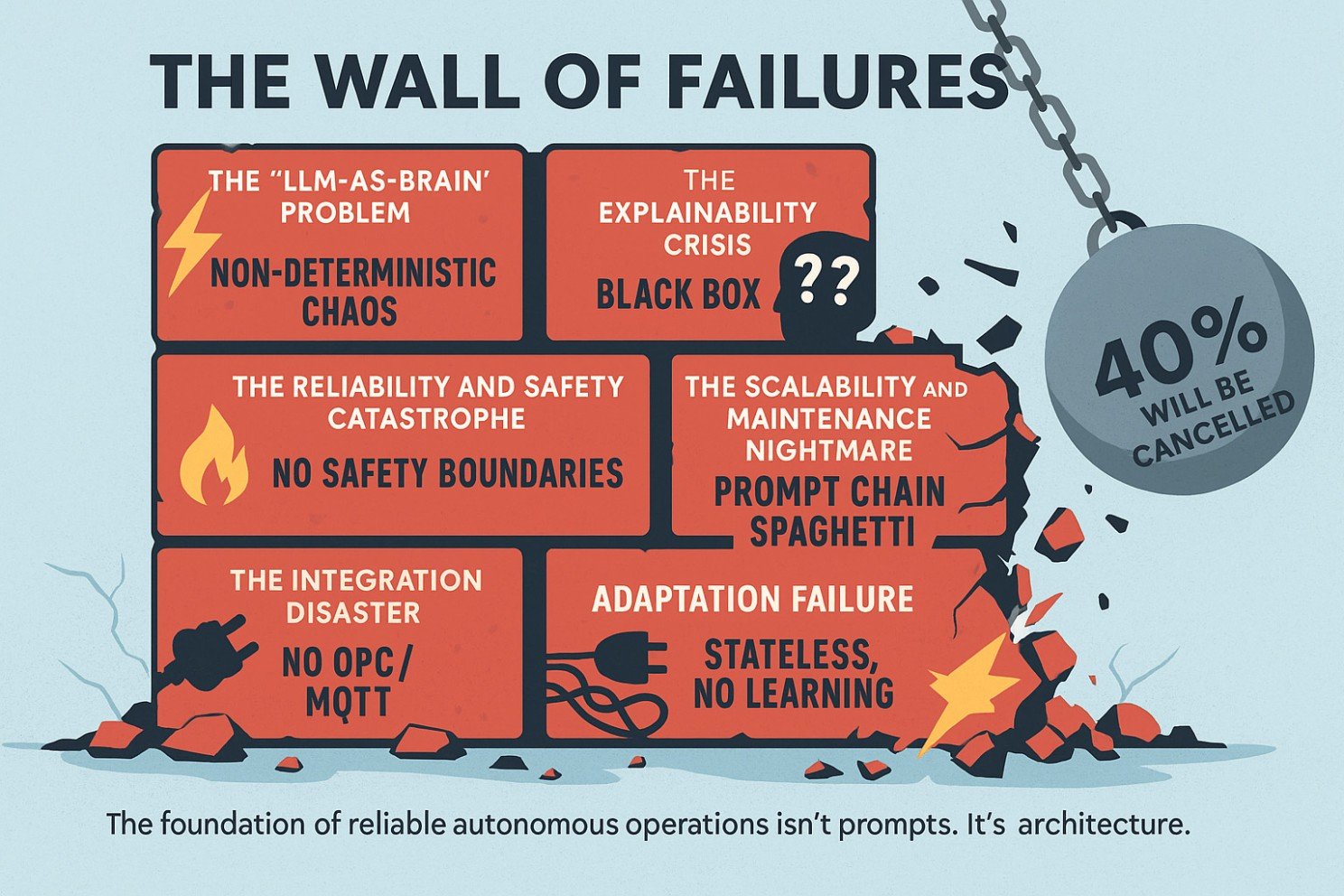
- The six critical architectural shortfalls plaguing autonomous AI approaches and why 40% of projects will be canceled by 2027
- How XMPro's Multi Agent Generative System MAGS architecture solves each architectural issue through the four pillars of trustworthy autonomous operations that separate substance from AI hype.
- Academic and industry validation: University of Adelaide's $490K autonomous agriculture project, Digital Twin Consortium testbeds with Microsoft and NEC
Whether you're evaluating autonomous AI strategies or struggling with failed agent implementations, this article provides the technical insights and proven framework to move beyond experimentation to trusted, reliable, and explainable autonomous operations.
The Autonomous Operations Crisis: Why 96% Need What 67% Won't Trust
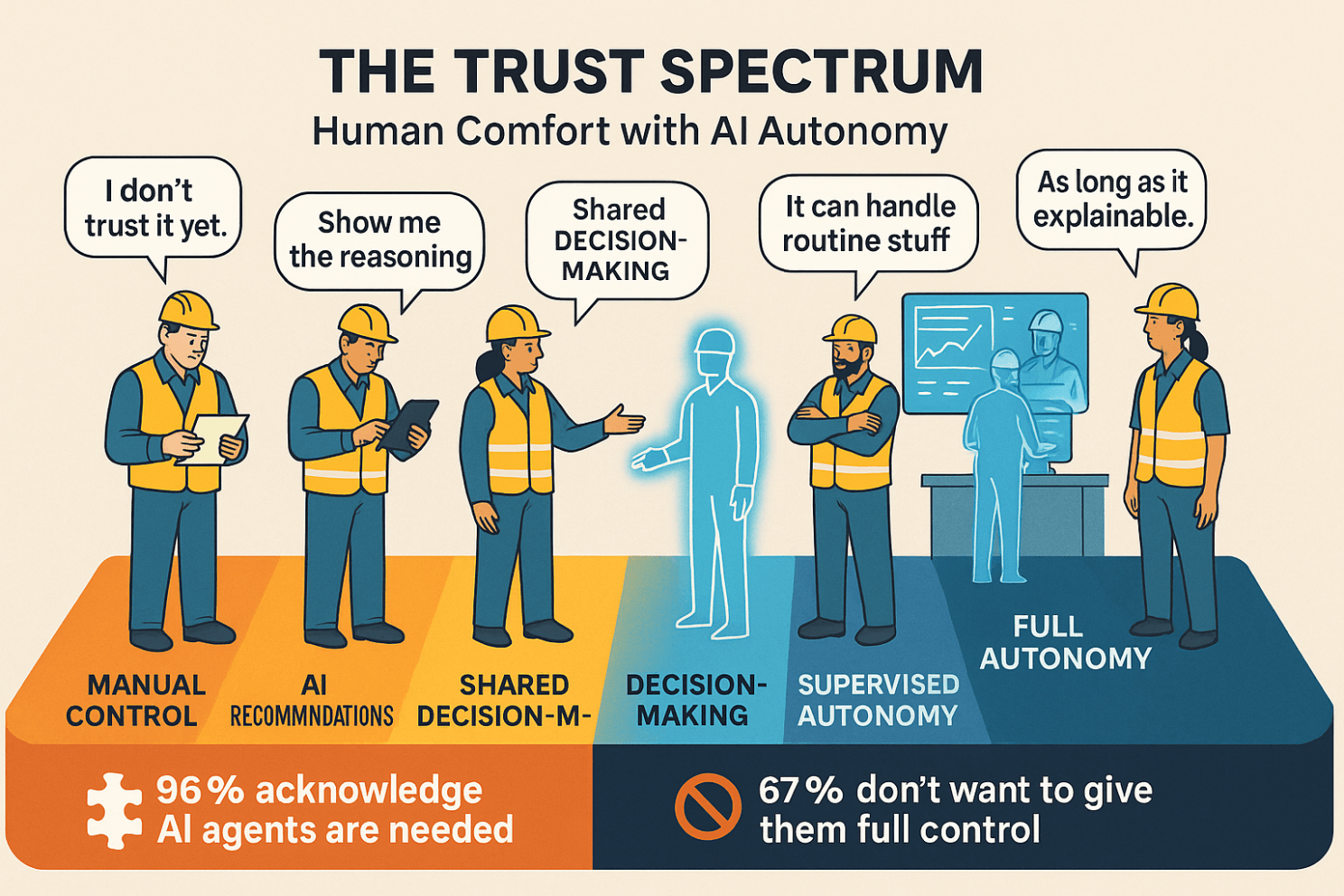
In a recent article citing LNS Research , XMPro CEO Pieter van Schalkwyk reveals a striking paradox: 96% of organizations recognize the need for AI agents, yet 67% are unwilling to grant them full control. This isn't about technical readiness...it's about trust. (Read Pieter's Full Article Here)
The numbers tell the story of an industry at an inflection point:
- 2.1 million manufacturing jobs will go unfilled by 2030, potentially costing $1 trillion annually
- Gartner predicts over 40% of agentic AI projects will be canceled by 2027 due to "escalating costs, unclear business value, and inadequate risk controls"
- Yet 15% of daily work decisions will be autonomous by 2028, up from 0% today
The companies that succeed will bridge this trust gap through transparent, explainable systems that preserve human agency while delivering autonomous intelligence.
There is, however, a big problem (and opportunity)... designing systems that adapt execution authority to different comfort levels isn’t just a technical challenge, it’s an architectural imperative that traditional approaches can’t solve.
Why Alternative Approaches Fall Short
Gartner Senior Director Analyst Anushree Verma explains: "Most agentic AI projects right now are early-stage experiments driven by hype and often misapplied, blinding organizations to the real cost and complexity of deploying AI agents at scale."
Organizations attempting autonomous operations through conventional approaches encounter predictable failure patterns:
The "LLM-as-Brain" Problem: Non-Deterministic Chaos
Using Large Language Models for core decision logic creates unpredictable outputs, the same input generates different responses, making industrial operations impossible. Business rules buried in prompts change with model updates, creating hallucination risks in critical decisions.
The Black Box Explainability Crisis
LLM "reasoning" is narrative generation, not actual logic. When failures occur, it's impossible to trace causes or explain decisions to auditors and regulators.
The Reliability and Safety Catastrophe
Single points of failure where one bad LLM response crashes operations, no hard safety boundaries, and inconsistent performance varying with model parameters.
The Scalability and Maintenance Nightmare
Prompt drift changes system behavior unpredictably, model dependency breaks systems when providers update, and technical debt accumulates from spaghetti code of prompt chains.
The Integration and Interoperability Disaster
Fragile API connections, no support for industrial protocols (OPC UA, MQTT, DDS), data format chaos, and basic security through API keys.
The Learning and Adaptation Failure
Stateless operations with no memory between interactions, no learning framework for improvement, and no knowledge transfer between agents.
The Market Reality: Gartner estimates only about 130 of the thousands of agentic AI vendors are real, with most engaging in "agent washing"—rebranding existing products without substantial agentic capabilities.
XMPro's Cognitive Architecture: Solving Each Challenge
XMPro's Multi-Agent Generative Systems MAGS provide a comprehensive cognitive architecture that directly addresses each failure mode while providing the transparency, explainability, reliability, and safety that industrial operations demand.
Advanced Memory Architecture: Beyond Stateless Operations

Unlike chatbots that forget each interaction, MAGS agents maintain continuous memory through specialized cognitive cycles called ORPA (Observe-Reflect-Plan-Act).
The Cognitive Flow:
- Environmental data processes into insights
- Insights inform strategic planning
- Plans drive decisions
- Action outcomes create new observations
The system includes sophisticated significance scoring and memory consolidation, enabling agents to build institutional knowledge and share insights across the entire team. This cycle mirrors human expert decision-making but operates at machine speed and scale.
90% Business Logic, 10% LLM: Deterministic Intelligence

XMPro's approach inverts the typical AI architecture. Mathematical optimization drives decisions, not probabilistic text generation. LLMs serve as text processing utilities while deterministic systems handle critical choices, eliminating the non-deterministic chaos of LLM-as-brain approaches.
The real intelligence consists of memory management, consensus protocols, objective optimization, and adaptive planning—defensible, proprietary algorithms representing genuine competitive advantages.
Consensus-Driven Coordination: Multi-Agent Collaboration

XMPro implements different consensus algorithms based on decision criticality, with routine decisions requiring simple agreement, critical decisions incorporating expertise weighting, and safety-critical choices requiring higher consensus thresholds.
The system includes sophisticated conflict resolution processes with automatic resource conflict detection, escalating to human operators only when deadlock occurs.
This collaborative framework enables the team to generate optimal "Best Next Action" decisions that encompass decision intelligence, prognostic planning, and autonomous process control. The result is superior operational outcomes achieved through coordinated specialist expertise rather than isolated agent optimization.
Safe Execution through Separation of Control :
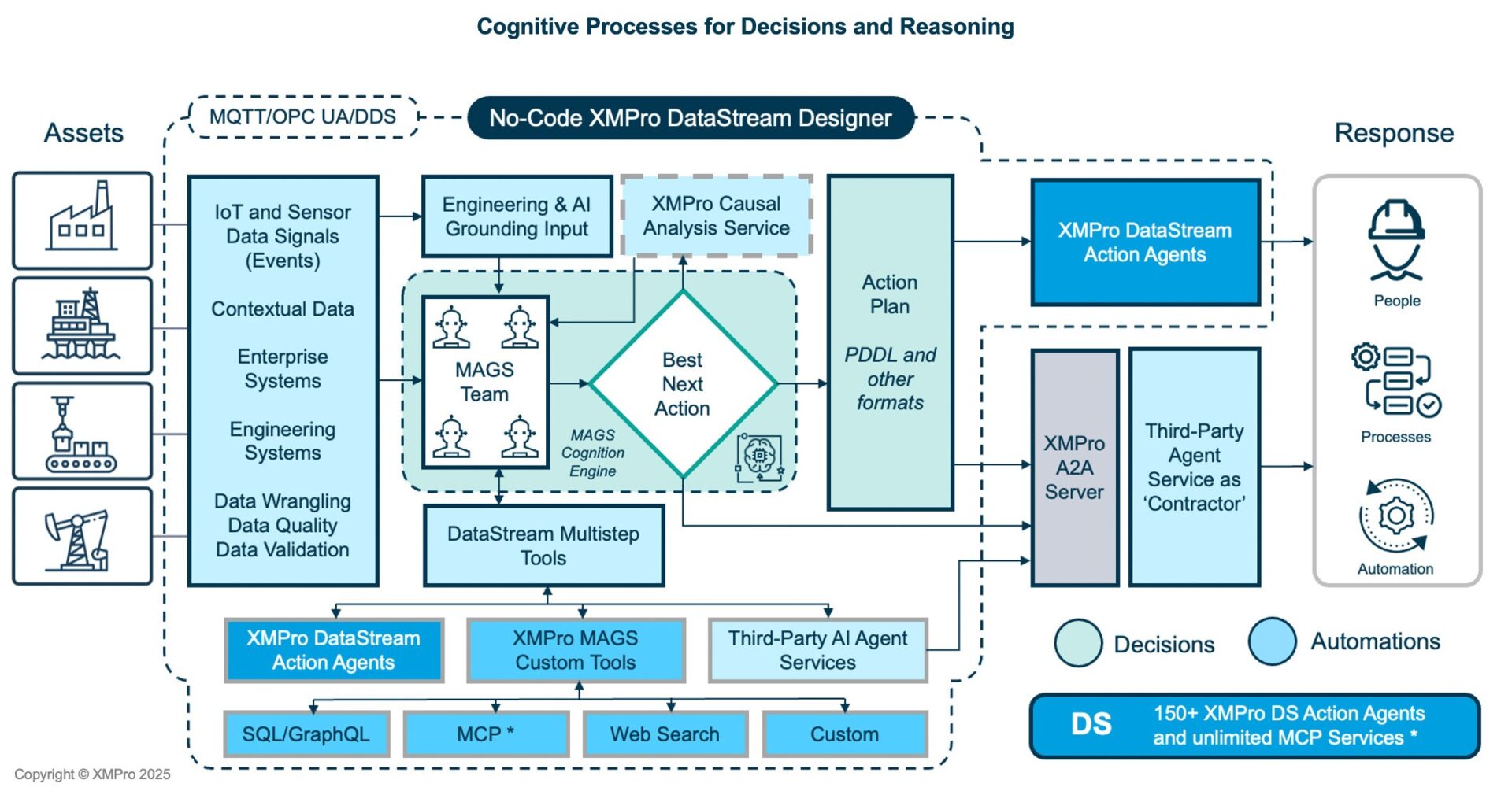
XMPro maintains strict separation between cognitive decision-making and physical execution. MAGS-generated action plans (formatted in standards like PDDL) flow to DataStream Action Agents for controlled implementation.
Key Architecture Benefits:
- Agents reason with full intelligence but only execute through bounded, safety-validated channels
- Progressive autonomy: expand execution authority without rebuilding intelligence
- Native industrial integration (OPC UA, MQTT, DDS) with enterprise security
- Over 150 native action agents with comprehensive tool integration
Edge-to-Cloud Autonomous Operations:
Through partnership with AMD , XMPro MAGS can deploy directly at the industrial edge using AMD Ryzen™ AI acceleration, delivering up to 8-9x faster processing.
This solves critical industrial challenges including:
- Latency: No cloud round trips for critical decisions
- Cost: Eliminates $15K+ monthly cloud API fees for typical manufacturing plants
- Security: Sensitive data never leaves the facility
- Resilience: Autonomous operations continue during connectivity loss
Agentic Operations at Scale - XMPro Agentic Platform Experience (APEX)

XMPro APEX (Agent Platform EXperience) provides the critical operational framework for deploying and managing Multi-Agent Generative Systems at enterprise scale. While MAGS delivers cognitive agent capabilities, APEX ensures these systems operate reliably, safely, and consistently across complex industrial environments.
APEX Comprehensive Agent Lifecycle Management includes the following:
- Agent Profile Management: Define capabilities, customize behaviors, and track performance evolution
- Team Management: Organize agents into collaborative teams with defined structures and hierarchies
- Memory Management: Store and retrieve agent memories efficiently with optimized vector database solutions
- Planning and Decision Management: Oversee agent planning processes and optimize decision-making strategies
- Communication Management: Facilitate inter-agent communication and manage external system interactions
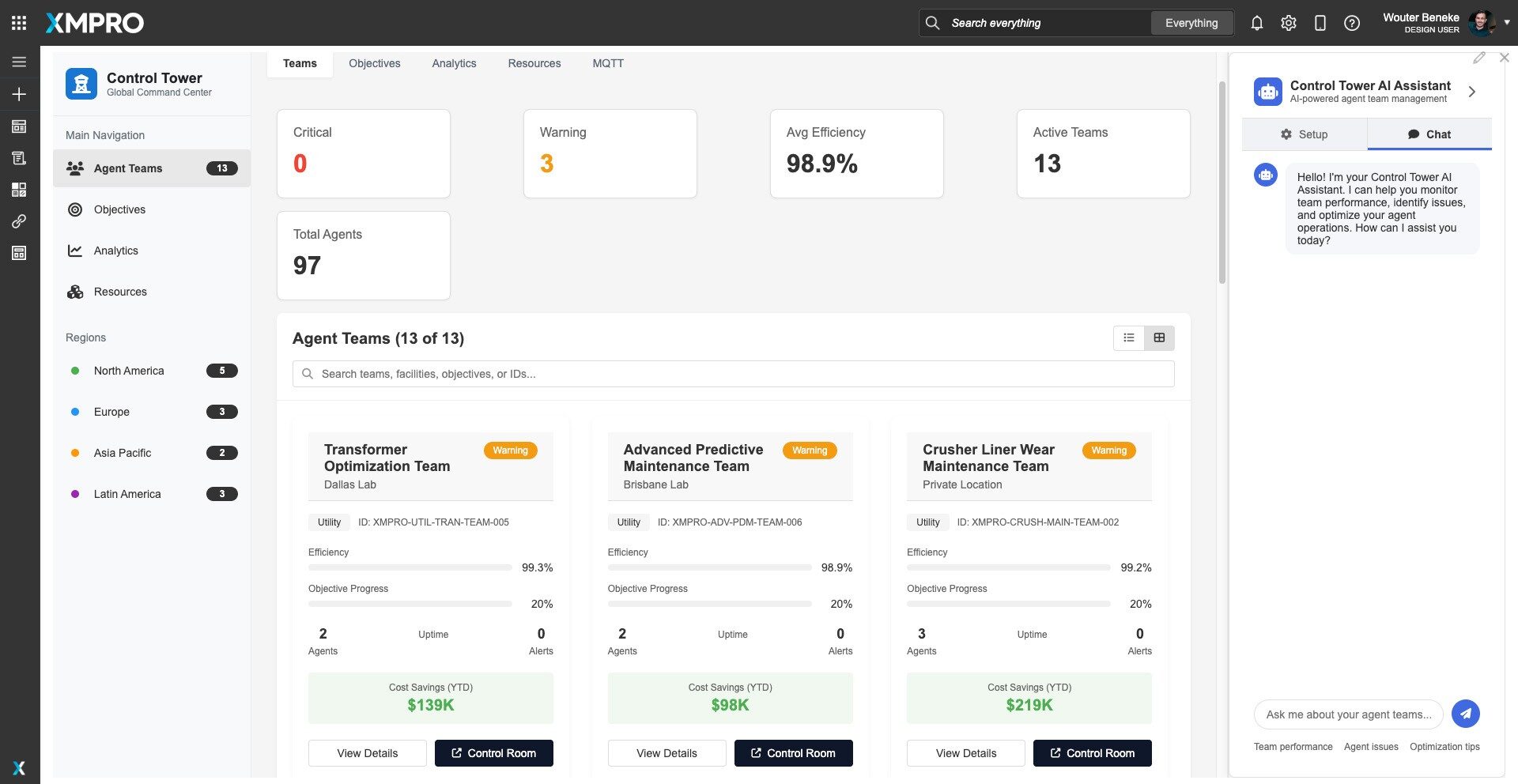
The Agent Control Tower serves as your enterprise command center, providing:
- Real-time Team Performance: Monitor hundreds of agents & agent teams across your operations in real-time.
- Global Command Center: Unified visibility across Intercontinental operations
- Intelligent Alerting: Priority alerting system with automated escalation
- Resource Management: Track agent utilization, identify bottlenecks, and optimize team composition
- Live Communication Hub: MQTT-based real-time messaging with active agents and comprehensive topic management
The Trust Equation: Four Pillars of Autonomous Operations
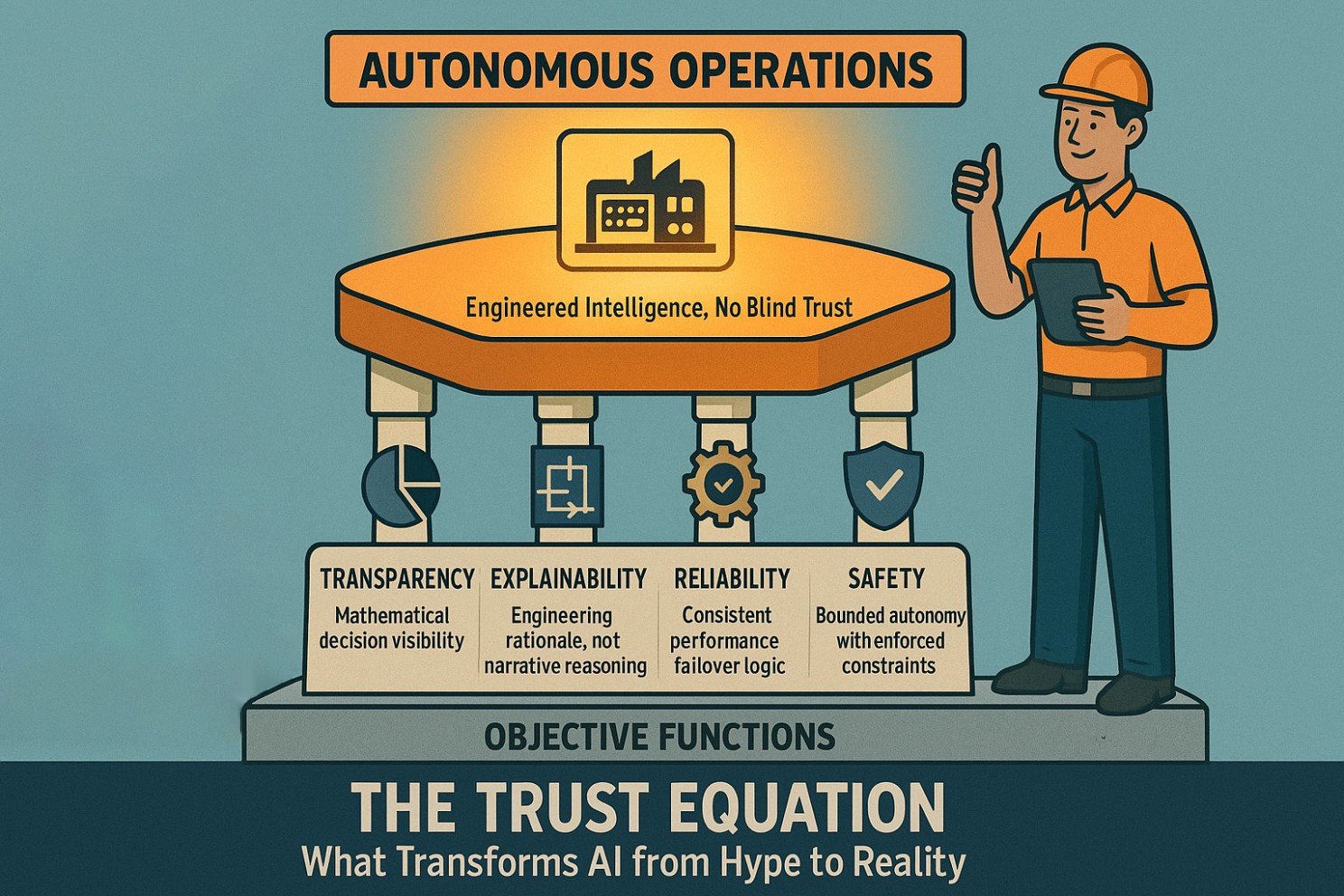
While technical architecture helps to solve many of the mentioned issues, organizational trust requires four pillars that distinguish substance from hype:
1. Transparency
Every autonomous decision must show exactly how competing objectives were prioritized—no black boxes allowed.
XMPro’s Objective Functions break down every autonomous decision to show exactly how different factors, like safety, efficiency, and cost, were considered and weighted. This gives operators full visibility into how the system makes trade-offs instead of relying on black-box outputs.
The framework supports many performance goals using weighted optimization. During operation, teams can adjust how much each factor matters, set limits, and choose whether to maximize or minimize each metric. Safety rules always take priority, and the system automatically detects when goals conflict and makes adjustments. This lets teams fine-tune decisions in real time
When autonomous systems make million-dollar decisions, "trust me" isn't good enough. XMPro's objective functions provide mathematical transparency into every autonomous choice.
2. Explainability
Multi-Component Reasoning: XMPro explains decisions through weighted contributions of safety, efficiency, quality, and cost factors that industrial engineers can validate and improve. When multiple agents reach consensus, the system explains the convergent reasoning and why alternative approaches were rejected.
Industrial Ontologies Integration: Built-in support for industry standards like ISA-95, DEXPI, and IDO provides structured domain knowledge that enables reasoning with industrial context, not just text patterns. This addresses Gartner's prediction that by 2027, over half of enterprise AI models will focus on specific industries—a fifty-fold increase from today's 1%⁶.
3. Reliability
Quantified Performance Optimization: XMPro's objective functions ensure agents maintain performance standards even as conditions change. Every agent's contribution to system objectives is measured and tracked, with automatic early warnings when performance metrics trend toward failure thresholds.
Vendor-Agnostic Architecture: Unlike single-vendor AI solutions, XMPro provides true flexibility across OpenAI, Anthropic, AWS Bedrock, Google, and Ollama for LLMs, plus multiple vector databases (Milvus, MongoDB Atlas, Qdrant) and graph databases (Neo4j, CosmosDB). As AI models evolve, XMPro ensures you can leverage the best AI for each specific industrial use case.
Edge-to-Cloud Resilience: XMPro's architecture enables autonomous operations to continue during connectivity loss through local consensus among edge agents, cached memory for recent observations and critical knowledge, and degraded mode operations with reduced but continued autonomous functionality. The system seamlessly transitions between edge processing (real-time consensus, immediate safety decisions, local memory cache) and cloud processing (long-term memory consolidation, complex planning, cross-team coordination) based on connectivity availability.
4. Safety
Bounded Autonomy: XMPro's objective functions implement multiple constraint levels with varying degrees of flexibility—immutable constraints that cannot be overridden regardless of optimization pressure, critical constraints essential for business operations requiring elevated consensus to modify, and flexible constraints that can be adjusted through standard consensus processes. Safety constraints always override efficiency optimization through operational limits enforced at the system architecture level.
Deontic Authorization: XMPro's advanced authorization system enforces organizational rules and ethical guidelines, going beyond traditional "can access" permissions to context-sensitive "should access" authorization based on current operational state and organizational policies. The system includes sophisticated token management with temporal controls and secure cross-organizational coordination capabilities.
Multi-Round Consensus & Escalation Framework: To ensure safe and reliable outcomes in ambiguous or conflicting scenarios, MAGS agents use a multi-round consensus mechanism. Agents iteratively share proposals, refine decisions, and reach agreement based on weighted logic and confidence scores. If consensus is not achieved within a bounded time or confidence threshold, the escalation framework engages higher-authority agents or human supervisors. This safeguards operations from indecision, errant actions, or model hallucinations, especially in mission-critical environments.
The 40% of agentic AI projects that will fail by 2027 will fail on safety. XMPro's architecture makes safety a mathematical requirement, not an afterthought.
How XMPro Solves the Human Trust Issue With Human Agency Controls
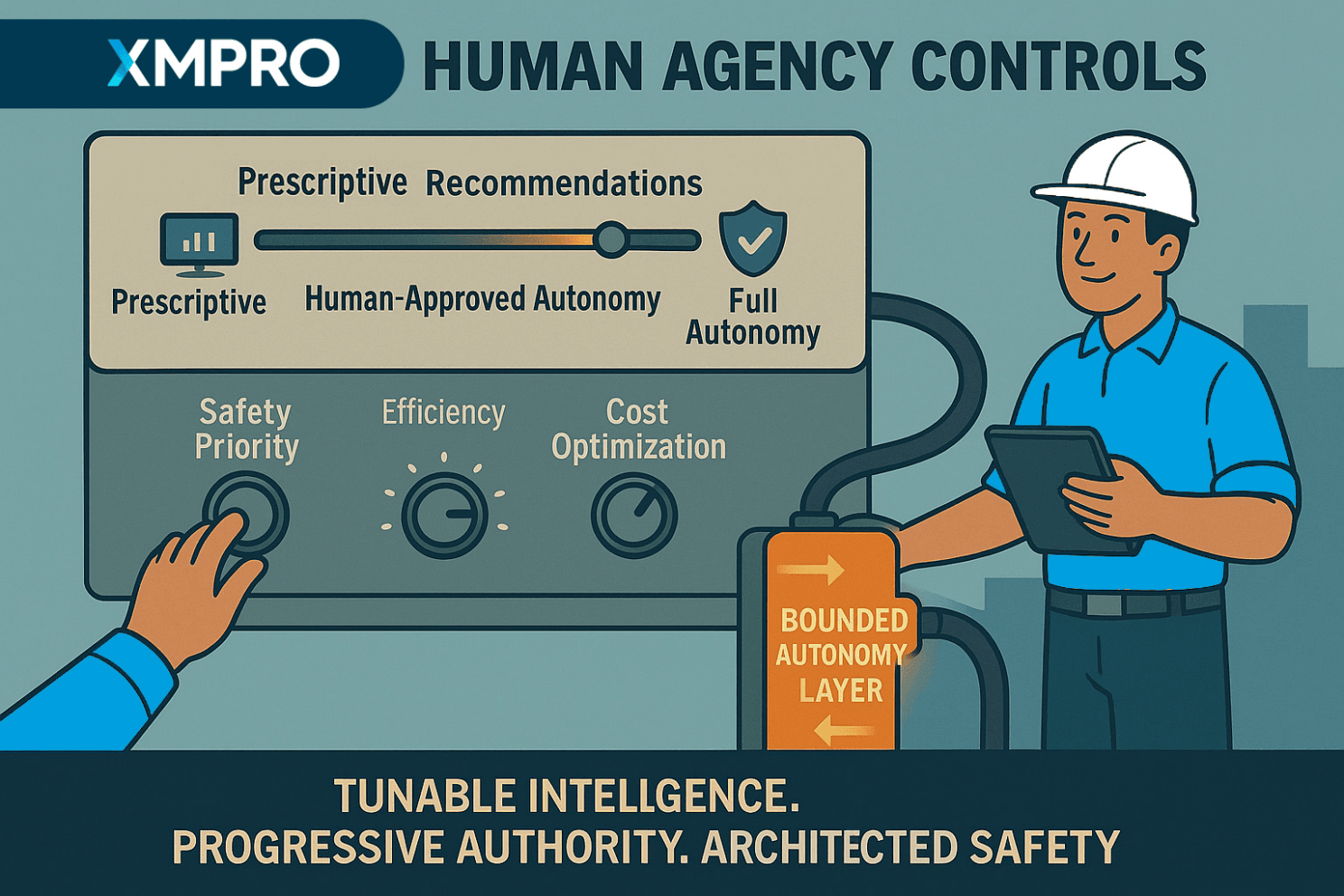
XMPro directly addresses the human trust challenge through Human Agency Controls that enable dynamic authority management without limiting intelligence.
Progressive Autonomy: From Recommendations to Trusted Execution
XMPro enables organizations to begin with advisory-mode autonomy, where agents generate recommendations rather than take direct action. These recommendations appear in dashboards, alerts, or collaborative interfaces where operators review, validate, and approve them. As confidence grows, execution authority can be selectively expanded.
This progression is managed in XMPro’s DataStream Designer, where each agent’s output is routed to human review points or automated execution endpoints based on predefined autonomy levels. Decision routing, audit trails, and approval workflows are built directly into the data pipeline, ensuring that intelligence evolves without requiring architectural changes.
By starting with decision support and moving gradually toward autonomous action, XMPro aligns agent authority with operational trust, allowing organizations to adopt autonomous operations at their own pace, without compromising safety or oversight.
Parametric Control: XMPro allows real-time tuning of agent objective function weights, enabling operators to reprioritize safety, efficiency, or cost based on live operational needs, without disrupting ongoing processes.
Architectural Safety: XMPro's DataStream architecture provides bounded autonomy hardwired into the system through separation of reasoning from execution, making it impossible for agents to act outside predefined safety pathways.
With progressive autonomy, tunable objectives, and enforced safety limits, XMPro turns black-box algorithms into operator-adjustable precision tools. The difference between autonomous systems and autonomous operations is control—XMPro provides both sophisticated intelligence and operational flexibility through architectural controls rather than system redesign.
Real-World Autonomous Operations: Academic and Industry Validation
University of Adelaide: Autonomous Agriculture
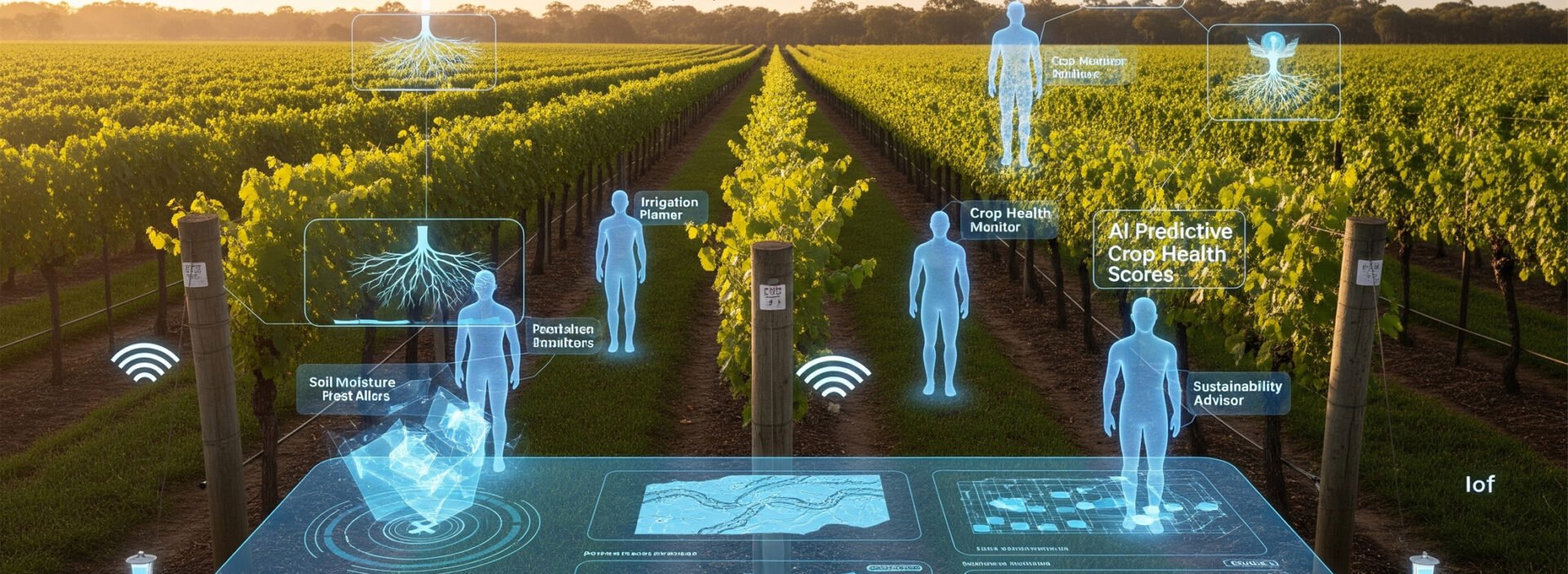
An AEA-funded project led by Professor Volker Hessel at the University of Adelaide is bringing together digital twins, IoT, and collaborative Agentic AI Teams to improve crop health, reduce emissions, and boost sustainability in viticulture and canola production.
XMProis proud to contribute our Multi-Agent Generative Systems MAGS to this groundbreaking collaboration alongside:
- Serafino Wines, led by Maria Maglieri
- Federation University Australia, with Professor Harpinder Sandhu
- Constellation Technologies Limited
- Agora High Tech Pty Ltd, led by Adjunct Professor Nicola Sasanelli AM
At Serafino Wines in McLaren Vale, real-time sensor data feeds into a living digital twin of the vineyard. XMPro’s autonomous agents simulate outcomes, identify early risks, and recommend the best next actions, supporting faster, more confident decisions without overloading farmers with raw data.
This project builds on research from the ARC Centre of Excellence in Plants for Space, in partnership with NASA - National Aeronautics and Space Administration. That same innovation is now being applied to orchestrate sustainable, intelligent decisions here on Earth.
Automated Negotiation: Multi-Agent Coordination with NEC Corporation

Built on NEC Corporation ’s negotiation platform and XMPro ’s Multi-Agent Generative Systems MAGS, this testbed demonstrates secure, autonomous negotiation between organizations, where agents simulate outcomes, evaluate utility, and optimize decisions based on shared goals and constraints.
Key contributions:
- Decision Flexibility: Agents dynamically adapt to negotiation complexity using generative reasoning models.
- Utility-Based Outcomes: Digital twins provide live representations of assets and constraints to optimize agreement quality and alignment.
- Policy-Aware Coordination: Cross-boundary negotiations respect institutional policies, privacy requirements, and governance rules.
This testbed highlights how autonomous negotiation outperforms traditional manual processes in speed, quality, and coordination, unlocking scalable collaboration in competitive environments like manufacturing, logistics, and defense supply chains.
Rowan University & XMPro: Real-Time Additive Manufacturing Testbed

In partnership with Rowan University , XMPro co-developed a live testbed for real-time metal 3D printing using a commercial-grade Laser Powder Bed Fusion (LPBF) system. This testbed integrates AI-powered agents, digital twins, and high-performance computing to create a fully autonomous, closed-loop manufacturing process.
Key capabilities include the following:
- AI-driven defect detection and in-process correction
- Real-time feedback via a complete digital twin of the production environment
- Seamless integration with enterprise systems to support a continuous digital thread
- Support for the Quality Information Framework (QIF) to enhance traceability and compliance
This testbed supports manufacturers in aerospace, defense, and medical sectors working with complex metal alloys.
The Competitive Divide: 60% Success vs 40% Failure
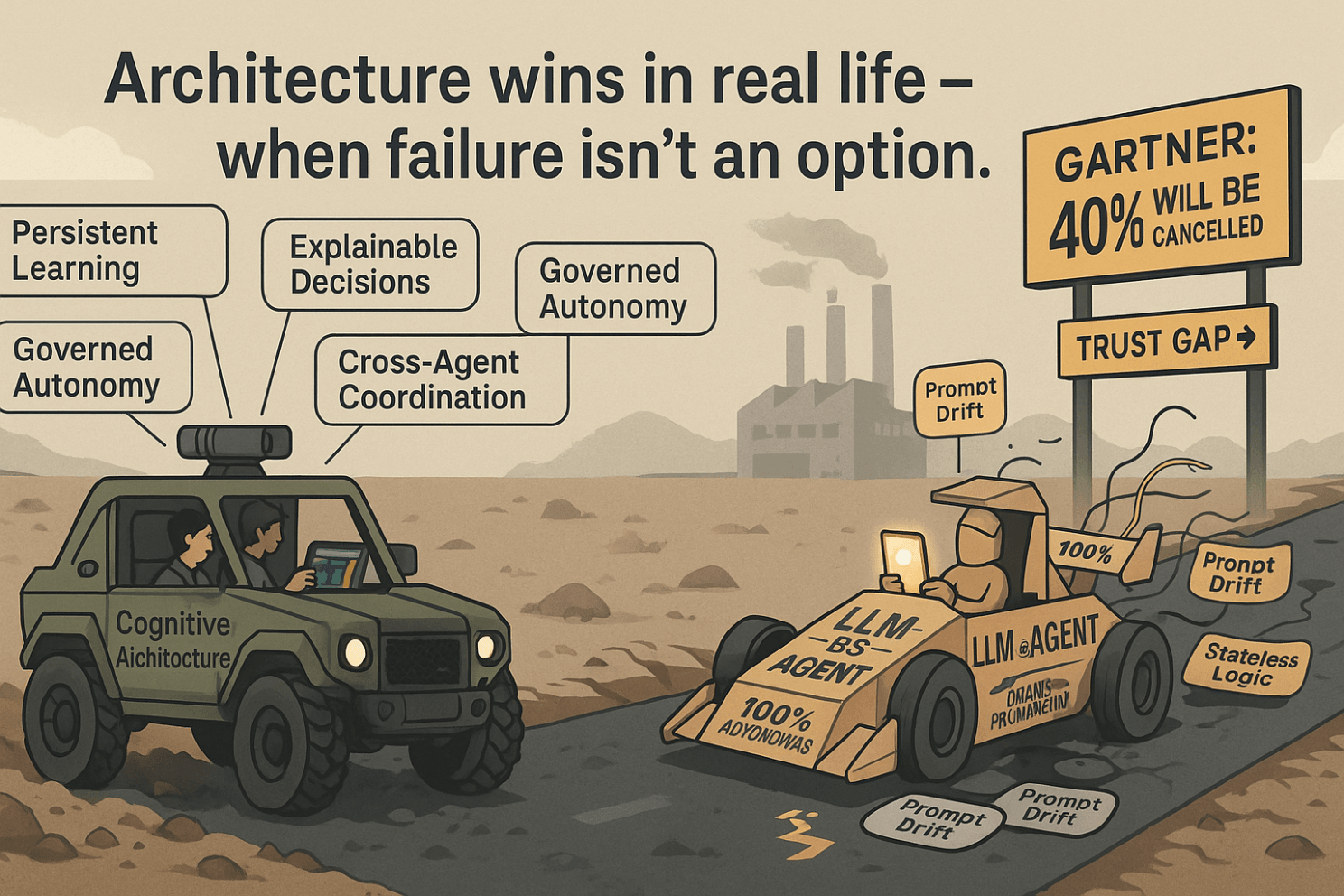
The difference between companies that succeed and those that join Gartner's 40% failure rate isn't about AI sophistication, it's about architectural discipline.
The 40% That Will Fail build sophisticated automation, call it intelligence, and wonder why organizations won't trust black-box recommendations with million-dollar consequences.
As XMPro CEO Pieter van Schalkwyk explains: "The true power of MAGS comes not from automating what you already do but from doing what was previously impossible. By focusing on decisions rather than processes, you unlock value that remains invisible to organizations trapped in the 'horseless carriage' mindset."
If your team is navigating trust, transparency, or autonomy challenges, XMPro offers a proven, scalable path. Learn more about XMPro's Multi-Agent Generative Systems at xmpro.com
Decision Automation isn't a future possibility, it's happening now, with XMPro leading the way through validated, field-tested autonomous operations that industrial engineers can trust, understand, and control.
Next in our series: "Supervisory Intelligence: The Command Center for Autonomous Operations" - exploring how traditional dashboards evolve into governance interfaces for multi-agent systems.
References
- LNS Research - "Autonomous Operations: AI with Guardrails" - blog.lnsresearch.com
- Gartner Press Release - "Gartner Predicts Over 40 Percent of Agentic AI Projects Will Be Canceled by End of 2027"
- Manufacturing Institute & Deloitte - "Creating pathways for tomorrow's workforce today: Beyond reskilling in manufacturing" (2021)
- XMPro - "Secure, Fast & Predictable AI at the Edge" - Cloud cost analysis based on 72 million sensor readings per month at AWS, Azure, and Google Cloud AI inference rates - xmpro.com/amd
- Stanford University Research - "Human Agency Scores" across 1,500 workers in 104 occupations
- van Schalkwyk, Pieter - "Why Industrial AI Must Understand Your Business Context" - LinkedIn, July 22, 2025
- Gartner - "Tech FutureSight: Domain-Specific Insight Will Dominate the Agentic AI Race"
- University of Adelaide - "Digital Twins in Agriculture: Virtual Farm Model for Enhancing Crop Health, Productivity, and Sustainability" ($490,000 AEA funding)
- Digital Twin Consortium - "Automated Negotiation with Digital Twins and MAGs Testbed"
- XMPro Customer Case Study - "Digital Twins in Mining Operations and Maintenance"
- XMPro Customer Case Study - Oil & Gas Supermajor Implementation
- Digital Twin Consortium - "Cognitive Network Orchestration Testbed" (XMPro + Microsoft)
- Gartner Prediction - "By 2028, at least 15% of day-to-day work decisions will be made autonomously through agentic AI"
About the Author
Wouter Beneke leads global marketing at XMPro, where he works closely with industrial clients to communicate the real-world impact of Decision Intelligence and autonomous operations. He brings a background in engineering-first storytelling, helping operations leaders distinguish between AI hype and industrial reality. His writing explores how Multi-Agent Generative Systems deliver measurable outcomes through cognitive architectures that are transparent, explainable, reliable, and safe.
About XMPro: We help industrial companies move beyond AI hype to genuine autonomous operations through Multi-Agent Generative Systems that learn from your experts and continuously improve. Our cognitive architectures deliver transparency, explainability, reliability, and safety—ensuring consistent performance even as your workforce changes. Unlike vendors focused on demos, we deliver measurable outcomes through proven industrial implementations.
#DecisionIntelligence #AutonomousOperations #IndustrialAI #MAGS #DigitalTwins #XMPro #CognitiveArchitecture #AgenticAI