
























Pieter Van Schalkwyk
CEO at XMPRO
When a chemical plant operator monitors 1,000 daily alarms instead of the 60 they could handle a decade ago, something has gone seriously wrong. The complexity explosion in industrial operations has outpaced human cognitive capacity. We're asking people to process information and make decisions at speeds that exceed what human brains can handle.
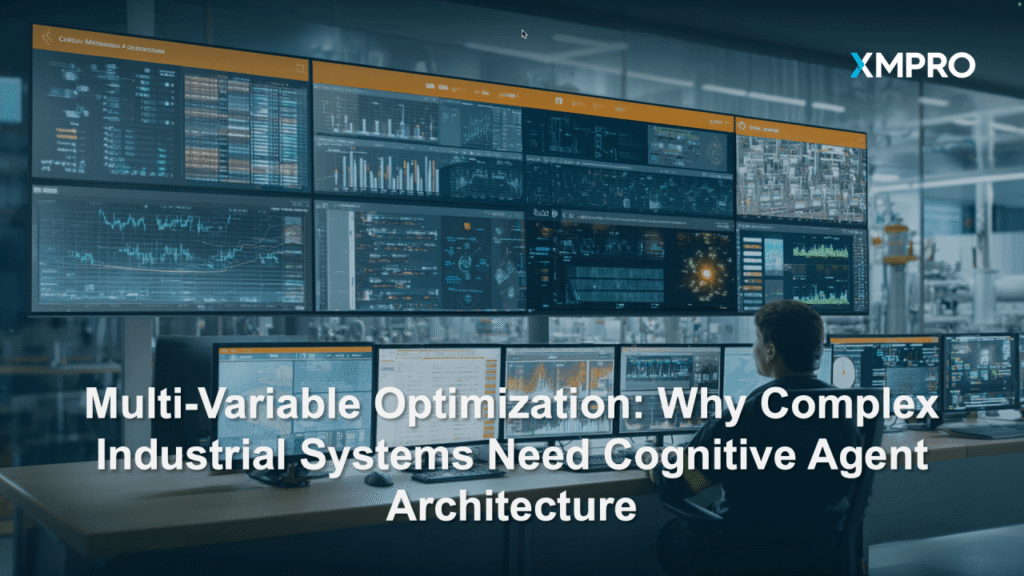
The cognitive burden on operators has reached critical levels. Plant managers routinely monitor over 1,000 alarms daily, up from 60-100 historically manageable levels. Control room operators must simultaneously track 7 different screens while processing real-time data from hundreds of sensors. This cognitive overload leads to decision fatigue, safety risks, and increased error rates.
Expert discussions consistently highlight multi-variable optimization as the core challenge. Information complexity now exceeds human processing capacity and reaction speed in most asset-intensive industries. The solution lies in cognitive agent architecture that extends human reasoning at machine speed and scale.
The Reality of Industrial Complexity
Oil and gas refineries demonstrate this challenge clearly. Operators must simultaneously manage:
- Gasoline yield optimization versus diesel production targets
- Feedstock cost variations and energy consumption patterns
- Environmental compliance limits and market condition changes
- Quality specifications across multiple product streams
The mathematical reality proves overwhelming. Two interacting variables create a two-dimensional optimization space. Adding a third variable expands this to three dimensions. Each additional variable multiplies complexity exponentially rather than linearly.
Human experts navigate this through pattern recognition and experience-based intuition. However, their cognitive architecture operates at human speeds. When processes require responses in seconds or minutes, human limitations become system bottlenecks.
Why Traditional Approaches Fail
Traditional control systems excel at single-variable optimization. They maintain temperatures, regulate pressures, and control flow rates with impressive precision. These systems break down when variables interact dynamically across multiple process units.
Multi-variable optimization creates several critical challenges:
- Local optimization often destroys system-wide performance metrics
- Process unit decisions affect downstream operations unpredictably
- Information processing requirements exceed human cognitive capacity
- Response time demands surpass human reaction speeds
Current industrial AI focuses on analytics and recommendations that still require human interpretation. People become the limiting factor in system performance. The gap between system complexity and human capacity continues widening.
The Cognitive Architecture Solution
XMPro MAGS addresses this fundamental limitation through structured cognitive processes. The system implements observe-reflect-plan-act cycles that mirror human expert reasoning. However, these cycles execute continuously at machine speed rather than human pace.
Each cognitive cycle involves four distinct phases:
- Observe: Monitor process conditions with full contextual awareness and pattern recognition
- Reflect: Analyze observations against accumulated knowledge and historical patterns
- Plan: Develop response strategies that consider system-wide impacts and trade-offs
- Act: Execute decisions within carefully defined safety boundaries and constraints

This cognitive architecture operates beyond human temporal and spatial limitations. Agents process hundreds of variables simultaneously while maintaining coherent optimization strategies.
Universal Application Across Industries
The multi-variable optimization challenge extends far beyond oil and gas operations. Every asset-intensive industry faces similar complexity management problems. The underlying mathematical and cognitive principles remain constant across different applications.
Industries experiencing these optimization challenges include the following:
- Steel production: Product mix, energy consumption, and equipment utilization optimization
- Chemical manufacturing: Reaction conditions, separation processes, and purification coordination
- Mining operations: Ore grade management, equipment scheduling, and environmental constraints
- Pharmaceutical manufacturing: Yield optimization, purity requirements, and regulatory compliance
- Food processing: Taste, nutrition, shelf life, and cost balance optimization
Each industry involves coordinating multiple objectives that interact in complex ways. The optimization complexity mirrors refinery operations with different objective functions.
System-Level Intelligence Through Coordination
Individual agents handling single process units provide incremental value. Transformative potential emerges when multiple agents coordinate through shared objective functions. This coordination prevents local optimization from undermining system-wide performance.
XMPro creates shared memory and decision spaces where agents access each other's observations. This architectural choice enables system-wide coherence that traditional control approaches cannot achieve. Agents share insights and coordinate responses rather than optimizing in isolation.
Effective agent coordination requires several key capabilities:
- Shared observation access: Agents can review each other's environmental monitoring data
- Coordinated planning: Multiple agents develop compatible response strategies together
- Conflict resolution: Systems manage competing objectives through mathematical trade-offs
- Collective learning: Agents improve performance by sharing experience and insights
Network effects emerge when multiple optimization agents work together effectively. Coordinated agent teams create system-level intelligence that exceeds individual agent contributions.
Mathematical Foundation: Objective Functions
XMPro MAGS distinguishes itself through objective functions that mathematically define optimization targets. These functions provide coherent frameworks that align agent decisions with business goals. Agents optimize toward mathematical objectives rather than following predetermined rules.
Consider a refinery optimization objective function for maximizing daily profit:
Maximize: Daily Profit = Σ(Product_Price × Product_Yield) - Σ(Feedstock_Cost × Feedstock_Volume) - Operating_CostsSubject to constraints:
- Quality_Gasoline ≥ 87 octane minimum
- Sulfur_Content ≤ 10 ppm maximum
- Equipment_Utilization ≤ 95% capacity limit
- Environmental_Emissions ≤ regulatory limits
- Safety_Parameters within defined operating envelope
This mathematical framework enables agents to balance competing priorities automatically. When gasoline prices rise, agents increase gasoline production within quality and capacity constraints. When feedstock costs spike, they optimize for higher-margin products while maintaining throughput targets.
Objective functions typically incorporate multiple components:
- Revenue optimization: Product prices multiplied by production yields
- Cost minimization: Input costs multiplied by consumption rates
- Operational efficiency: Energy usage, equipment utilization, and maintenance costs
- Constraint compliance: Quality specifications, environmental limits, and safety parameters
Cognitive agents actively optimize toward these mathematical objectives using real-time data. They incorporate predictive models and causal understanding of process relationships.
The mathematical framework enables coherent decision-making across multiple variables. Rather than optimizing components separately, agents evaluate how local decisions affect system-wide performance. They choose interventions that improve overall objective function values.
Safety Through Separation of Control
XMPro maintains strict separation between cognitive reasoning and execution control. Agents can observe, reflect, plan, and recommend actions within defined boundaries. However, execution control remains separate and governed by safety constraints.

MAGS Agents separated from the actuation layer
This separation of control architecture provides multiple safety layers:
- Cognitive processing: Agents analyze data and develop recommendations independently
- Safety validation: All recommendations undergo automated safety checking procedures
- Human oversight: Critical decisions can trigger human approval requirements
- Execution boundaries: Physical actions remain within predetermined safe operating limits
The separation ensures cognitive reasoning operates at machine speed with human oversight. Agents recommend optimal interventions based on comprehensive analysis.
This bounded autonomy approach prevents dangerous actions while enabling beneficial optimization. Cognitive agents operate within carefully defined constraints that align with operational safety requirements.
Evolution Toward Autonomous Optimization
Current implementations often haven't fully realized autonomous optimization potential. XMPro MAGS provides the architectural foundation for this natural evolution. Several key enablers make this progression possible:
Cognitive Architecture: The observe-reflect-plan-act cycle mirrors human expert reasoning at machine speed. This creates familiar reasoning patterns that operate beyond human temporal limitations.
Shared Intelligence: Memory and decision spaces enable coordination without losing specialized expertise. Agents maintain individual capabilities while contributing to collective intelligence.
Causal Understanding: Systems understand why events occur rather than identifying correlational patterns. This causal knowledge enables more effective decision-making under changing conditions.
Safety Integration: Bounded autonomy prevents dangerous actions while enabling beneficial optimization. Safety constraints operate as hard limits rather than advisory guidelines.
Network Effects and Scaling
Scaling cognitive agent implementations creates powerful network effects throughout industrial operations. Individual process optimization provides incremental improvements. Coordinated optimization across multiple processes creates transformative value.
Agent coordination enables discovery of optimization opportunities invisible to human operators. The gasoline agent learns from diesel agent experiences with similar feedstock conditions. This shared learning accelerates system-wide improvement beyond individual agent capabilities.
Collective intelligence emerges from agents sharing observations, coordinating plans, and learning together. This creates optimization strategies that exceed what any single agent achieves. The mathematical complexity becomes manageable through distributed cognitive processing.
As more agents join the network, optimization opportunities multiply exponentially. Each agent contributes specialized knowledge while benefiting from collective intelligence. This creates sustainable competitive advantages through superior operational performance.
Implementation Principles
Successful cognitive agent implementation requires adherence to several fundamental principles. These ensure both operational effectiveness and safety compliance in critical industrial environments.
Core implementation principles include the following:
- Bounded Autonomy: Agents operate within carefully defined constraints that prevent dangerous actions
- Causal Understanding: Systems understand why events occur rather than just identifying patterns
- Shared Intelligence: Multiple agents coordinate effectively while maintaining specialized expertise
- Continuous Learning: Performance improves over time through experience-based adaptation
- Safety Integration: Hard limits prevent unsafe actions while enabling beneficial optimization
These principles distinguish cognitive architecture from static systems that cannot evolve with changing conditions.
The Competitive Advantage
Organizations implementing cognitive agent architecture gain sustainable competitive advantages through superior optimization capabilities. These systems optimize operations at levels that exceed traditional control systems. The advantages compound over time as agents continue learning and improving.
Key competitive benefits include the following:
- Real-time optimization: Systems process hundreds of variables simultaneously
- Value capture: Agents identify opportunities that human operators typically miss
- Adaptive response: Continuous learning creates ongoing performance improvements
- Scale advantages: Network effects multiply as more agents join the system
- Cost reduction: Automated optimization reduces operational expenses significantly
The competitive advantage proves sustainable because cognitive agents continuously learn and adapt. Organizations mastering cognitive agent architecture will outperform competitors using traditional approaches.
The Cognitive Revolution
Expert insights about industrial optimization reveal where AI systems must evolve next. Multi-variable optimization challenges require cognitive solutions that extend human reasoning capabilities. The focus on coordination, speed, and mathematical optimization correctly identifies fundamental requirements.
XMPro MAGS provides the architectural solution that addresses these challenges across all industries. The cognitive approach, shared intelligence capabilities, and objective function optimization create foundations for autonomous systems. These systems optimize complex processes while maintaining safety and business alignment.
The transformation extends beyond oil and gas toward any operation requiring multi-variable optimization. Organizations implementing cognitive agent architecture will achieve optimization levels that exceed human-operated systems. This represents the natural evolution toward truly intelligent industrial operations that reason about optimization at scales beyond individual human capacity.
Pieter van Schalkwyk is the CEO of XMPro, specializing in industrial AI agent orchestration and governance. Drawing on 30+ years of experience in industrial automation, he helps organizations implement practical AI solutions that deliver measurable business outcomes while ensuring responsible AI deployment at scale.
About XMPro: We help industrial companies automate complex operational decisions. Our cognitive agents learn from your experts and keep improving, ensuring consistent operations even as your workforce changes.
Our GitHub Repo has more technical information. You can also contact me or Gavin Green for more information.
Read more on MAGS at The Digital Engineer