
























Pieter Van Schalkwyk
CEO at XMPRO
When equipment fails at 2 AM, the operator who sees the alarm often knows what needs to happen. Yet in most industrial operations, that knowledge remains trapped behind approval chains while the problem compounds. Three phone calls, two escalations, and forty minutes later, the response finally begins. This isn’t a failure of technology or people but of architecture designed for a world where information moved slowly and decisions climbed hierarchies.
That world no longer exists, but the organizational structures remain. The distance between those who understand the problem and those authorized to solve it has become the constraint that prevents industrial enterprises from operating at the speed their technology enables.
The difference between Agentic AI and Agentic Operations represents more than semantic preference. It captures a fundamental gap in how industrial enterprises approach autonomous intelligence. Agentic AI describes what technology can do while Agentic Operations describes what businesses achieve. This distinction matters because enterprises investing millions in transformation initiatives require outcomes, not capabilities.
What Is Agentic Operations for Industrial Enterprises?
Agentic Operations is the coordination of multiple AI agents AND human workers to autonomously execute, optimize, and improve operational processes through progressive decision intelligence.
For Industrial Enterprises means manufacturing, mining, oil and gas, process industries, and power and utilities that require 24/7 decision-making at human-expert quality. These operations demand real-time response, edge-to-cloud architecture, and safety-critical capabilities that generic AI platforms cannot provide.
This category matters because industrial operations face three fundamental requirements:
First, continuous operations require decision-making that never stops, maintaining expert-level quality around the clock. When a petrochemical process runs continuously or a mining operation spans three shifts across multiple time zones, human experts cannot provide constant oversight. The alternative isn’t replacing humans but coordinating AI agents with human workers to maintain expertise continuously.
Second, individual AI agents create operational sprawl without coordination. A predictive maintenance agent, production optimization agent, and quality control agent operating independently will optimize conflicting objectives, creating chaos rather than value. Agentic Operations coordinates these agents as teams with shared context and aligned objectives.
Third, the journey from visibility through automation to autonomy requires a single unified platform. When each stage demands platform migration, enterprises face implementation costs and operational discontinuity that prevent progressive value delivery. Agentic Operations provides the architecture that enables this progression without disruption.
The Technology-Outcome Gap
Vendors demonstrate impressive agentic AI systems with sophisticated reasoning, planning, and execution capabilities. Yet industrial operators face a persistent gap between these demonstrations and operational value. A maintenance agent that predicts equipment failure delivers no value if the organization lacks coordinated systems to prevent that failure, optimize maintenance windows, manage resources, and learn from outcomes.
This gap emerges from fundamental misalignment. Agentic AI positions technology as the primary consideration, asking which LLM powers the agent, what reasoning framework it uses, and how sophisticated its planning capability appears. Industrial enterprises care whether unplanned downtime decreased thirty percent, whether autonomous operations maintained safety-critical standards for fifteen consecutive days, whether quality improvements delivered independently validated ROI, or whether cost reductions reached ten million dollars annually.
The fracture isn’t technological but organizational. As Michael Carroll articulates in his recent piece “When the Middle Disappears,” the people in the middle were trained to coordinate rather than contribute, to manage process rather than outcomes. When AI enters that space, it doesn’t replace talent but exposes a design flaw: the idea that you could scale efficiency by scaling mediation.
Why Coordination Matters More Than Capabilities
Industrial operations function through coordination, not individual excellence. A mining operation requires simultaneous optimization across crushing, conveying, milling, and hauling (each with constraints, dependencies, and failure modes). A petrochemical facility balances throughput, quality, safety, and regulatory compliance in real-time, where decisions in one process stage cascade through downstream operations.
The old organizational model created distance between those who decide and those who do, requiring layers of coordination that slowed decision velocity.
Data now moves instantly, and reasoning systems can process causality at the edge. Yet many still cling to structures built on the belief that information is scarce and slow, that it must climb a ladder before it can decide. That assumption is now fatal.
Without coordinated AI agents (Multi Agent Generative Systems or MAGS) working alongside human workers, industrial enterprises face two paths to failure. First, they can deploy individual agents that create sprawl, where maintenance agents optimize for reliability while production agents optimize for throughput, creating conflicts that human coordinators must resolve manually. Second, they can attempt autonomous operations without progressive intelligence, jumping from basic monitoring to full autonomy without the augmentation stage that builds organizational trust and validates technical capability.

Progessive Intelligence
Agentic Operations addresses this reality by collapsing permission into capability, distributing understanding rather than just decentralizing authority. The formal definition establishes this frame: The coordination of multiple AI agents AND human workers to autonomously execute, optimize, and improve operational processes through progressive decision intelligence.
Three elements establish operational coherence:
- Coordination of multiple AI agents positions agent teams rather than individual agents as the fundamental unit, because industrial outcomes require fifteen to twenty specialized agents working together (monitoring, diagnostic, optimization, planning, execution, and learning agents), all sharing context, objectives, and outcomes.
- AND human workers embeds human-agent collaboration as core architecture rather than an integration challenge, because industrial operations require systematic handoff protocols, clear escalation paths, governance frameworks for regulatory compliance, and progressive autonomy that respects workforce capabilities.
- Progressive decision intelligence acknowledges that autonomous operations represent a journey, not a destination, because organizations must progress through visibility, augmentation, and autonomy (each stage delivering measurable value while building toward the next).
The New Architecture: Intent, Coherence, Context
Carroll’s framework for organizational transformation maps directly to how Agentic Operations restructures industrial decision-making. When organizations stop treating AI as a system and start treating it as a participant, the entire structure realigns into three layers:
The executive layer defines intent: purpose, principle, direction. This is where strategic decisions get made about what the organization aims to achieve and why.
The reasoning layer manages coherence: information, timing, consequence. AI agents coordinate across this layer, managing complexity that once required multiple management tiers. This is orchestration rather than management, knowing when an action will have the most influence across time.
The frontline executes context: action, adaptation, delivery. Operators work with full understanding and authority to act, supported by reasoning systems that provide insight without requiring approval chains.
Everything in between (the reporting, translation, and waiting) becomes unnecessary. You don’t lose control but regain it through coherence rather than hierarchy.
The Human Agency Scale: Mapping Technology to Outcomes
The progression from visibility through augmentation to autonomy requires a framework that maps technical capabilities to business outcomes while building organizational readiness. The XMPro Human Agency Scale provides this mapping:
- HAS 1-2 (Decision Support) answers “Tell me what is happening” through real-time monitoring, event detection, and alerting. The business outcome focuses on identifying cost drivers, establishing performance baselines, and creating the data foundation for optimization. This visibility stage establishes the baseline that enables all subsequent intelligence levels.
- HAS 3-4 (Decision Augmentation) answers “Advise me what to do” through AI-powered recommendations with human-in-loop decision making and system learning from outcomes. This stage delivers the highest immediate ROI for most enterprises because it enhances human expertise rather than attempting to replace it, which is why a mining and metals producer achieved significant ROI at this level through quality optimization where agents recommended parameter adjustments and operators approved them.
- HAS 5 (Decision Automation) answers “Do it for me autonomously” through multi-agent coordination that executes decisions with human-on-loop oversight for exceptions. A petrochemical operator achieved fully autonomous operations with seven agents working in coordination (monitoring, optimization, quality, safety, scheduling, execution, and learning), but the operational viability depended entirely on systematic exception handling that escalated edge cases to human oversight.
The augmentation stage builds organizational trust necessary for eventual autonomy. When human operators see AI recommendations prove correct repeatedly, when they understand how agents reason about process constraints, when they develop intuition for when to override versus when to accept agent advice, this accumulated experience creates the foundation for transitioning to autonomous operations. Organizations that attempt to jump from monitoring to automation without this augmentation stage ofetn fail because they lack both the technical validation and the organizational readiness that augmentation provides.
As Carroll observes, the challenge ahead isn’t technological capability but emotional readiness. We’ve built machines that can reason, but we need people who can work wisely alongside them. The human role shifts from control to orchestration, making judgments that depend on moral weight, empathy, or consequence that stretches across time. Wisdom is not data but the ability to let go of a hypothesis after learning something new. That cannot be automated.
Four Strategic Value Levers
Business outcomes from Agentic Operations cluster around four strategic value levers:
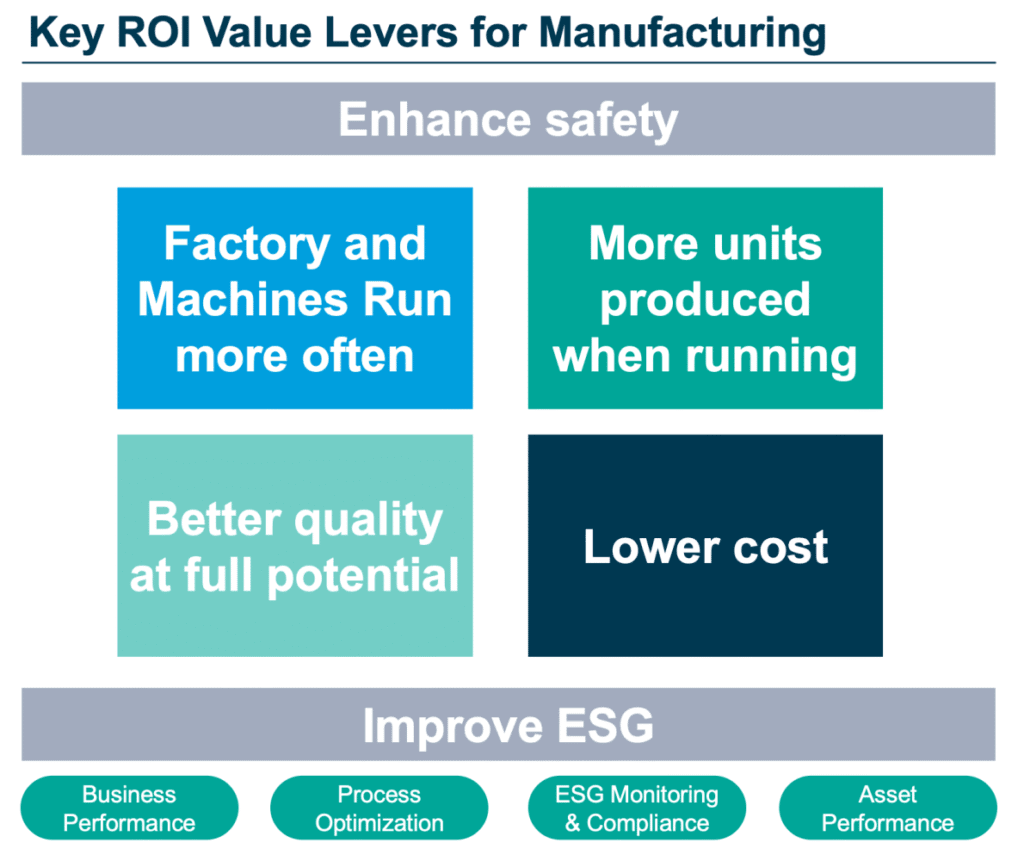
Typical Value Levers that deliver Agentic Operations ROI
- Operations run more often through predictive maintenance coordination, where multi-agent teams monitor equipment health, predict failure modes, optimize maintenance windows, coordinate resources, and learn from outcomes. Global mining operations achieved thirty percent reduction in unplanned downtime, generating ten million dollars in annual savings.
- More output when running through autonomous production coordination, where agent teams analyze bottlenecks in real-time, adjust process parameters, coordinate scheduling, maintain quality standards, and ensure safety compliance (all while operating autonomously with systematic human oversight).
- Better quality at full potential through AI augmentation with human oversight, where agent teams predict quality outcomes, recommend process parameter adjustments, learn from human decisions, and continuously improve both agent accuracy and human effectiveness.
- Lower cost through progressive efficiency gains across the HAS journey, where visibility identifies cost drivers at HAS 1-2, augmentation recommends optimization at HAS 3-4, and autonomy coordinates resource utilization at HAS 5. Multiple elite operators have validated savings in the five to fifteen million dollar annual range.
The Architecture That Enables Outcomes
The journey from visibility through augmentation to autonomy creates a critical architectural requirement: organizations must progress across HAS levels on a single platform to maintain operational coherence and protect investment. When each stage requires platform migration (from monitoring systems to AI platforms to autonomous orchestration), enterprises face not just implementation costs but fundamental discontinuity in how operations function.
This single platform requirement matters because industrial enterprises cannot afford the operational disruption and knowledge loss that comes with platform migrations. The same data integration layer that enables visibility at HAS 1-2 must feed AI models at HAS 3-4 and autonomous agents at HAS 5. The same governance framework that captures manual decisions at HAS 1-2 must learn from human-approved AI recommendations at HAS 3-4 and audits autonomous decisions at HAS 5.
Without this unified architecture, enterprises face a choice between staying at lower intelligence levels indefinitely or accepting the risk and cost of migration when they’re ready to advance. XMPro Agentic Operations for Industrial Enterprises eliminates this forced choice through platform architecture designed from the start for progressive intelligence across all HAS levels.
This architectural continuity enables three critical outcomes:
- Incremental value delivery: Deploy monitoring for immediate visibility value, add AI augmentation that builds on existing monitoring, then scale to autonomy that leverages both without requiring replacement
- Investment protection: Each stage generates ROI that funds the next stage rather than requiring full investment upfront based on autonomy promises that may take years to realize
- Operational continuity: Operators learn progressive capabilities within a consistent framework rather than three different systems as they move through HAS levels
Choosing the Operations-First Path
Industrial enterprises investing in autonomous intelligence face a decision that will shape operational capabilities for the next decade. The question is not whether agents will transform industrial operations (they clearly will) but whether that transformation follows a path that respects operational reality or one that treats industrial requirements as customization challenges.
Agentic AIoffers sophisticated technology that enterprises must adapt to their operations, requiring substantial investment in coordination frameworks, human collaboration design, progressive intelligence architecture, and outcome measurement systems.
Agentic Operations offers validated operational patterns that embed industrial requirements from the start, providing proven coordination at scale, systematic human-agent collaboration, progressive intelligence across HAS levels, and direct mapping to business outcomes.
The companies that thrive next won’t bolt AI onto the old hierarchy. They’ll design AI into the operating model itself, treating it not as a tool but as a participant in a new kind of organizational architecture. When understanding becomes instantaneous, hierarchy has no purpose. What remains is the direct connection between intent and outcome, between principle and practice.
The difference between Agentic AI and Agentic Operations ultimately reflects a difference in what you optimize for: technological sophistication or operational outcomes, agent capabilities or business value, impressive demonstrations or production validation. Industrial enterprises choosing the operations-first path choose to optimize for what actually matters: coordinated intelligence that delivers measurable value while respecting the realities of industrial operations.
The future of work isn’t fewer people. It’s fewer barriers between people and progress.
Acknowledgment
This article builds on themes from Michael Carroll‘s “When the Middle Disappears,” particularly his insights on organizational architecture, the three-layer framework (intent, coherence, context), and the shift from management to orchestration. His articulation of how AI exposes organizational design flaws rather than simply replacing workers informed the positioning of Agentic Operations as an architectural transformation rather than a technology replacement.
Pieter van Schalkwyk is the CEO of XMPro, specializing in industrial AI agent orchestration and governance. Drawing on 30+ years of experience in industrial automation, he helps organizations implement practical AI solutions that deliver measurable business outcomes while ensuring responsible AI deployment at scale.
About XMPro: We help industrial companies automate complex operational decisions. Our cognitive agents learn from your experts and keep improving, ensuring consistent operations even as your workforce changes.
Our GitHub Repo has more technical information. You can also contact me or Gavin Green for more information.
Read more on MAGS at The Digital Engineer