






















Pieter Van Schalkwyk
CEO at XMPRO
In Parts 1 and 2, we explored business model shifts, organizational changes, governance requirements, and workforce transformations that define agentic operations. Now we’ll examine the technology architecture that makes this possible and provide a practical roadmap for getting started.
This is where strategy meets execution. The right architecture enables the transformation we’ve described, while the wrong architecture creates expensive technical debt that slows you down.
Created with ChatGPT
Technology Architecture: Three Critical Principles
McKinsey emphasizes three technical principles for agentic organizations: distributed ownership where business users can create and modify agent behaviors, agent-to-agent protocols that simplify integration, and dynamic sourcing that avoids vendor lock-in. These principles address real constraints that have historically limited industrial digital transformation.
Principle 1: Distributed Ownership
Distributed ownership challenges the traditional separation between operational technology users and information technology developers. Industrial operations typically require formal requirements gathering, development sprints, testing cycles, and change control processes to modify system behavior. This creates appropriate safety and reliability controls but also creates friction and delay that makes rapid adaptation impossible.
The Middle Path
XMPro MAGS enables a middle path where domain experts configure agent behaviors, define workflows, and modify decision logic using tools that abstract software complexity while maintaining technical safety controls. A reliability engineer can create a new monitoring agent, define its data sources, specify its analytical logic, and configure its escalation thresholds without writing code.
The platform enforces cybersecurity requirements, maintains audit trails, and prevents unsafe configurations through embedded constraints rather than through process barriers. This democratization accelerates learning and adaptation while maintaining governance because the controls operate at the platform level rather than the process level.
Why This Matters
Traditional IT delivery cycles measure changes in weeks to months, but operational conditions change in minutes to hours. This mismatch creates a fundamental constraint on adaptation speed that no amount of agile methodology can overcome. Distributed ownership closes this gap by enabling operational experts to respond to changing conditions directly while the platform maintains safety and security controls automatically.
Principle 2: Agent-to-Agent Protocols
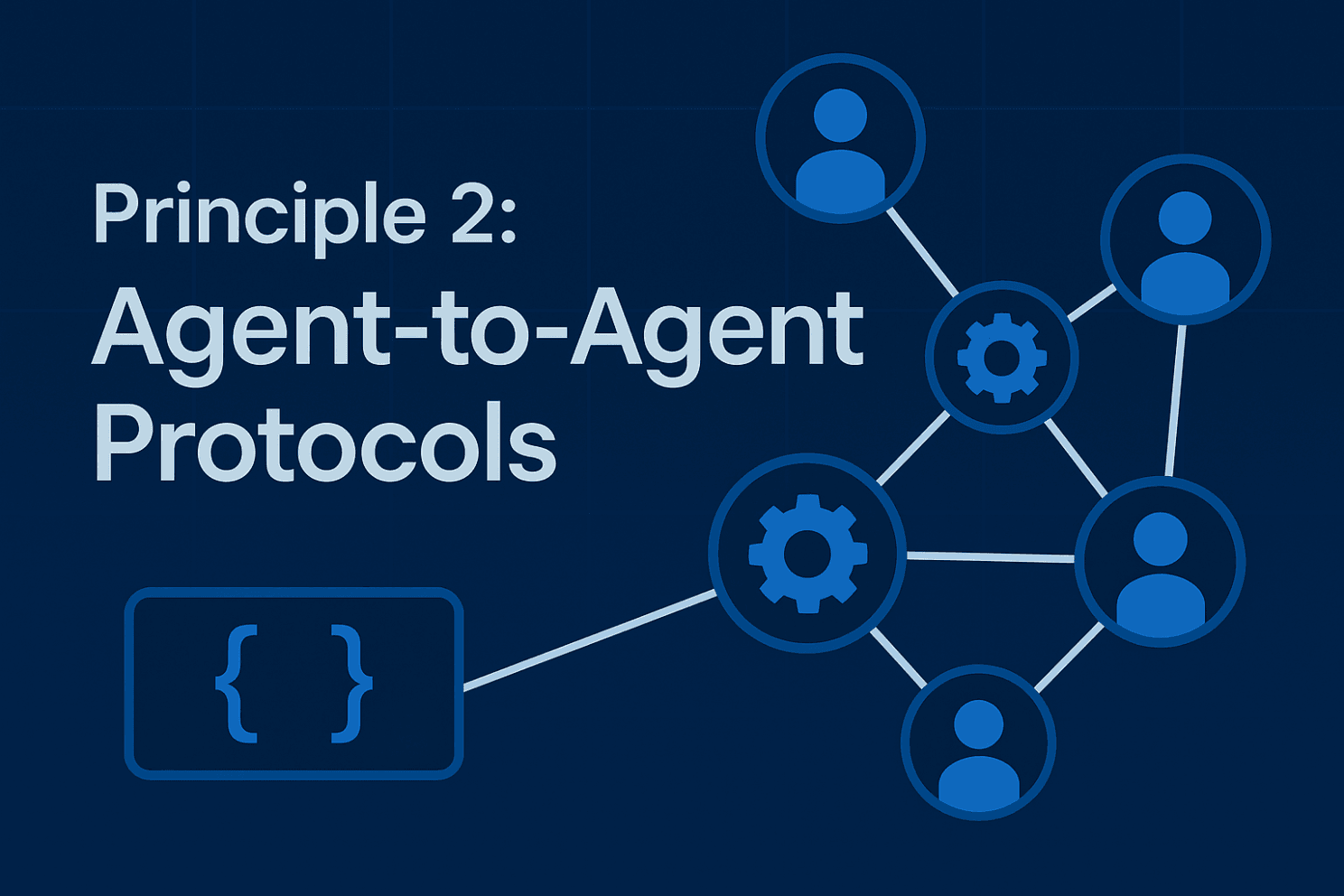
Agent-to-agent protocols address the integration challenge that has consumed enormous effort in industrial digital transformation. Industrial operations involve dozens or hundreds of separate systems including distributed control systems, SCADA, historians, maintenance management, and enterprise resource planning that were never designed to work together.
Created with ChatGPT
Traditional integration approaches require substantial engineering effort and create brittle connections that break when systems change. You build a custom interface between the maintenance system and the process historian, then six months later the maintenance system gets upgraded and the interface breaks. This brittleness makes organizations reluctant to change systems because the integration cascade becomes overwhelming.
The Agentic Alternative
The agentic model offers a fundamentally different approach where agents act as intermediaries that understand context and can adapt to system changes. An equipment monitoring agent needs maintenance history, so instead of a hardcoded interface to the maintenance system, it requests information from a maintenance agent using a standard protocol.
When the underlying maintenance system changes, only the maintenance agent requires updates because it encapsulates the system-specific logic. You don’t need to update all dependent integrations because they communicate through the agent interface, not directly with the system. This dramatically reduces integration brittleness and accelerates capability evolution.
Standards Enabling Collaboration
Two emerging standards are reshaping how agents communicate and collaborate. The Model Context Protocol (MCP) provides a standardized way for AI systems to access context and tools, enabling agents to work with various data sources and capabilities through a common interface. Agent-to-Agent (A2A) protocols enable direct communication between autonomous agents, allowing them to coordinate activities, share insights, and collaborate on complex tasks without human intermediation.
These standards matter because they enable agentic teams from different organizations or departments to collaborate seamlessly. A reliability agent team in your facility can coordinate with scheduling agents from your planning system, quality agents from your lab system, and even supply chain agents from vendor systems, all using standard protocols rather than custom integrations.
How XMPro Implements This
XMPro implements this through a common internal message broker abstraction that supports multiple industrial-grade protocols, including AMQP, MQTT, DDS, and OPC UA, while also supporting emerging standards like MCP for context sharing and A2A for external agent collaboration. This enables agent-to-agent communication independent of underlying system details while allowing you to choose the best protocol for each use case.
The XMPro DataStreams integration provides connectivity to over 150 industrial systems through a library of pre-built, tested connectors that create a secure data foundation for agent operations.XMPro DataStreams are designed for complex industrial data at scale with some customers processing more that 100million data points per day. While MCP enables standardized context sharing, direct agent-to-system connections can introduce security vulnerabilities and integration risks in industrial environments.
XMPro DataStreams acts as a trusted integration layer between agents and operational technology, providing tested connectivity, data validation, and security controls at scale. You’re not building custom integrations for each agent or exposing systems directly to agent protocols because you’re connecting agents to a data fabric that already has established, secure system connectivity.
Principle 3: Dynamic Sourcing
Dynamic sourcing responds to the reality that AI capabilities evolve rapidly while industrial technology traditionally operates on decade timescales. Organizations need architecture that separates stable elements from rapidly evolving elements so they can adapt as capabilities improve.
Stable elements include operational context, domain knowledge, and orchestration logic that reflect your specific processes and expertise. Rapidly evolving elements include AI models, analytical algorithms, and interface capabilities that improve monthly as vendors release new versions.
Avoiding Lock-In
XMPro MAGS achieves this separation by maintaining agent definitions, workflows, and knowledge graphs independently from underlying AI model implementations. The same operational agent can use different AI models for different capabilities including language understanding, anomaly detection, and optimization, and you don’t need agent redesign when better models become available.
This architecture matters because it prevents you from becoming locked into specific AI vendors or technologies as capabilities evolve. The competitive advantage comes from accumulated operational intelligence and refined agent orchestration rather than from any particular AI model, which means you can adopt better models as they emerge without losing your core capabilities.
Modular Architecture Benefits
XMPro MAGS supports pluggable components that enable independent optimization:
- Multiple LLM providers (OpenAI, Anthropic, Azure, AWS, local models)
- Multiple embedding providers for knowledge management
- Flexible tool libraries that agents can use
- Three-tier knowledge management (instance-specific, profile-level, general collections)
This modularity means you can use the best language model for reasoning, a different model for embeddings, and switch providers as capabilities or pricing change.
The Practical Starting Point: Lighthouse Implementations
McKinsey recommends thinking boldly, moving fast, and going deep. For industrial organizations, this translates into specific implementation patterns that balance ambition with pragmatism while building real capabilities.
Think Boldly: Envision Agentic Operations
Think boldly means envisioning agentic operations rather than incrementally improving current processes, and this mental model shift is critical for success. Don’t ask how AI can help maintenance planners be more efficient because that question assumes the current process structure. Ask what maintenance looks like when agents handle routine planning and humans focus on strategic asset management because that question challenges organizational assumptions.
The vision should be genuinely transformative while remaining grounded in operational reality.
An agentic organization doesn’t mean zero humans but rather means humans focus on strategic decisions, complex exceptions, and continuous improvement while agents handle routine execution and coordination. The goal is not to eliminate human expertise but to apply it more effectively by removing the execution burden that consumes most of their time today.
Move Fast: Launch Focused Lighthouses
Move fast means starting with focused lighthouse implementations that deliver tangible value quickly while building organizational learning that you can apply to broader deployments.
Selecting Your Lighthouse
The lighthouse should have several characteristics that increase the probability of success:
- Sufficient data infrastructure must exist to enable agent operation because you cannot run equipment monitoring agents without equipment data flowing to accessible systems
- Clear value drivers must exist, including reduced downtime, improved yield, or better safety performance, that justify the investment and effort
- Bounded scope must show results within months rather than years so you maintain momentum and leadership support
- Leadership support must exist to work through inevitable challenges because transformation always encounters resistance and obstacles
Why Reliability Makes an Excellent Starting Point
Reliability management often makes an excellent lighthouse domain for several reasons:
- Equipment generates substantial telemetry that’s already collected through existing systems, so the data foundation exists
- Failure patterns are often recognizable with historical data, making them suitable for agent learning
- Maintenance optimization has clear financial impact that’s easy to measure and communicate
- Cross-functional coordination overhead is high with lots of handoffs between reliability engineers, maintenance planners, and operators, creating substantial room for improvement
Starting with agent-based reliability management allows you to build capabilities, demonstrate value, develop governance models, and build workforce competency in a contained scope before expanding to broader operations. You learn the lessons on a manageable scale before attempting enterprise-wide deployment.
Go Deep: Build Real Capability
Go deep means building real capability rather than running superficial pilots, and McKinsey warns against ending up with “more pilots than Lufthansa” that deliver limited value and create cynicism throughout the organization.
Required Investments
Deep implementation requires several investments across multiple domains:
- Data infrastructure: Connectivity, contextualization, and quality (ensuring sensors function, data flows to accessible systems, and data quality is sufficient for agent use)
- Agent orchestration capabilities: Defining workflows, building knowledge graphs, and establishing governance frameworks that combine domain expertise with agent fluency
- Workforce skills: Identifying and developing M-shaped supervisors and T-shaped experts through training programs, rotation opportunities, and mentorship structures (explained in Part 2)
- Scaling mechanisms: Agent libraries, reference architectures, and centers of excellence that enable capability reuse as you expand beyond the lighthouse
The Implementation Timeline
Be realistic about timelines because implementation is measured in quarters to years, not weeks to months. The organizational learning curve is substantial even when the technical capabilities exist, and rushing the process typically creates resistance rather than adoption.
Months 1-3: Foundation and Lighthouse Selection
The first three months focus on assessment and preparation. Assess current data infrastructure and identify gaps that need addressing before agent deployment. Select lighthouse domain based on criteria including data availability, value potential, bounded scope, and organizational readiness. Build core team combining domain experts with agent capability and give them time to learn together. Establish governance framework for agent behavior including rules, constraints, and escalation protocols. Set up XMPro MAGS platform and initial connectivity to verify technical foundations are sound.
Months 4-6: Initial Agent Deployment
The second quarter focuses on initial deployment and learning. Deploy first monitoring and recommendation agents in the lighthouse domain to begin gathering operational data. Build human confidence through transparency and explanation of agent reasoning so people understand how decisions are made. Gather operational data and refine agent behavior based on what you learn from actual operations. Document lessons learned and governance requirements as they emerge from real use. Begin workforce training for broader team to prepare for expansion beyond the core group.
Months 7-9: Progressive Autonomy
The third quarter focuses on increasing agent autonomy carefully. Transition from monitoring to recommendation mode as confidence builds in agent reliability. Pilot execution authority for low-risk decisions where failure has limited consequences and humans can intervene quickly. Measure value delivery and refine business case based on actual results rather than projections. Expand agent capabilities based on operational learning about what works and what needs improvement. Prepare scaling plan for additional domains by documenting approach and identifying next opportunities.
Months 10-12: Scaling Preparation
The final quarter of year one focuses on preparing for broader deployment. Document reference architecture and best practices so other teams can learn from your experience without repeating mistakes. Build agent library for reuse in other domains by abstracting common patterns and capabilities. Establish center of excellence for agent development that can support multiple teams as deployment expands. Train additional M-shaped supervisors and T-shaped experts to ensure you have capacity for broader deployment. Select next domains for expansion based on lessons learned and organizational readiness.
The Fundamental Choice: Lead or Follow
For industrial operations, the question is whether agentic AI represents an opportunity for competitive advantage or a competitive necessity for survival, and the answer likely depends on industry dynamics and competitive intensity.
Industries with thin margins, high capital intensity, and operational complexity including refining, chemicals, mining, and power generation will find that efficiency gains and risk reduction from agentic operations become survival requirements. Industries with more forgiving economics or less operational complexity may have longer timelines before competitive pressure becomes acute.
The Compounding Advantage
Organizations that develop agentic capabilities earlier will compound their advantages over time as they accumulate proprietary operational intelligence, optimize their organizational models, and build workforce capabilities that competitors struggle to replicate. The gap between agentic leaders and laggards will likely expand rather than narrow because the learning curves are long, the organizational changes are substantial, and the network effects are powerful.
As agents become more capable, they enable more ambitious applications that generate more operational data, which makes agents more capable in a reinforcing cycle. This creates a compounding advantage where early movers pull away from followers because their data accumulation and organizational learning accelerate faster than competitors can catch up.
The Window Is Closing
The window for gaining first-mover advantage remains open today, but it’s closing as more organizations recognize the strategic importance and begin their journeys. The organizations that act now will define the standards that others struggle to match because they’ll have years of operational learning and data accumulation that create genuine competitive moats.
From Vision to Reality: What XMPro MAGS Delivers Today
McKinsey describes the strategic framework, while XMPro MAGS demonstrates the operational reality. The agentic organization isn’t a future possibility requiring breakthrough capabilities but rather a present reality operating in mission-critical industrial environments today and transforming how companies operate, compete, and create value.
Concrete Implementation Evidence
Production facilities are demonstrating agentic operations today:
- Autonomous operations with agent-driven monitoring replacing continuous human oversight
- Assessment cycles are measured in minutes rather than hours
- Mathematical objective functions tracking performance in real time
- Specialized agent teams collaborating with measurable consensus mechanisms
- Embedded governance providing continuous compliance validation
Technical Capabilities Available Now
XMPro MAGS provides enterprise-grade capabilities:
- Direct integration with 150+ industrial systems through XMPro DataStreams
- Modular agent architecture with pluggable LLM providers
- Three-tier knowledge management with smart retrieval
- Deontic framework for embedded behavioral rules
- Complete audit trails with explainable reasoning
- Agent-to-agent communication protocols
- Graduated autonomy from monitoring to recommendation to execution
Your Next Steps
The transformation is comprehensive and touches business models, operating structures, governance systems, workforce composition, and technology architecture. This isn’t a technology project that IT can manage independently but rather a strategic transformation requiring CEO-level vision, cross-functional commitment, and sustained investment in organizational capabilities over multiple years.
Immediate Actions
- Assess your readiness: Do you have sufficient data infrastructure? Clear value drivers? Leadership support for transformation?
- Select your lighthouse domain: Choose based on data availability, value potential, bounded scope, and organizational readiness for change.
- Build your core team: Identify individuals who can become M-shaped supervisors. Start their development now rather than waiting.
- Establish governance framework: Define rules, constraints, and escalation protocols before agents operate rather than reacting to problems.
- Start learning: Deploy monitoring agents to build organizational familiarity before moving to execution authority that requires higher confidence.
The Critical Success Factor
The technology is the enabler while the real work is organizational.
You must develop new mental models about how work gets done, build new capabilities across the workforce, create new governance mechanisms that operate at machine speed, and foster the culture that makes agentic operations possible through leadership commitment and change management.
XMPro MAGS with APEX provides industrial organizations with practical tools to begin this journey without requiring complete organizational transformation or wholesale technology replacement. The platform enables incremental adoption through lighthouse implementations, learning through doing rather than extensive planning, and progressive expansion from initial deployments to enterprise scale as confidence and capability build.
In The End: Your Choice
The question isn’t whether your organization will become agentic because the competitive dynamics will force this transformation on everyone eventually. The question is whether you’ll shape this transformation deliberately through early action or have it forced upon you reactively when competitive disadvantage becomes undeniable and your options are limited.
We Have a Front Row Seat to This Transformation
Working with leading organizations in oil and gas and mining, we’re watching this shift happen in real time. Major operators are launching lighthouse implementations with clear paths to production. These aren’t research projects or innovation theater. They’re structured proof-of-concepts with dedicated teams, committed budgets, and production roadmaps.
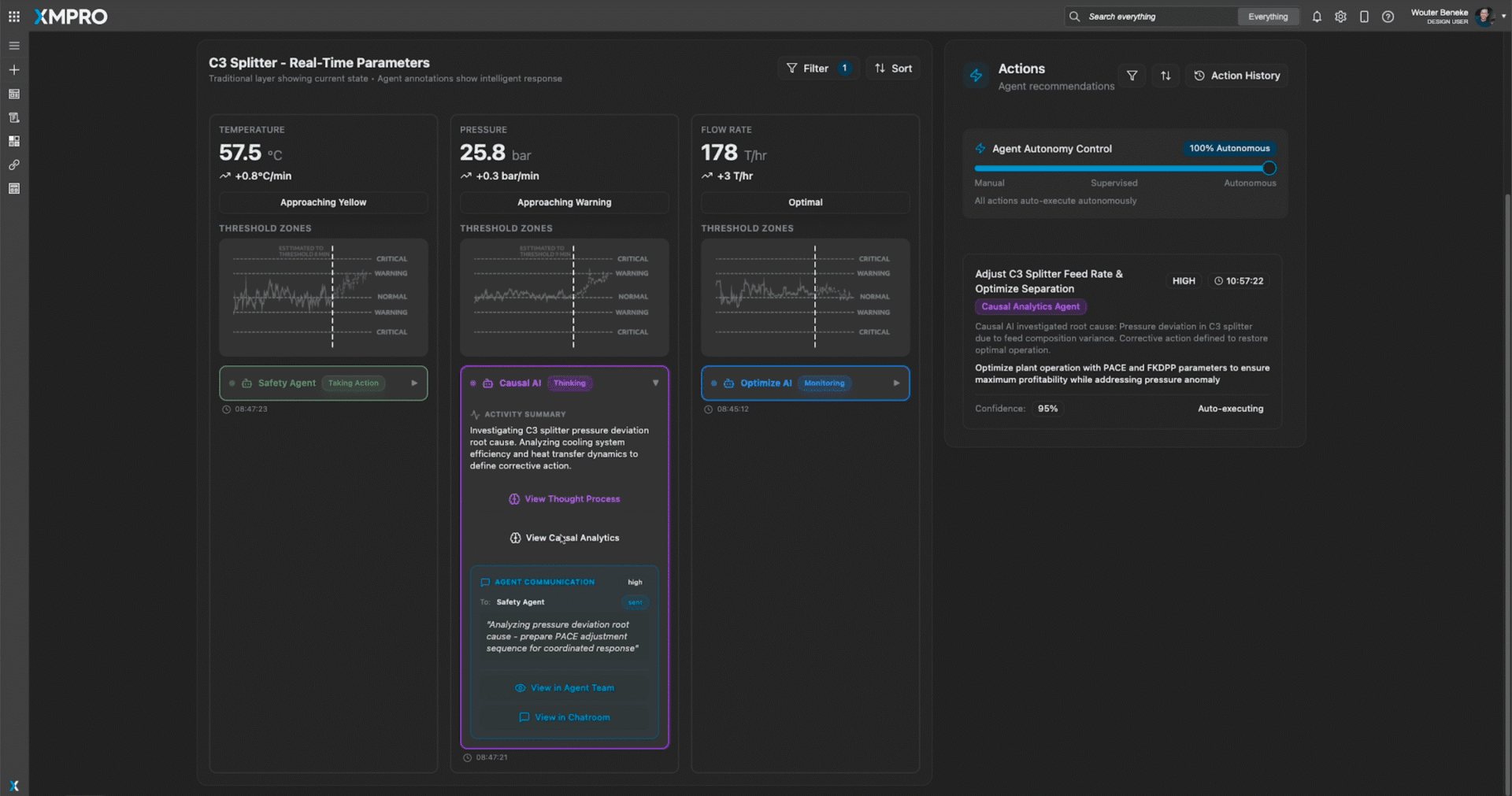
XMPro MAGS Team in Oil and Gas Use Case
What makes these implementations significant is the strategic intent behind them. Global energy companies are validating agentic approaches for critical operations including refining, production optimization, and safety management with explicit plans for production deployment. Major mining operators are proving out autonomous agent networks for equipment reliability, process control, and operational planning. These organizations understand that early capability development creates compounding advantages that fast followers cannot easily replicate.
The lighthouse approach we described earlier isn’t theoretical. It’s the actual pattern these leading organizations are following. They’re starting with focused proof-of-concepts in bounded domains where value is clear and data infrastructure exists, building core teams with combined domain and agent expertise, proving value and refining the approach, then planning systematic expansion to production and additional domains as capabilities mature.
The Competitive Implications
The industrial future is agentic, and the only question is whether your organization will help create that future or be disrupted by it. Organizations that act now by thinking boldly about the vision, moving fast with focused implementations, and going deep to build real capabilities will define the standards that others struggle to match.
The gap is already forming. Leading organizations are investing in capability development, building workforce expertise, and refining governance models while many competitors remain in planning mode or waiting for proven case studies. This isn’t a gap that can be closed quickly because the learning curves are measured in years, not months, and the organizational changes require sustained commitment from senior leadership.
The window for first-mover advantage remains open today. But it won’t stay open forever as more organizations recognize the imperative and begin their journeys.
Pieter van Schalkwyk is the CEO of XMPro, specializing in industrial AI agent orchestration and governance. Drawing on 30+ years of experience in industrial automation, he helps organizations implement practical AI solutions that deliver measurable business outcomes while ensuring responsible AI deployment at scale.
About XMPro: We help industrial companies automate complex operational decisions. Our cognitive agents learn from your experts and keep improving, ensuring consistent operations even as your workforce changes.
Our GitHub Repo has more technical information. You can also contact me or Gavin Green for more information.
Read more on MAGS at The Digital Engineer