


























Pieter Van Schalkwyk
CEO at XMPRO
This obituary was composed from the collected works and articles of Michael Carroll and Pieter van Schalkwyk Every insight belongs to them. The narrative thread is simply the story 2025 lived and the lessons it died teaching.
In Memoriam
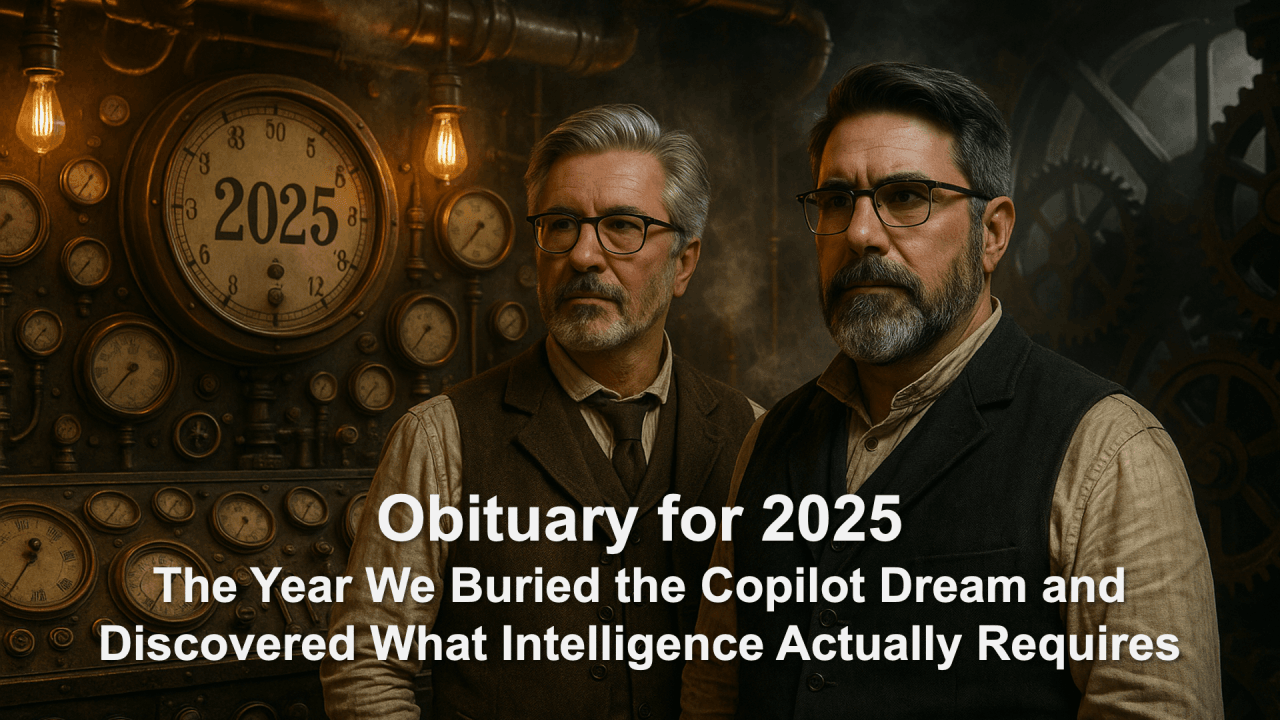
2025 passed quietly in its sleep on December 31st, surrounded by dashboards, unfulfilled pilot projects, and executives still waiting for quarterly reviews of decisions that needed to happen in milliseconds. It was a year of great promise and painful reckoning. It is survived by its successors, who now carry the burden of building what 2025 only talked about.
This reflection began, as the most useful work usually begins, with a conversation that would not let us off the hook. We gather not with bravado or self-congratulation, but with the only posture that earns trust: precision. Let us speak honestly about what this year taught us, what it took from us, and what it leaves behind.
Early Life: The Inheritance
2025 was born into a world drunk on possibility. Generative AI had captured the imagination of every boardroom. Copilots were everywhere, promising to save minutes, summarize meetings, and draft emails with unprecedented fluency. The demos were spectacular. The expectations were stratospheric.
But 2025 inherited a troubling condition that its parents refused to acknowledge: information had been rising for years while outcomes had not moved in proportion. That gap was never a technology gap. It was a conversion gap. The enterprise was not short on intelligence. It was short on architectures that could convert evidence into action.
Most companies building AI agents were creating sophisticated chatbots, not intelligent systems. They focused on language models while missing the coordination, memory management, and decision-making capabilities that create genuine intelligence. They were, in the kindest interpretation, building horseless carriages, taking traditional automation, bolting on Large Language Models, and missing the revolutionary potential right in front of them.
The Struggle: What Went Wrong
2025 struggled with a question it could never quite answer: what happens when you respond to a knowledge collapse by giving people more to think about?
The copilots that promised relief delivered a different kind of burden. They were sold as tools for individual productivity, but manufacturing was never an individual productivity contest. It was system behavior. It was throughput of the constraint. It was stability of the line. You could save minutes in email and still lose hours in decision latency. You could be productive in the office layer and still be ineffective in the operational layer.
The enterprise became a machine that produced more signals than its people could safely interpret. Then it blamed the people when they couldn’t keep up. It was the operational equivalent of texting and driving, not because people were careless, but because the system was asking minds to do too much at the moment they needed to control reality.
Too many organizations spent 2025 focused on reengineering processes when they should have been reengineering decisions. Process reengineering asks “how can we do this better?” Decision reengineering asks “what should we be doing in the first place?” The first leads to incremental improvements. The second creates transformative change. Most chose the first. Most stayed stuck.
The SaaS platforms that dominated enterprise software revealed their fatal flaw: they were perfectly designed for a world that no longer exists. They were filing cabinets with digital veneers, systems of record when what we needed were systems of reasoning. They managed state, not intent. They tracked transactions, not decisions. And they trapped users in menus that stole time, focus, and purpose with every click.
The Reckoning: What 2025 Revealed
Midway through its life, 2025 delivered a harsh verdict. Gartner predicted that over 40% of agentic AI projects would be canceled by 2027. The reason was not technical complexity or market conditions. Companies were building sophisticated automation and calling it agentic AI. They were creating expensive systems that could not deliver on their promises.
Only about 130 of thousands of agentic AI vendors offered genuine capabilities. The rest practiced “agent washing,” rebranding existing chatbots and RPA tools with fashionable terminology. The industry learned, painfully, that you cannot buy intelligence. You can only buy activity. And activity without conversion is just expensive motion.
The deeper revelation cut closer to the bone. The decisive constraint was never intelligence. It was permission. Analytics had increased knowledge without changing authority. It had increased visibility without deleting approvals. It had increased awareness without reducing handoffs. It had made the enterprise better at describing problems without being better at acting.
When you leave decision geometry untouched, the productivity line stays flat. The organization just becomes more articulate about why it cannot move.
Meanwhile, the workforce crisis that 2025 inherited grew worse. Experienced operators retired faster than replacements could be trained. Process engineers with deep domain knowledge grew scarce. The talent pipeline could not keep pace with operational demands. We were asking humans to do more inference at the exact moment we had fewer humans left who could do inference well.
The Lessons: What 2025 Taught Us
Despite its struggles, 2025 was a teacher. It taught us what we must build instead.
We learned to stop buying answer engines and calling them intelligence. We learned to start building inference removal, systems where the enterprise stops requiring humans to be the integration layer between fragmented systems.
We discovered that in traditional operations, humans execute work and coordinate with each other, but in agentic operations, AI agents execute work while humans orchestrate agent networks. This is not automation in the traditional sense. Automation replaces human execution with programmed logic. Agentic systems replace human execution with adaptive intelligence that learns, reasons, and coordinates. Automation breaks when conditions change. Agentic systems adapt to novel situations within learned boundaries.
We learned that LLMs represent only 8% of actual system intelligence. The remaining 92% consists of business process logic that handles cognitive, coordination, and operational challenges. Intelligence, it turns out, comes from coordination, not conversation.
We learned that governance must transform from a constraint that slows operations to a capability that enables safe autonomy. You cannot audit agent decisions quarterly when agents make thousands of decisions daily. Governance must become embedded in the agent architecture itself, operating as a continuous control system rather than a periodic review process. Embedded controls allow agents to operate at machine speed precisely because the controls operate at machine speed as well.
We learned the measurement that matters: Event. Detection. Reasoning. Intervention. Stabilization. If your AI deployment does not reduce that chain for a real operational loop, without increasing risk, then you did not buy intelligence. You bought activity.
The Legacy: What 2025 Leaves Behind
2025 leaves behind a clarified mission for its survivors.
The real question was never whether copilots are useful. The real question is whether leadership will finally do the architecture work it has been postponing.
The agentic transformation does not eliminate frontline workers. It elevates their work by removing routine burden. This was never about eliminating jobs. It was about operating sustainably when the skilled workforce you need does not exist. It was about multiplying the impact of scarce expertise rather than trying to replace it. It was about ensuring new operators gain access to decades of operational wisdom from day one rather than spending years developing their own experience.
Organizations that understood this in 2025 are not just deploying agents. They are creating proprietary operational intelligence that compounds over time as their systems learn and adapt to their specific processes, equipment, and operating conditions.
The winners emerging from 2025 are not the companies with the prettiest dashboards. They are the companies whose decision loops move faster without breaking trust. Manufacturing does not win because it drafts better. Manufacturing wins because it stabilizes faster.
The Survivors: A Word to Those Who Carry On
To those who inherit what 2025 could not finish, we offer this counsel:
Do not be part of the 40% that built automation and called it intelligence.
Remember that professional competency cannot be replaced by better language processing. Would you let your IT help desk operator start up your $50 million production line? Would you trust your HR chatbot to decide when to shut down a reactor? The question answers itself.
We are no longer trying to digitize processes that originated when we still moved paper around in brown envelopes with small holes. We can now create dynamic processes that continuously optimize toward real-time monitored objective functions.
The true power of what comes next lies not in automating what you already do, but in doing what was previously impossible.
The pause remains the true adversary, a silent thief of momentum. Every second reclaimed compounds into hours of production, months of innovation, years of dominance.
Visibility without conversion is entertainment. Build conversion.
Final Words
2025 asked a question it could not answer: will your organization lead the AI transformation or struggle to catch up later?
The industrial future is agentic. The only question is whether your organization will help create that future or be disrupted by it.
That is what we now know. That is what we learned. And that is what we only suspected, but could not yet prove, when this year began.
As we lower 2025 into the ground, we do so with gratitude for its lessons and resolve for what comes next.
Ignore the headline. Listen to the mechanism.
Know your problem. Measure your value. Choose accordingly.
2025 – 2025
Preceded in death by the illusion that language models alone could transform operations.
Survived by architects, builders, and leaders who now know what intelligence actually requires.
In lieu of flowers, please build systems that convert evidence into action.
Services will be held in control rooms, plant floors, and boardrooms everywhere, starting January 1st, 2026.
Continue the Conversation
The ideas in this piece come from two newsletters where we explore the future of industrial operations, AI, and what intelligence actually requires.
Michael Carroll writes The One-Degree Dispatch, exploring decision velocity, enterprise architecture, and the conversion gap between intelligence and action.
Pieter van Schalkwyk writes The Digital Engineer, covering Multi-Agent Generative Systems, Intelligent Digital Twins, and the practical architecture of agentic operations.
Subscribe to both. The conversation continues in 2026.
A Note on How This Piece Came Together
I’ll be honest: this started as a bit of fun. I’ve been collecting “one-liners” from Mike’s articles for months because they kept showing up in my own thinking and talks. At some point, I realized I was doing the same with my own writing. So I asked myself: what happens if you weave them together?
With the help of Claude (Anthropic’s LLM), I extracted the quotable insights from both our bodies of work, organized them by theme, and then experimented with formats until the obituary concept emerged. Claude helped structure the narrative and stitch the quotes into flowing prose, but every substantive insight comes directly from Michael’s published work and mine. No new claims were invented. We just let the ideas talk to each other.
The result surprised me. Our perspectives complement each other in ways I hadn’t fully appreciated: Michael diagnoses the problem with philosophical precision, while my work tends to point toward architectural solutions. Together, they tell a story neither of us wrote alone.
Consider this a tribute to the power of ideas finding each other, with a little AI assistance to make the introduction.
— Pieter