
PREFACE

In today's fast-paced and constantly evolving business landscape, organizations are increasingly turning to digital transformation to gain a competitive edge. The rise of Industry 4.0, with its focus on advanced technologies such as the Internet of Things (IoT), artificial intelligence (AI), and machine learning (ML), has created a wealth of opportunities for companies to optimize their operations and drive growth.

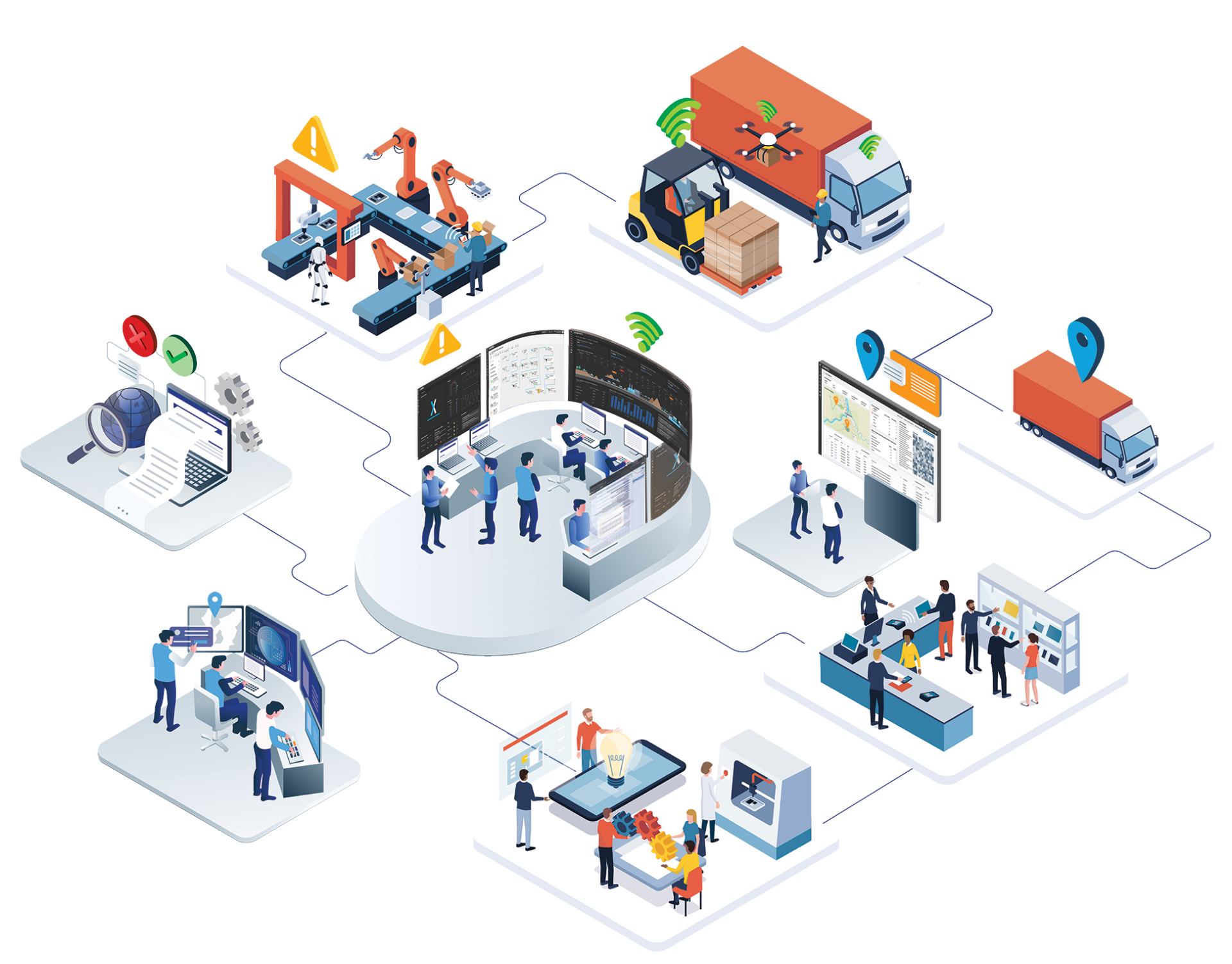
One key technology that has emerged as a critical enabler of digital transformation is the digital twin. A digital twin is a virtual replica of a physical asset, system, or process that enables companies to simulate, monitor, and optimize performance in real time. By leveraging digital twins, organizations can improve efficiency, reduce costs, and enhance customer experiences.

This ebook, "The Power of Digital Twins: Leveraging Industry 4.0 and digital transformation for competitive advantage", explores the fourth industrial revolution, digital transformation and digital twins.

We hope that this ebook serves as a valuable resource for readers who are interested in leveraging digital twins to achieve competitive advantage in today's digital age.

Introduction

The world is rapidly changing and the business landscape is no exception. With the advent of new technologies such as the Internet of Things (IoT), artificial intelligence (AI), big data, and robotics, the way we do business is undergoing a major transformation. This transformation is known as Industry 4.0, the fourth industrial revolution, which represents a new era of advanced manufacturing and a fundamental shift in the way products are produced. The integration of advanced technologies into all areas of an organization as a result of Industry 4.0 is driving the digital transformation of businesses. This changes the way it operates and delivers value to customers. In today’s rapidly changing market environment, digital transformation has the potential to transform businesses of all sizes, enabling them to better compete and stay ahead of the curve In this e-book, we will explore the concepts of Industry 4.0 and digital transformation in detail, examining their key components, benefits, and challenges. We will also look at how these new technologies are being applied in real-world scenarios and the impact they are having on businesses and the global economy. With this understanding, organizations can prepare themselves for the future and embrace the opportunities that Industry 4.0 and digital transformation present.

Definition of Industry 4.0

Industry 4.0 refers to the fourth industrial revolution, a new era of advanced manufacturing characterized by the integration of advanced technologies such as the Internet of Things (IoT), artificial intelligence (AI), big data, robotics, and more.

Industry 4.0 factories are characterized by the ability to produce high-quality products at scale, while also reducing production costs and improving operational efficiency. Industry 4.0 represents a fundamental shift in the way products are manufactured, offering new opportunities for businesses to create value and growth.

Disclaimer: In this e-book, when referring to the fourth industrial revolution, we are discussing the general concept of the technological transformation of industry and society, and not specifically the Industrie 4.0 platform initiative developed in Germany.

Any references or discussions related to Industry 4.0 are intended to provide context and background information on the broader topic of the fourth industrial revolution. While we acknowledge that Industry 4.0 is a specific term used to describe the technological advancements in manufacturing and other industries, we will be using the terms "fourth industrial revolution" and "Industry 4.0" interchangeably to refer to the broader concept of the fourth industrial revolution.

Overview of the four industrial revolutions.

The industrial revolution has been a driving force behind the growth and development of the global economy for centuries. Each revolution has brought about significant changes in the way goods are produced and has had a profound impact on the world’s economy and society. Let’s take a closer look at the different economic impacts experienced during each industrial revolution:

The First Industrial Revolution (1760-1840)

The first industrial revolution was characterized by the introduction of steam power, water power, and the use of iron and steel. This revolution saw the rise of large- scale manufacturing and the growth of new industries, such as the cotton industry. The first industrial revolution had a profound impact on the global economy, leading to significant increases in productivity and efficiency. It also led to the growth of new markets, as goods could now be produced on a mass scale, making them more affordable and accessible to a wider range of consumers.

The Second Industrial Revolution (1870-1914)

The second industrial revolution was characterized by the introduction of electricity and the telephone, leading to the growth of mass production and the rise of assembly line manufacturing. This revolution had a significant impact on the global economy, as the use of electricity allowed for increased efficiency and reduced production costs. It also led to the growth of new industries, such as the automobile and consumer goods industries.

The Third Industrial Revolution (1960s to present)

The third industrial revolution was characterized by the introduction of computers and automation, leading to significant increases in productivity and efficiency. This revolution saw the rise of digital technologies and the growth of the information technology industry, which has had a profound impact on the global economy. The third industrial revolution has also led to the growth of new business models, such as e-commerce, and has enabled companies to reach new markets and customers through the power of the internet.

Industry 4.0 (Present to Future)

Industry 4.0 represents the fourth industrial revolution, where advanced technologies such as IoT, AI, big data, robotics, and more are integrated into the manufacturing process. This new era of manufacturing is characterized by smart, connected factories that are able to produce high-quality products at scale, while also reducing production costs and improving operational efficiency.

The impact of Industry 4.0 on the global economy is expected to be profound, as it offers new opportunities for businesses to create value and growth, while also addressing some of the world’s most pressing challenges, such as sustainability and the need for increased efficiency. Industry 4.0 is expected to drive significant economic growth, creating new jobs and boosting the competitiveness of businesses around the world.

Understanding the history of industrial revolutions and their impact on the global economy is essential for organizations to prepare for the future and embrace the opportunities presented by Industry 4.0 and digital transformation.

The industrial revolution has been a driving force behind the growth and development of the global economy for centuries. Each industrial revolution has brought about significant changes in the way goods are produced and has had a profound impact on the world’s economy and society. Let’s take a closer look at the positives and negatives of each industrial revolution:

Each industrial revolution has brought both positives and negatives to the global economy and society. It is important for organizations to be mindful of both the benefits and challenges presented by each revolution, to effectively prepare for the future and embrace the opportunities presented by Industry 4.0 and digital transformation.

Importance of Industry 4.0 and digital transformation

The term "Fourth Industrial Revolution" was coined by Klaus Schwab, the Founder and Executive Chairman of the World Economic Forum, in 2015. The Fourth Industrial Revolution builds on the digital revolution that began in the latter half of the 20th century and involves the fusion of technologies that blur the lines between the physical, digital, and biological spheres.

In 2023, The Fourth Industrial Revolution is well and truly here, and is changing the way businesses operate. In the same vein as previous industrial revolutions, companies must adapt and evolve to remain competitive in the marketplace. Those who failed to do so in previous industrial revolutions did not survive, and it is no different with Industry 4.0 and digital transformation.

Just as the first industrial revolution brought about significant changes in the way goods were produced, Industry 4.0 is revolutionizing the way products are designed, manufactured, and delivered.

The impact of Industry 4.0 and digital transformation is not limited to the manufacturing sector. It is also affecting the way we work, learn, and interact with one another. Companies must embrace these changes in order to remain relevant and competitive in the marketplace.

Business leaders who ignore the importance of Industry 4.0 and digital transformation risk being left behind by their competitors. The companies that successfully adopt and integrate these technologies into their operations will enjoy a significant advantage in the marketplace.
In the words of billionaire investor and philanthropist Ray Dalio, “In a rapidly changing world, the biggest risk is not taking any risk... In a rapidly changing world, the winners will be those who are able to adapt the quickest.” Companies that are able to quickly and effectively embrace Industry 4.0 and digital transformation will be well-positioned to succeed in the future.

Overview of the advanced technologies driving Industry 4.0

Industry 4.0 is being driven by a variety of advanced technologies that are transforming the way businesses operate. These technologies are changing the way products are designed, manufactured, and delivered, as well as the way we work and interact with one another. In this chapter, we will provide an overview of some of the key technologies driving Industry 4.0.

Internet of Things (IoT): The IoT refers to the interconnected network of devices and sensors that collect and share data. In the context of Industry 4.0, IoT devices are being used to monitor and control the manufacturing process, as well as to collect data that can be used to inform decision-making.

Artificial Intelligence (AI): AI refers to the development of computer systems that can perform tasks that typically require human intelligence, such as visual perception, speech recognition, decision-making, and language translation. In Industry 4.0, AI is being used to automate repetitive tasks, improve process efficiency, and enhance the customer experience.

Big Data: Big data refers to the vast amounts of data generated by IoT devices, social media, and other sources. In Industry 4.0, big data is being used to inform decision-making, optimize operations, and develop new products and services.

Robotics: Robotics refers to the use of robots to perform tasks that are typically performed by humans. In Industry 4.0, robotics is being used to automate repetitive tasks, increase efficiency, and improve the accuracy of manufacturing processes.

3D Printing: 3D printing refers to the process of creating three- dimensional objects by depositing material layer by layer. In Industry 4.0, 3D printing is being used to reduce production time and costs, as well as to create customized products.

Virtual Reality (VR) and Augmented Reality (AR): VR and AR refer to the use of computer technology to create immersive experiences and digital overlays. In Industry 4.0, VR and AR are being used to train employees, visualize products, and improve the customer experience.

Blockchain: Blockchain is a decentralized digital ledger that can be used to record transactions across a network of computers. In Industry 4.0, blockchain is being used to increase transparency and security in supply chain management, as well as to create digital identities and track the movement of assets.

Cybersecurity: As Industry 4.0 relies heavily on connected devices and the sharing of data, cybersecurity has become a critical issue. In Industry 4.0, advanced cybersecurity measures are being developed to protect against cyberattacks, data breaches, and other forms of cybercrime.

5G Networks: 5G is the fifth generation of mobile networks, which offers faster speeds and greater capacity than previous generations. In Industry 4.0, 5G networks are being used to connect IoT devices, enable real-time data transfer, and support the deployment of new technologies like autonomous vehicles.

Digital Twins: Digital twins refer to digital replicas of physical assets, such as machines and products. In Industry 4.0, digital twins are being used to monitor and optimize the performance of assets in real-time, as well as to simulate and test new designs and configurations.

READ MORE...

DOWNLOAD NOW