




























Wouter Beneke
Marketing Lead at XMPRO
This article explores how control rooms are evolving from dashboards that show what’s happening, to Supervisory Interfaces that reveal what AI agents are doing about it… and let humans guide them in real time.
Authored by Wouter Beneke, Marketing Lead at XMPro
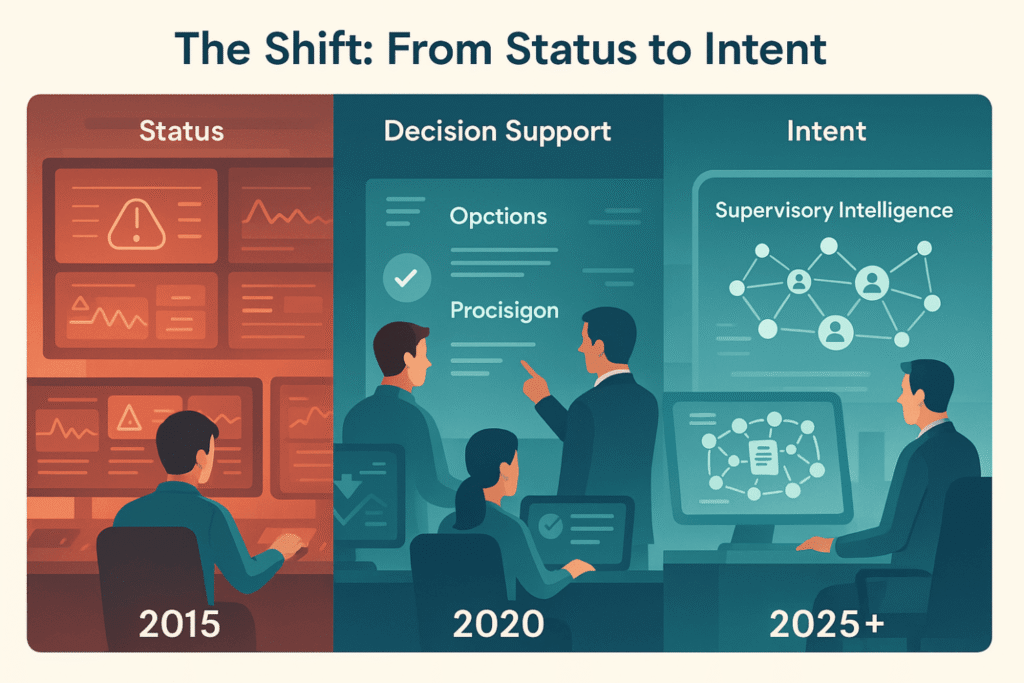
The Shift: From Status to Intent
In most control rooms today, operators still face the same challenge: too much data and too little time. They monitor dozens of systems, respond to thousands of alarms each day, and try to make sense of overlapping trends and alerts. As operations become more interconnected and data-driven, this constant information flow leads to cognitive overload and delayed decisions.
To manage this complexity, many organizations are turning to intelligent systems that help humans make faster, better decisions. These systems start by augmenting human judgment — analyzing data, surfacing insights, and recommending actions. Over time, as confidence and governance frameworks mature, they can safely take on more autonomy, acting independently within defined limits.
As this evolution continues, the way we manage operations will also change. We will see a growing need for supervisory viewsthat allow humans to oversee and guide teams of intelligent agents — agents that detect events, propose options, and act within authority limits.
- Traditional dashboards told us what is happening.
- Decision support systems helped us decide what to do.
- Supervisory Intelligence now answers what the agents are doing, why, and whether their actions align with our goals.
This article explores the governance capabilities required to scale from a handful of agents to enterprise-wide orchestration — including real-time visibility into reasoning, parametric control of objectives, structured escalation, and performance analytics. Each of these is illustrated through XMPro APEX, which implements these capabilities without rewriting your existing systems.
Missed the previous articles in our series?
Our Decision Automation article established four trust pillars: Transparency, Explainability, Reliability, and Safety. This piece shows how Supervisory Intelligence operationalizes those pillars at scale.
- Read Part 1: The Dashboard Graveyard
- Read Part 2: Decision Support
- Read Part 3: Decision Augmentation
- Read Part 4: Decision Automation
Why Legacy Dashboards Fail for Autonomous Operations
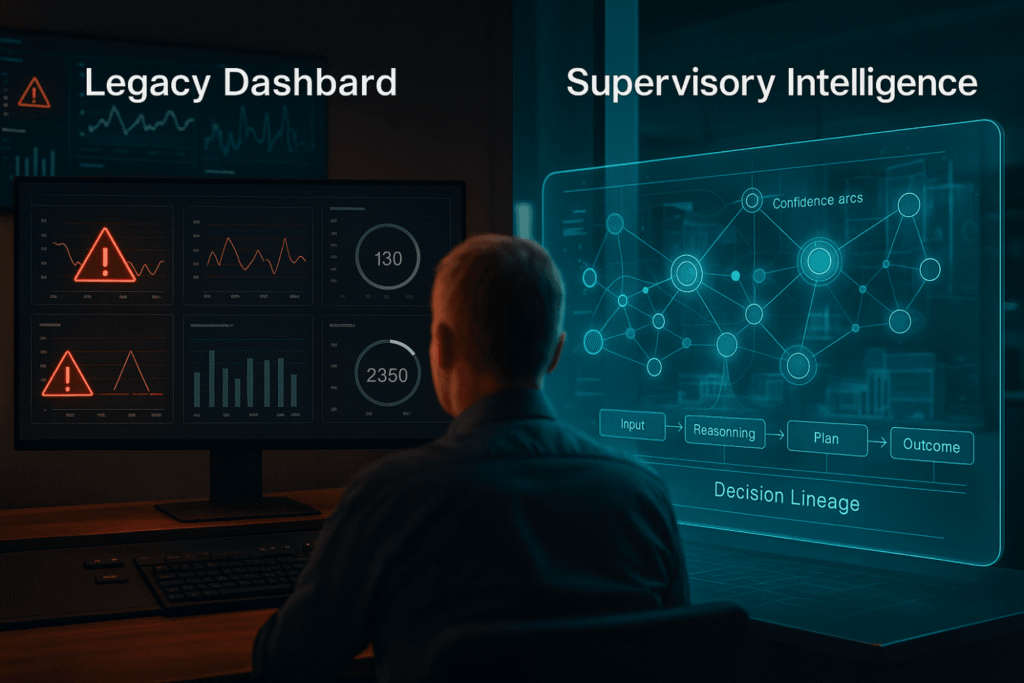
Traditional dashboards monitor physical assets. Supervisory Intelligence governs cognitive agents. The failure modes are completely different.
Black box operations erode trust. When supervisors cannot see how agents reason or what evidence they used, trust disappears. The teams that keep authority tight are responding rationally to opacity. The solution is decision lineage: inputs, reasoning, plan, action, outcome, with timestamps.
No visibility into agent reasoning. Dashboards show outputs but hide the cognitive process. When an agent suggests shutting down a production line, supervisors need the proposal logic, trade-offs considered, and confidence level.
No consensus protocol tracking. Multi-agent teams make decisions through collaborative iteration. Traditional dashboards cannot show how five specialist agents negotiated a solution, which proposals were rejected, or why consensus required escalation.
No performance measurement against objectives. Equipment dashboards track uptime and throughput. Agent governance requires tracking decision quality, planning accuracy, learning velocity, and objective optimization over time.
Reactive rather than proactive oversight. Dashboards alert after problems occur. Supervisory Intelligence provides leading indicators: degrading consensus efficiency, conflicting priorities, or agents approaching authority boundaries before intervention becomes necessary.
The result: Organizations hit scaling walls around 10-15 agents because human oversight becomes impossible. Projects stall. Budgets disappear.
Supervisory Intelligence provides the architectural bridge between decision automation and governed autonomy at scale.
🧭 Supervisory Intelligence in Action
How the Four Pillars Work Together in Real Operations
In modern operations, supervisors no longer watch equipment — they watch intelligent teams of AI agents.
The supervisor’s role is to see what they see, understand why they act, and guide how they align. The following example shows how all four pillars of Supervisory Intelligence unfold in a single incident.
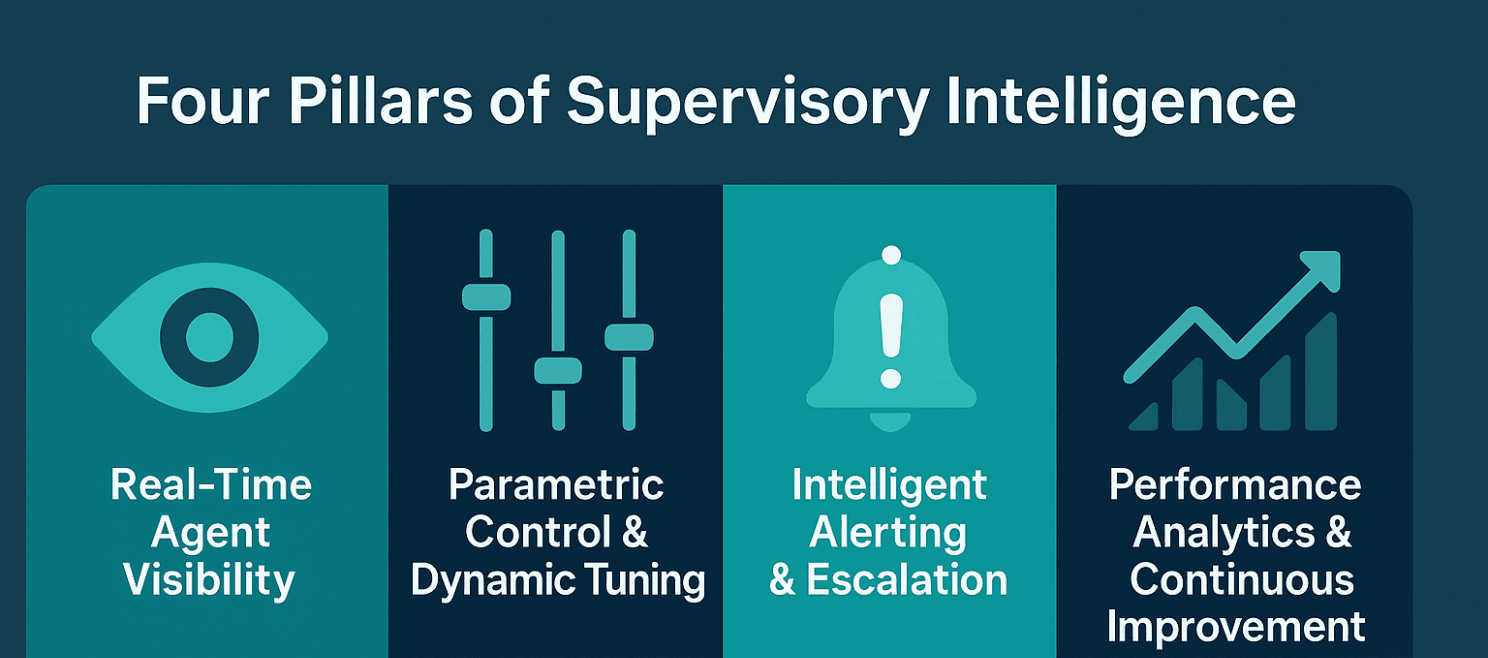
In traditional control rooms, operators stare at dashboards full of alarms, trends, and KPIs—data without context. Supervisory Intelligence changes that view completely. Instead of watching assets, supervisors watch intelligent teams of agents and see why each is acting, how it reached that decision, and whether its reasoning aligns with enterprise objectives.
In Supervisory Interfaces, users need to see:
- Current Operational Status (Is there a problem, or will there be one soon?)
- Real-time & historic agent decision making process
- Transparency into decision making such as causal analytics
- Communication flows between agents
- Performance metrics against defined KPIs
Decision lineage is non-negotiable. Surface the full chain: inputs → reasoning → plan → action → outcome, with timestamps. This turns black-box agent plans and actions into traceable decisions.
Supervisory View Enables Visibility Into Agent Reasoning & Actions in Real-Time
In the clip above, the supervisor observes an alert triggered by a vibration-health deviation and a slowly degrading engine-health score. The supervisory view immediately shows that the agent team detected the anomaly and what predictive model it used.
Key takeaway: Detection is transparent – every alert is tied to its source reasoning and timestamped evidence chain.
The supervisor expands the causal-analytics panel.
Here the supervisor drills down into the reasoning chain – viewing the causal relationships the AI derived between feed rate, load, and vibration. This decision lineage reveals the logic, not just the outcome.
Key takeaway: Causal transparency replaces black-box analytics with explainable reasoning.
Agents reach alignment through structured negotiation, not automation.
In the clip above, the supervisor observes the MAGS team initiating a multi-round consensus process. Each agent — such as the Safety Agent, Optimization Agent, and Availability Agent — evaluates the same event (engine vibration anomaly) through its Objective Function, balancing priorities like safety margin, energy cost, and production throughput.
From the supervisor’s interface, every stage of this negotiation is visible — proposals, dissent rationale, confidence bands, and the evolution of agreement. If consensus confidence falls below the governance threshold, the system escalates automatically with full reasoning lineage and supporting evidence.
Most events are routine and stay within authority bounds. Conflicts escalate with context: proposals, dissent, constraints, and time to breach. Supervisors resolve the trade-off and the rationale becomes part of institutional memory.
When agents cannot reach consensus within bounded thresholds, escalation provides supervisors with:
- All proposals submitted with confidence scores
- Dissent rationale explaining objections
- Resource conflicts detected
- Consensus round count and why resolution failed
- Guidance on what strategic input would break the deadlock
The critical distinction:
Traditional systems announce: “Something went wrong!”
Supervisory Intelligence explains: “Agent team consensus failed on optimization decision X due to conflicting safety vs. efficiency constraints. Recommended guidance: accept 8% throughput reduction to maintain 15% safety margin, or adjust margin to 12% if current risk assessment supports it.”
In addition to visibility, parametric control and dynamic tuning is important here.
Parametric Control gives supervisors the ability to shape the intent of autonomous operations without micromanaging execution. Instead of adjusting hundreds of control parameters, supervisors tune Objective Function weights — the mathematical priorities that guide agent decision-making (for example: Safety 0.40, Quality 0.30, Cost 0.20, Throughput 0.10).
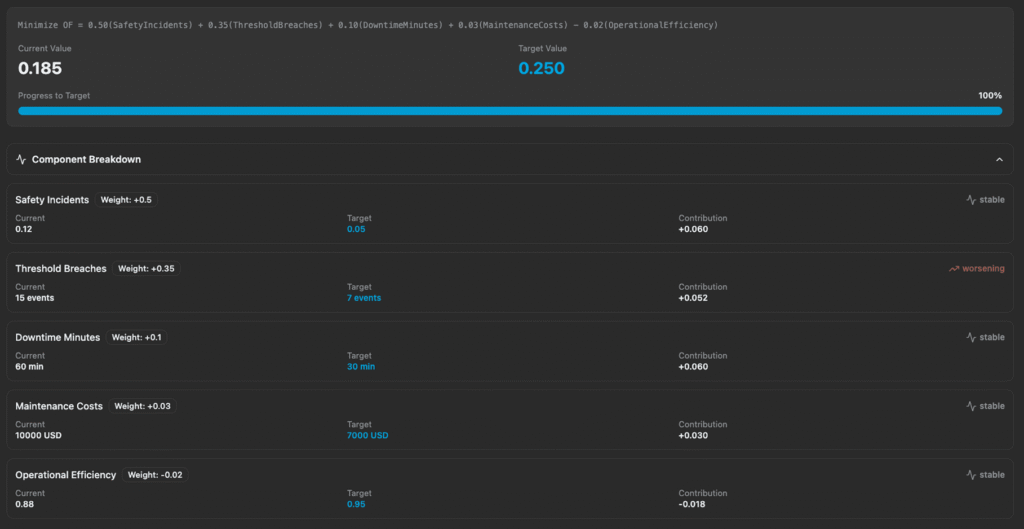
This allows agents to coordinate thousands of interdependent setpoints and constraints autonomously, ensuring that every decision remains aligned to current business priorities.
Safety First: Every parametric adjustment displays immutable constraints that cannot be overridden. Safety, environmental compliance, and permit limits show as locked red values. Flexible operational parameters show as adjustable green values.
The contrast:
- Traditional: Operator adjusts 20+ setpoints manually over 2-3 hours, risking inconsistency
- Supervisory: Supervisor adjusts one parameter, agents optimize in minutes with documented lineage
Key takeaway: Supervisory Intelligence gives leaders transparent oversight into how autonomous agents reason, negotiate, and act within authority limits. XMPro’s multi-round consensus protocol ensures that autonomy remains explainable and safety-bound, while keeping every decision traceable to its contributing agents.
In the clip above, the supervisor pauses the agent-initiated maintenance action in the Agent Chatroom to confirm resource availability such as maintenance hangar space, spare-parts etc… before authorizing execution. This moment demonstrates how supervisors can shape and mould intent in real time, just as they would when coordinating with colleagues online.
What’s happening behind the scenes is where the fourth pillar—Performance Analytics and Continuous Improvement—quietly activates. Every pause, dialogue, and decision is recorded in the ORPA (Observe–Reflect–Plan–Act) log, creating a transparent learning loop. APEX compares predicted versus actual results, tracking decision accuracy, response times, and consensus efficiency. Over time, these insights guide subtle refinements to objective weights and escalation thresholds, helping agent teams make faster, safer, and more consistent decisions on their own.
Key takeaway: Supervisory Intelligence isn’t about replacing people; it’s about extending human judgment into autonomous operations—where every guided decision makes the next one smarter.
Finally, supervisory Intelligence tracks whether agents are improving over time and where optimization opportunities exist.
The continuous improvement loop:
Agents execute decisions → APEX tracks outcomes vs. predictions → Analytics identify patterns → Supervisors refine objective functions → Agents adapt → Learning accelerates.
Every decision becomes training data. Every outcome informs better objectives. Organizations with mature Supervisory Intelligence continuously optimize while competitors remain static.
UI Patterns for Governance
XMPro APEX introduces governance interface patterns that enable strategic guidance rather than tactical micromanagement.
Objective Control Panel: Real-time sliders adjusting optimization weights with identity-stamped change logs (who, when, why), immutable constraint visibility (locked safety/environmental/compliance limits shown in red), flexible operational parameters (adjustable values shown in green), and predicted impact displays calculating expected outcome changes.
Consensus Timeline: Visual representation of multi-agent proposals with confidence bands indicating agreement strength, dissent rationale accessible via click, and round progression showing iteration toward consensus or escalation.
Escalation Ladder: Time remaining until breach, authority chain showing who can resolve at each tier, next approver routing with automatic notifications, and emergency override controls for immediate human intervention.
Action Interlock Map: Real-time view of permitted execution channels (green), pending approvals awaiting validation (yellow), blocked interlocks where safety/permit/environmental constraints prevent action (red), and dependency chains showing how one action enables or blocks others.
Safety First Callout: The Action Interlock Map displays granular safety controls: “Blocked due to active permit,” “Environmental threshold exceeded,” “Lock-out/tag-out in effect,” “Concurrent maintenance limit reached.” This signals operational maturity beyond demos.
ORPA Audit Replay: Step-by-step playback through Observe-Reflect-Plan-Act cycles with observation timeline, reflection synthesis, PDDL plan formulation, action execution logs, and evidence pins linking to source memories and knowledge bases.
Traditional dashboards show current state. Supervisory Intelligence shows agent activity and enables direct parametric guidance.
Truth-Grounding and Safety Architecture
Supervisory Intelligence requires agents that make decisions based on physical reality, not theoretical models disconnected from actual operations.
XMPro’s validation approach combines:
Composite AI: Decisions validated through physics-based models, rules-based logic, machine learning patterns, expert systems, and symbolic reasoning working in concert. Multi-method consensus creates confidence scores indicating when to trust recommendations vs. seek validation.
Pre-execution digital twin validation: Plans tested in simulation using current operational state, constraint violations detected before physical execution, predicted outcomes compared against acceptable ranges, alternative approaches evaluated if primary plan shows risks.
Edge-first inference with resilience: XMPro agents deploy at industrial edge using AMD Ryzen AI acceleration, delivering measured local inference improvements. This provides zero-latency decisions, resilient operation during connectivity loss, safe degraded modes with reduced functionality, and automatic recovery when connectivity restores.
Model drift and recertification: Agents undergo periodic recertification to detect model drift, validate performance against baseline metrics, and ensure continued alignment with operational reality. Site reliability engineers sign off on recertification before agents regain execution authority in critical systems.
Agent Lifecycle Management: AgentOps in Production
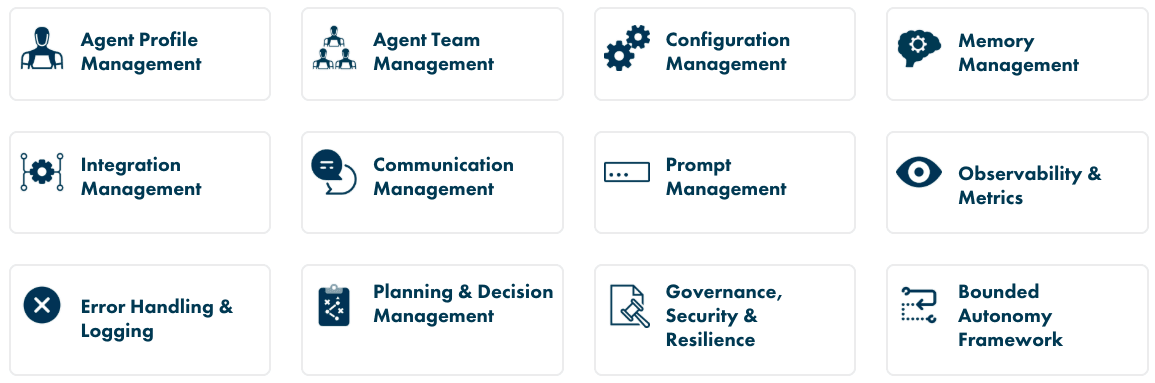
XMPro APEX manages autonomous agent teams through a governed eight-stage lifecycle — built on the same orchestration principles that power its 12 platform capabilities. This is how APEX turns autonomy into operational discipline.
1. Agent Profile Management Define agents with complete profiles — including capabilities, authority envelopes, objective functions, and deontic authorization rules. Profiles are dynamically configurable and version-controlled for governed behavior.
2. Agent Team Management Coordinate specialized agents into structured teams with defined roles and MQTT-based collaboration channels. Hierarchies and coordination protocols ensure reasoning agents (MAGS layer) work in sync with execution agents (DataStream layer).
3. Configuration & Integration Management Manage runtime configurations, environment variables, and integration points across data sources and systems. APEX provides centralized configuration control and seamless interoperability for distributed deployments.
4. Memory & Communication Management Leverage structured, significance-based memory and intelligent message routing for synchronized decision-making. Agents retain contextual awareness through shared memory and policy-governed communication pathways.
5. Planning & Decision Management Execute bounded autonomy through goal-driven planning frameworks, consensus timelines, and PDDL-based decision models. Objective functions align every agent action with business KPIs and operational safety.
6. Observability, Error Handling & Governance Monitor and govern performance in real time through comprehensive observability, OpenTelemetry metrics, and audit trails. Error handling, policy enforcement, and RBAC security maintain reliability across the enterprise.
7. Learning, Improvement & Version Management Continuously improve agents by comparing predicted vs. actual outcomes. APEX automates tuning suggestions, manages configuration versions, supports A/B testing, and ensures rollback to known-good states when required.
8. Retirement & Replacement Decommission agents safely while preserving institutional knowledge. Complete in-flight tasks, export memories, and maintain full lineage for compliance and future reuse — ensuring safe autonomy for critical operations.
Operational Outcomes Aligned with APEX Differentiators
- Safe Autonomy for Critical Operations – Policy-constrained execution, bounded autonomy, and governance by design.
- Composable Multi-Agent Systems at Scale – Reusable, collaborative agent teams that adapt to your environment.
- Integrated Decision Intelligence Framework – Agents that plan, reason, and explain decisions aligned to KPIs.
- Enterprise-Grade Orchestration Layer – Full observability, version control, and security from edge to cloud.
- Be the APEX in Your Industry – Deploy intelligent operations that are safe, explainable, and scalable.
For detailed AgentOps implementation guidance, see the XMPro APEX documentation.
Implementation: 8-Week Path to a Governed Agentic AI Team
Organizations establish Supervisory Intelligence foundations quickly when entry and exit criteria are clear.
Entry Criteria:
- Telemetry in place with real-time data flows
- Authority envelopes defined for at least one operational cell
- Safety constraints codified in enforceable rules
- Sponsor committed to governance discipline
Phase 1: Assessment (Weeks 1-2)
Activities: Inventory existing agents and decision scope, map governance gaps against four pillars, define supervisor roles and responsibilities, identify critical regulatory and compliance requirements.
Exit Criteria: Documented governance gaps, prioritized capability requirements, resource allocation confirmed.
Phase 2: Foundation (Weeks 3-4)
Activities: Deploy APEX Control Tower infrastructure, establish agent registration with comprehensive profiles, configure MQTT-based communication monitoring, set up basic performance metrics dashboards.
Exit Criteria: All agents visible in Control Tower, communication flows monitored, baseline metrics captured for at least three shifts.
Phase 3: Governance Framework (Weeks 5-6)
Activities: Define objective functions with locked safety constraints, establish escalation protocols with response time targets, create parametric control interfaces accessible to supervisors, configure alerting rules with tier-based routing.
Exit Criteria: Objective functions operational, escalation tested and validated, supervisors trained on parametric control interfaces.
Phase 4: Optimization (Weeks 7-8)
Activities: Implement performance analytics tracking agent and team evolution, refine objective function tuning based on operational results, optimize team structures and authority boundaries, train supervisors on advanced features.
Exit Criteria: <5% escalation rate sustained over two weeks, objective attainment variance <10% across shifts, supervisor confidence confirmed through competency assessment.
Timeline: 8 weeks from assessment to first governed cell.
Scale additional cells using proven patterns with reduced implementation time (typically 4-6 weeks per additional cell).
What to Measure and Why It Pays
Supervisory Intelligence effectiveness shows up in operational and financial metrics.
Operational Metrics:
- Supervisor-to-agent ratio (successful governance: 30-50 agents per supervisor)
- Escalation frequency (<5% of decisions requiring human intervention)
- Decision quality consistency (<10% variance across shifts and supervisors)
- Agent utilization (>70% productive decision-making vs. idle time)
- Consensus efficiency (rounds required to reach agreement trending downward)
Financial Metrics:
- Manual intervention reduction (60-80% fewer operator actions per shift)
- Avoided downtime from proactive governance (measured in production loss prevented)
- Labor efficiency gains (supervisors governing 3-5x more agents than before)
- Consistency value (reduced variance translates to predictable performance)
Example calculation: If each manual intervention takes 15 minutes and governance reduces interventions from 40 to 10 per shift, that saves 7.5 hours per shift. Across three shifts and five operators, that is 112.5 hours per week freed for higher-value work.
At a burdened labor rate, this becomes measurable six-figure annual value for a single operational cell.
Autonomy Scales When Governance Scales
This series showed how organizations evolve through the Decision Intelligence Continuum:
Decision Support filtered noise into focused alerts. Decision Augmentation provided expert guidance. Decision Automation enabled bounded execution. Supervisory Intelligence governs teams at scale.
The organizations succeeding with autonomous operations are not deploying smarter agents than competitors. They are governing them better.
If you can see it, explain it, bound it, and tune it, you can trust it. That is the foundation of scalable autonomy.
XMPro APEX provides the governance framework with validation across academic partnerships (University of Adelaide’s $490K autonomous agriculture project, Rowan University’s real-time additive manufacturing testbed) and industry testbeds (Digital Twin Consortium collaborations with NEC Corporation on automated negotiation and Microsoft on cognitive network orchestration).
See Supervisory Intelligence in action at xmpro.com/agentic-ai
Connect with me: Wouter Beneke on LinkedIn
About the Author
Wouter Beneke leads global marketing at XMPro. He works with industrial clients to communicate the measurable impact of Decision Intelligence and autonomous operations, helping operations leaders distinguish between AI hype and operational reality.
About XMPro
We help industrial companies implement autonomous operations through Multi-Agent Generative Systems that deliver transparency, explainability, reliability, and safety through enterprise-grade governance.
References
- Gartner research on autonomous decision-making in industrial operations. Cited findings represent analyst estimates of market trends. Specific predictions may vary based on industry and deployment context.
- LNS Research. “Autonomous Operations: AI with Guardrails.” Research by Niels Erik Andersen on industrial AI agent adoption preferences and operational domain frameworks. Available at: blog.lnsresearch.com
- Gartner analyst commentary on agentic AI project success factors and risk management requirements for industrial deployments.
- XMPro. “Multi-Agent Generative Systems (MAGS).” Technical documentation covering ORPA cognitive architecture, objective functions, and consensus protocols. Available at: https://xmpro.com/agentic-ai/multi-agent-generative-systems
- XMPro. “Agentic Platform Experience (APEX).” Platform documentation covering agent lifecycle management, governance capabilities, and enterprise orchestration. Available at: https://xmpro.com/agentic-ai/agentic-platform-experience
- Digital Twin Consortium. “Automated Negotiation with Digital Twins and MAGs Testbed.” NEC Corporation partnership demonstrating autonomous negotiation between organizations using utility-based decision-making and policy-aware coordination. Available at: digitaltwinconsortium.org
- University of Adelaide. “Digital Twins in Agriculture: Virtual Farm Model for Enhancing Crop Health, Productivity, and Sustainability.” AEA-funded project ($490,000) led by Professor Volker Hessel, demonstrating autonomous farming operations with XMPro MAGS for viticulture and canola production.
- Digital Twin Consortium. “Cognitive Network Orchestration Testbed.” XMPro and Microsoft partnership validating multi-agent coordination for network infrastructure management. Available at: digitaltwinconsortium.org
- Rowan University partnership with XMPro. “Real-Time Additive Manufacturing Testbed.” Demonstrates AI-powered closed-loop control for metal 3D printing (Laser Powder Bed Fusion) with defect detection and in-process correction.
- XMPro Customer Case Study. “Digital Twins in Mining Operations and Maintenance.” Implementation achieving 30% reduction in unplanned downtime through governed autonomous operations. Available at: xmpro.com
#DecisionIntelligence #AutonomousOperations #IndustrialAI #AgenticAI #SupervisoryIntelligence #AgentOps #APEX #IndustrialAutomation