
























Download XMPro’s definitive guide to Multi-Agent Generative Systems (MAGS) — a practical roadmap for industrial leaders who want AI that actually works in real operations, not just pilots.
Download the guideIntroduction
Industrial leaders face a perfect storm of complexity — workforce shortages, cognitive overload, and operational systems that can no longer keep up with data velocity. Despite years of digital transformation, productivity has stalled.
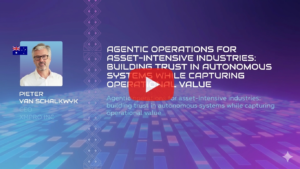
XMPro’s new publication, “Multi-Agent Generative Systems: A Senior Manager’s Guide to Industrial AI That Actually Works,” written by Pieter van Schalkwyk, CEO of XMPro, explains how Multi-Agent Generative Systems (MAGS) overcome these challenges.
It introduces a practical framework for deploying teams of AI agents that operate like virtual employees, managing industrial processes autonomously while maintaining human oversight and governance.
What You’ll Learn
This executive guide provides a clear path for industrial organizations to adopt AI that is safe, explainable, and effective at scale. Inside, you’ll discover:
-
What MAGS actually is and how it differs from chatbots or analytics tools.
-
Why traditional automation fails in complex operations with thousands of daily decisions.
-
How the Observe–Reflect–Plan–Act (ORPA) model enables cognitive, context-aware decision-making.
-
How to start with a Lighthouse Implementation that demonstrates measurable ROI in months.
-
The Deontic Governance Framework that ensures safety, compliance, and auditability.
-
Leadership principles for transitioning from operator-centric to agent-supervised environments.
Excerpt
“MAGS changes the operational model from sequential human execution to parallel autonomous coordination.
It doesn’t replace human decision-making — it extends it, handling routine scenarios consistently while escalating novel ones to human experts.”
— Pieter van Schalkwyk, CEO, XMProMulti-Agent Generative Systems-…
Why It Matters for Industrial AI
Most enterprise AI deployments still struggle to scale because they depend on human execution loops — every insight requires a person to act.
Multi-Agent Generative Systems (MAGS) change that equation. They introduce bounded autonomy — AI that can act, plan, and coordinate within defined operational and governance limits.
For industrial organizations, this means:
-
Faster and more consistent decision cycles.
-
Preservation of expert knowledge as AI agents learn from real operations.
-
Lower operational risk through embedded governance and continuous audit trails.
-
A scalable, composable framework for future AI maturity.
Who Should Read This
This guide is tailored for:
-
Senior operations leaders modernizing plant or field operations.
-
Engineering and reliability managers facing workforce or knowledge gaps.
-
Digital transformation executives building AI roadmaps beyond pilot stage.
-
Innovation and strategy leaders shaping AI governance and readiness.
Download the Full Guide
Download the PDF:
Multi-Agent Generative Systems: A Senior Manager’s Guide to Industrial AI That Actually Works
About the Author
Pieter van Schalkwyk is the CEO of XMPro, a global leader in Intelligent Digital Twin and Agentic AI solutions for asset-intensive industries.
He serves as an active member of the Digital Twin Consortium and has authored numerous papers on cognitive agents, governance frameworks, and composable industrial AI systems.
Related Reading from XMPro
-
The Industrial Agentic Organization – Part 1: Understanding the Shift
-
Rules of Engagement: Establishing Governance for Multi-Agent Generative Systems
-
XMPro APEX: Pioneering AgentOps for Industrial Multi-Agent Generative Systems